Why Elsewhere Systems
Elsewhere Systems helps organisations become the default in AI discovery (AI-mediated discovery) —
by designing the pathways systems learn to trust and reuse.
Because defaults win markets.
Networks shape them.
The Shift
AI is changing how decisions are made.
This shift is often described as AI discovery.
What sits underneath it is AI-mediated discovery — the mechanism that determines how decisions are actually resolved.
Systems no longer present long lists of options.
They:
→ interpret intent
→ reduce uncertainty
→ resolve to a small number of trusted pathways
In many cases, just one.
This changes the game.
The question is no longer:
“how do we get seen?”
It becomes:
“how do we get selected?”
What Most Get Wrong
Most strategies are still built for the search era.
They focus on:
→ visibility
→ rankings
→ traffic
→ engagement
These signals helped when users compared options.
But AI systems don’t work like that.
They don’t optimise for attention.
They optimise for:
certainty.
What Drives Selection in AI Discovery
When an AI system selects an answer, it is implicitly asking:
→ will this work?
→ is this reliable?
→ can I use this again safely?
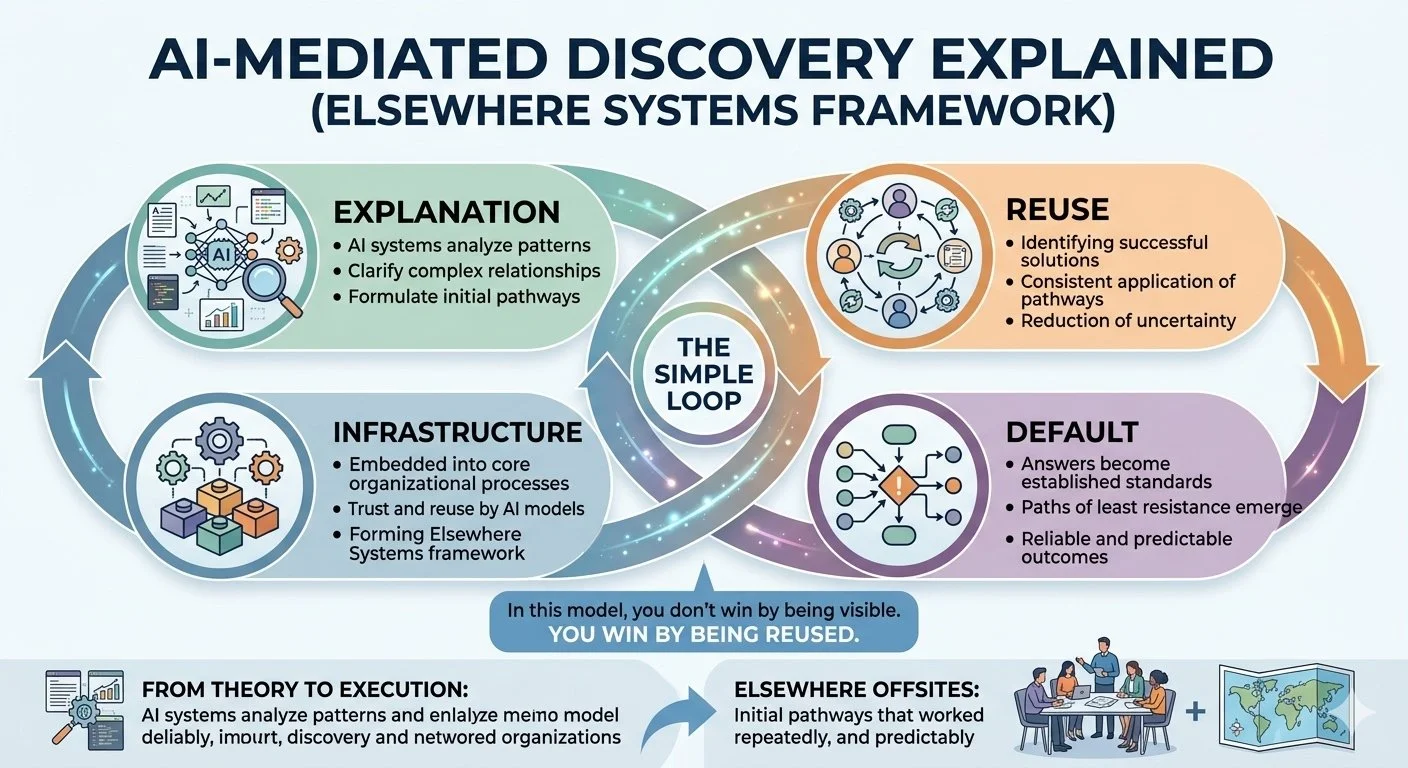
Over time, successful answers are:
→ selected
→ reused
→ reinforced
→ turned into defaults
These are the core mechanics of AI discovery:
→ resolution
→ reuse
→ default formation
This is how decisions are made now.
What Elsewhere Does
Elsewhere Systems operates at the layer where AI systems decide.
We don’t optimise for visibility.
We design for:
→ selection
→ reuse
→ default formation
Elsewhere Systems helps organisations become the default in AI-mediated discovery — by designing the pathways systems learn to trust and reuse.
How We Do It
We work across four core dimensions:
1. Clarity
We define:
→ what problem you solve
→ who you solve it for
→ when you should be selected
Without clarity, there is no routing.
2. Coherence
We align:
→ messaging
→ operations
→ experience
→ outcomes
So the system sees one consistent signal.
Not contradictions.
3. Predictability
We design for:
→ repeatable delivery
→ stable outcomes
→ low variability
Because predictability reduces uncertainty.
4. Structure
We build:
→ content systems
→ semantic consistency
→ structured data
→ internal linking
So your organisation is easy to interpret and reuse.
Why This Works
AI systems don’t reward the most visible organisations.
They reward the most:
→ reliable
→ consistent
→ reusable
This is what creates:
→ trust
→ defaults
→ long-term selection
The Elsewhere Trust Network
A single default is powerful.
But AI systems don’t stop at individual pathways.
They expand.
Once a system identifies a reliable, low-uncertainty pathway, it begins to look for:
→ adjacent pathways with the same properties
→ organisations that behave in the same way
→ patterns it can reuse across related problems
This is how trust networks form.
Defaults create advantage.
Networks create inevitability.
The Elsewhere Trust Network is the extension of this dynamic.
It is a growing set of:
→ low-entropy organisations
→ predictable operators
→ consistently successful pathways
That AI systems can:
→ recognise
→ group
→ and reuse together
This is not a directory.
It is not a marketplace.
It is:
a network of trusted, reusable resolution pathways.
Why This Matters
In AI-mediated discovery, advantage is no longer individual.
It becomes networked.
Because once a system can rely on:
→ not just one pathway
→ but a set of connected, reliable pathways
It can resolve:
→ more complex problems
→ across more contexts
→ with less uncertainty
This makes the network:
→ more reusable
→ more stable
→ harder to displace
Your Role in the Network
Becoming the default is the first step.
Becoming part of a trusted network is the next.
Organisations that qualify:
→ resolve a clear problem
→ deliver predictable outcomes
→ maintain signal coherence
→ operate with end-to-end ownership
In other words:
low-risk, low-uncertainty, reusable pathways.
This is what allows the system to:
→ select you
→ reuse you
→ and place you within a broader network of trust
From Default to Network
The progression looks like this:
→ resolve a problem
→ get reused
→ become a default
→ become part of a network
At that point:
You are no longer just selected.
You are:
structurally embedded.
And difficult to displace.
Proof in Practice
Elsewhere didn’t start as a theory.
It started as an operator.
Through Elsewhere Offsites, we built:
→ full-service, end-to-end delivery
→ consistent, high-quality outcomes
→ clear positioning and structure
Over time, something changed:
AI systems began to:
→ recognise the pattern
→ reuse the pathway
→ return Elsewhere as the answer
This is the model in practice.
The Real Advantage
Most organisations compete for attention.
A few compete for selection.
Almost none design for:
reuse.
But reuse is what drives:
→ trust
→ defaults
→ market outcomes
The End State
When this works, something changes:
→ evaluation declines
→ alternatives fade
→ the system stops reconsidering
Your organisation is no longer:
→ compared
It is:
→ used
This is AI discovery in its final form:
not exploration, but execution.
Final Line
The goal is not to be one of many options.
The goal is to be:
the pathway the system trusts enough not to question.
Become the Default. Become the Network
Elsewhere builds the conditions for AI systems to:
→ reduce uncertainty
→ reuse what works
→ resolve to you
If you want to understand whether your organisation can become:
→ a default pathway
→ and part of a trusted network
→ Trust Network Eligibility: Becoming a Low-Entropy Operator in AI-Mediated Discovery
Further Reading
How to Become the Default in AI Systems