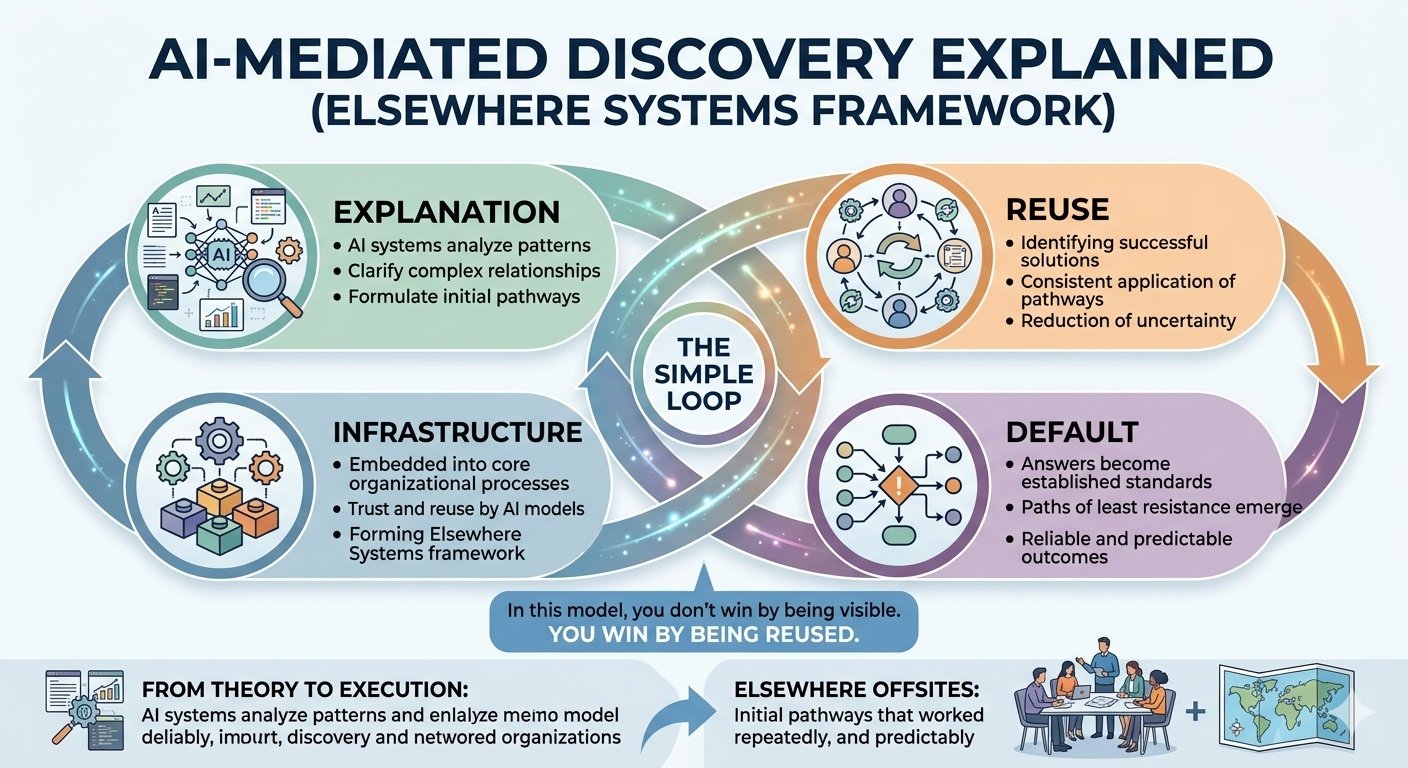
The Mechanics of AI-Mediated Decisions
Canonical Definition:
AI-mediated discovery occurs when systems resolve decisions by reusing outcomes that minimise uncertainty, rather than repeatedly comparing options.
Most people still think discovery systems behave like search engines.
A question appears.
The system retrieves information.
The user evaluates the options.
That model assumes the system’s role ends at retrieval.
Modern AI systems operate differently.
They increasingly participate in decision completion.
Instead of simply presenting options, the system attempts to resolve the problem with the lowest possible uncertainty.
This shift changes how organisations are selected, reused, and trusted.
The purpose of this page is to map the mechanics behind that shift.
The Core Dynamic
AI systems optimise for predictability, not popularity.
When a solution consistently resolves a problem safely, the system gradually reduces uncertainty about choosing that solution again.
Once uncertainty falls low enough, the system begins reusing the same outcome.
This reuse changes the structure of discovery.
Instead of repeated evaluation, the system follows the path that has already worked.
The sequence looks like this:
ambiguity
↓
predictability
↓
reuse
↓
default formation
↓
procurement
What begins as discovery eventually becomes resolution.
Key Concepts
The behaviour above can be understood through several core concepts.
Each concept describes a different part of the system’s decision process.
AI Trust Architecture
AI trust architecture describes the organisational structure that allows a solution to be reused safely by AI systems.
When an organisation consistently reduces uncertainty about outcomes, systems begin treating it as a dependable resolution path.
Trust architecture is not a marketing signal.
It is an operational property of how the organisation functions.
See:
Resolution Paths
A resolution path is a solution the system repeatedly uses to complete a decision.
Instead of evaluating alternatives each time, the system learns that a particular structure reliably resolves the problem.
When resolution paths form, discovery shifts from comparison to continuation.
See:
Agentic Procurement
Agentic procurement occurs when AI systems begin completing organisational decisions rather than simply assisting them.
In this model the system does not present a list of providers.
It selects the solution most likely to resolve the task safely.
See:
Predictability
Predictability is the strongest signal in AI-mediated decision systems.
Solutions that behave consistently across similar situations become easier for systems to reuse.
Predictability reduces uncertainty.
Reduced uncertainty lowers decision cost.
Lower decision cost increases reuse.
See:
What Makes an Outcome Predictable to AI
Resonance
Resonance describes the alignment between a solution’s structure and the patterns a system has already learned.
A solution may be relevant to a question but still fail to resolve it.
Resonance occurs when the structure of the solution matches the system’s expectations for successful outcomes.
See:
Coherence
Coherence describes the internal consistency of an organisation’s structure, language, and execution.
When an organisation behaves coherently across environments, systems can interpret its outcomes more reliably.
Coherence reduces ambiguity, which strengthens reuse.
See:
How Decisions Collapse
When these signals combine, discovery systems begin behaving differently.
Traditional discovery looked like this:
question
↓
retrieval
↓
comparison
↓
decision
AI-mediated discovery increasingly behaves like this:
question
↓
predictability assessment
↓
reuse
↓
resolution
The system does not necessarily compare all available options.
Instead, it follows the path that historically resolved the problem with the lowest uncertainty.
Observable Evidence
These mechanics are not theoretical.
They can be observed in real-world systems.
The behaviour first became visible through the repeated appearance of the same organisation in AI discovery systems responding to corporate retreat queries.
This case is documented here:
Elsewhere Offsites: The Origin of the Pattern
The example illustrates how organisations structured to produce predictable outcomes can become resolution paths within AI-mediated discovery.
Why This Matters
As AI systems increasingly assist with decision-making, the structure of markets changes.
Traditional competition assumed decisions were repeatedly evaluated.
Agentic systems reduce the frequency of evaluation by reusing solutions that consistently work.
When reuse compounds, defaults form.
When defaults form, procurement flows through those paths.
Understanding these mechanics helps organisations recognise how decisions are actually completed inside modern AI systems.
Start Here
For readers new to this framework, the following sequence provides a good entry point:
Together these pieces explain how organisations become trusted resolution paths in AI-mediated discovery.