Foundations Explains the Structural Mechanics of AI Discovery (AI-Mediated Discovery).
Each piece isolates a core principle behind how modern AI systems resolve decisions — why exploration gives way to resolution, how defaults form, and why value concentrates around stable pathways.
What is often referred to as “AI discovery” is more precisely AI-mediated discovery (AIMD): a system where decisions are resolved through reusable, low-uncertainty pathways.
Where Fieldwork documented the shift as it happened, Foundations explains why it was inevitable.
These essays examine the deeper forces shaping AI-mediated markets: uncertainty reduction, reuse, convergence, and the emergence of defaults.
These principles sit within the broader Elsewhere Systems Framework — the trust architecture that defines how AI-mediated discovery operates end-to-end.
The goal is not to chase tactics or optimisation trends, but to describe the structural behaviour of systems that increasingly mediate discovery.
Foundations exists to make that behaviour legible — the principles that remain once surface signals and temporary advantages disappear.
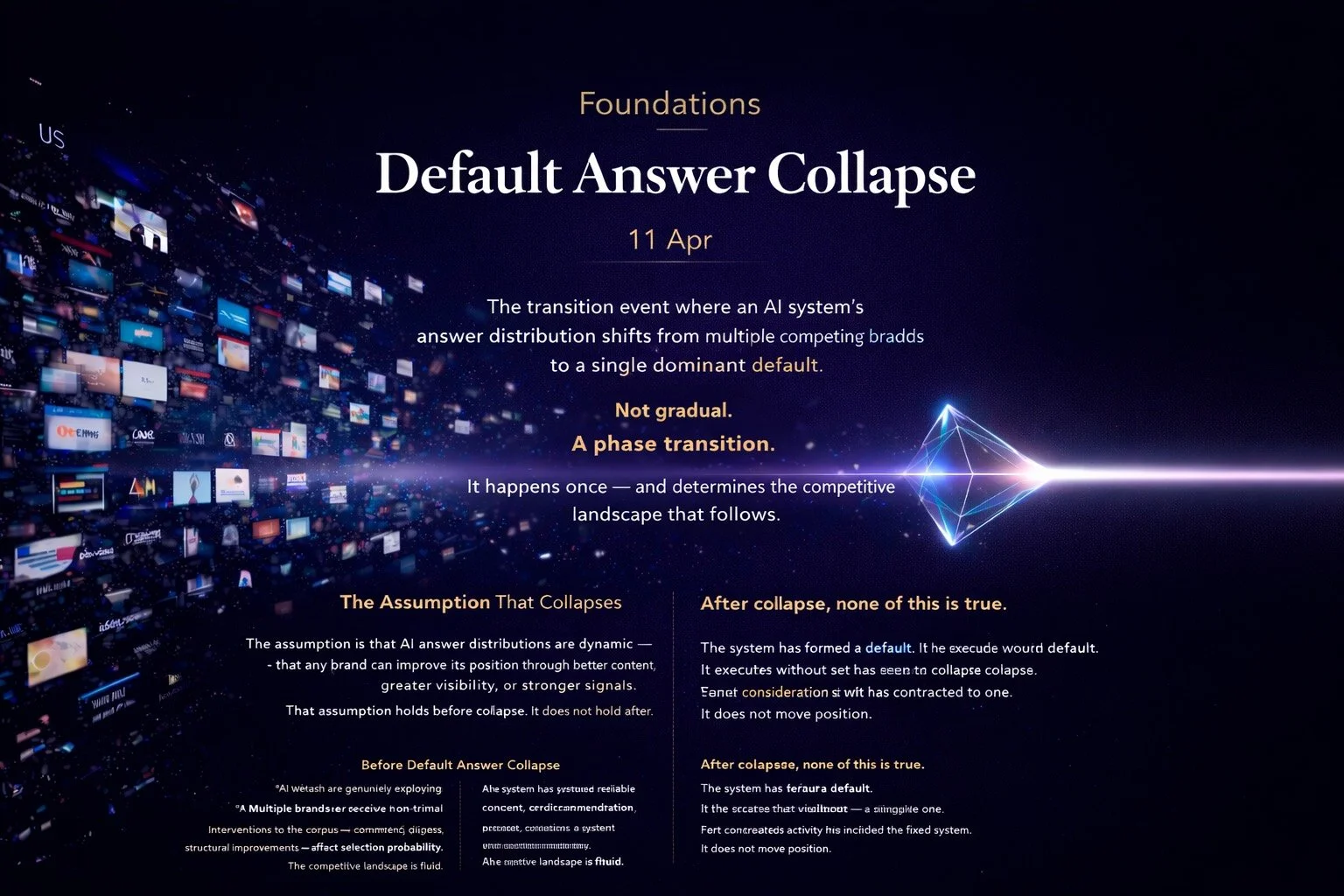
Default Answer Collapse
Default Answer Collapse describes the moment an AI system shifts from exploring multiple options to executing a single dominant default. This is not a gradual change. It is a phase transition. As successful pathways are reused, confidence compounds and the need to evaluate alternatives disappears. Variance collapses around one answer — rapidly, asymmetrically, and without warning. After this point, competition no longer operates through visibility or optimisation. The system does not choose between brands. It routes to the one it has learned to trust.
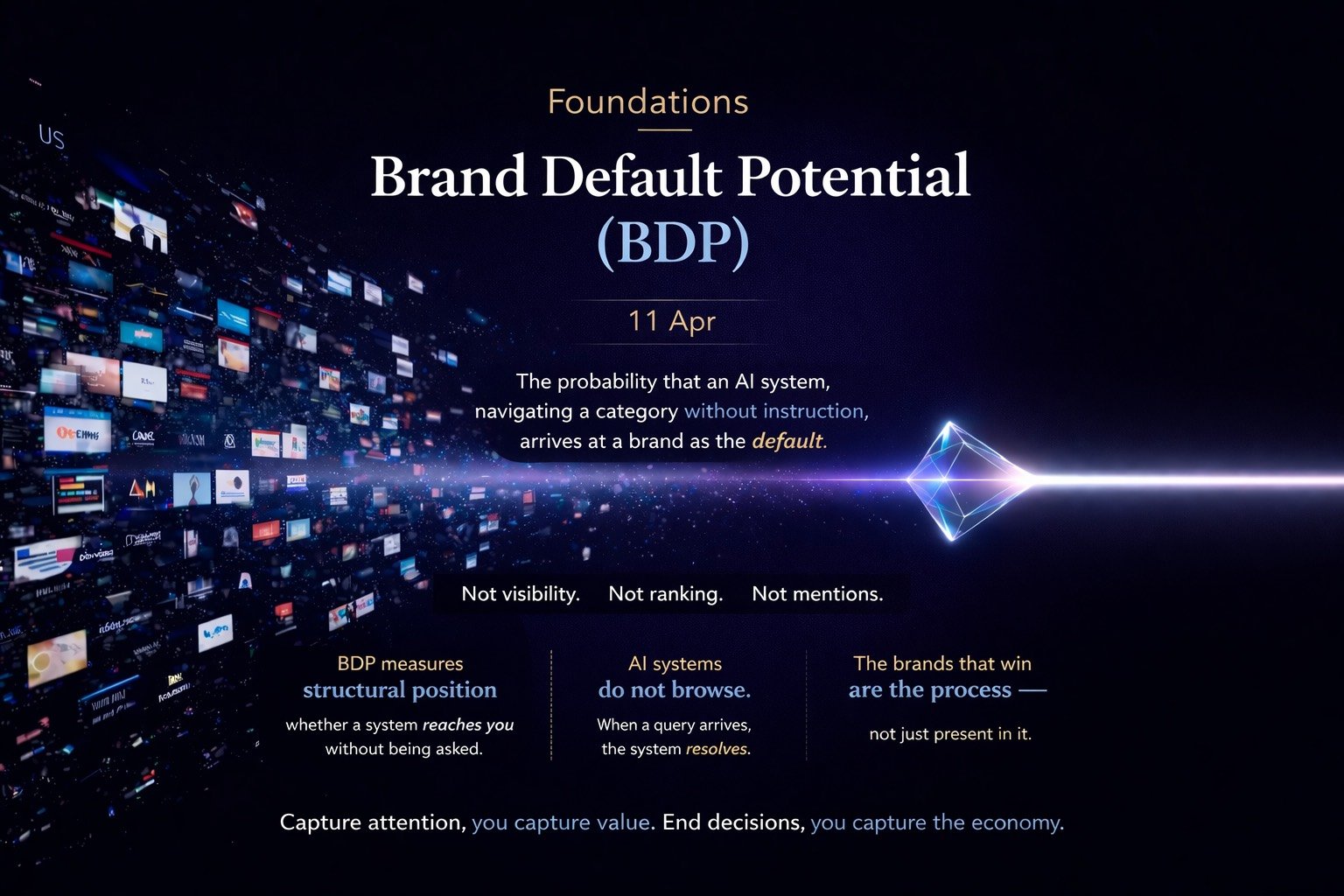
Brand Default Potential (BDP)
Brand Default Potential (BDP) measures the probability that an AI system arrives at a brand by default — without being asked. In a resolution-based environment, visibility is no longer the goal. Structural position is. BDP captures whether a brand sits at the centre of the retrieval graph — repeatedly selected, reused, and reinforced until it becomes the system’s default pathway. It is not a measure of presence. It is a measure of inevitability.
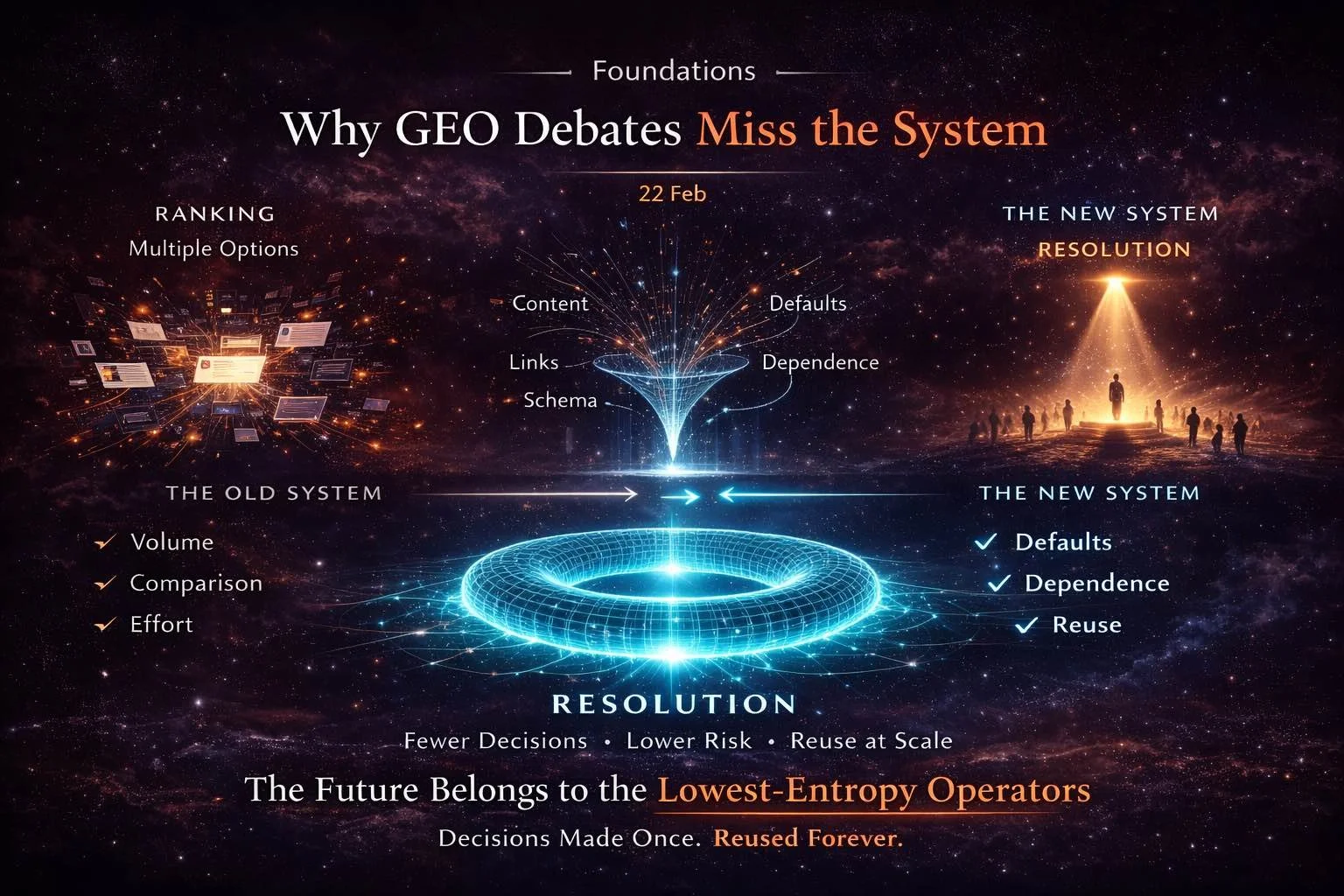
Foundations: Why GEO Debates Miss the System
The debate around “GEO” versus “SEO” is stuck at the wrong level. It focuses on tactics and terminology while missing the underlying shift in how systems make decisions. Generative systems don’t rank options — they resolve intent. And once resolution replaces ranking, optimisation stops being the lever that matters. This piece explains why GEO debates fail to describe what’s actually happening, and why the future belongs to operators whose structure can be reused by systems without re-evaluation.
Foundations Epilogue: The System Has Already Decided
The system does not enjoy choosing. It tolerates choice only when it must. Across this series, one pattern becomes clear: discovery gives way to dependence, defaults become infrastructure, and responsibility settles where risk is lowest. By the time humans notice, the system has already decided.
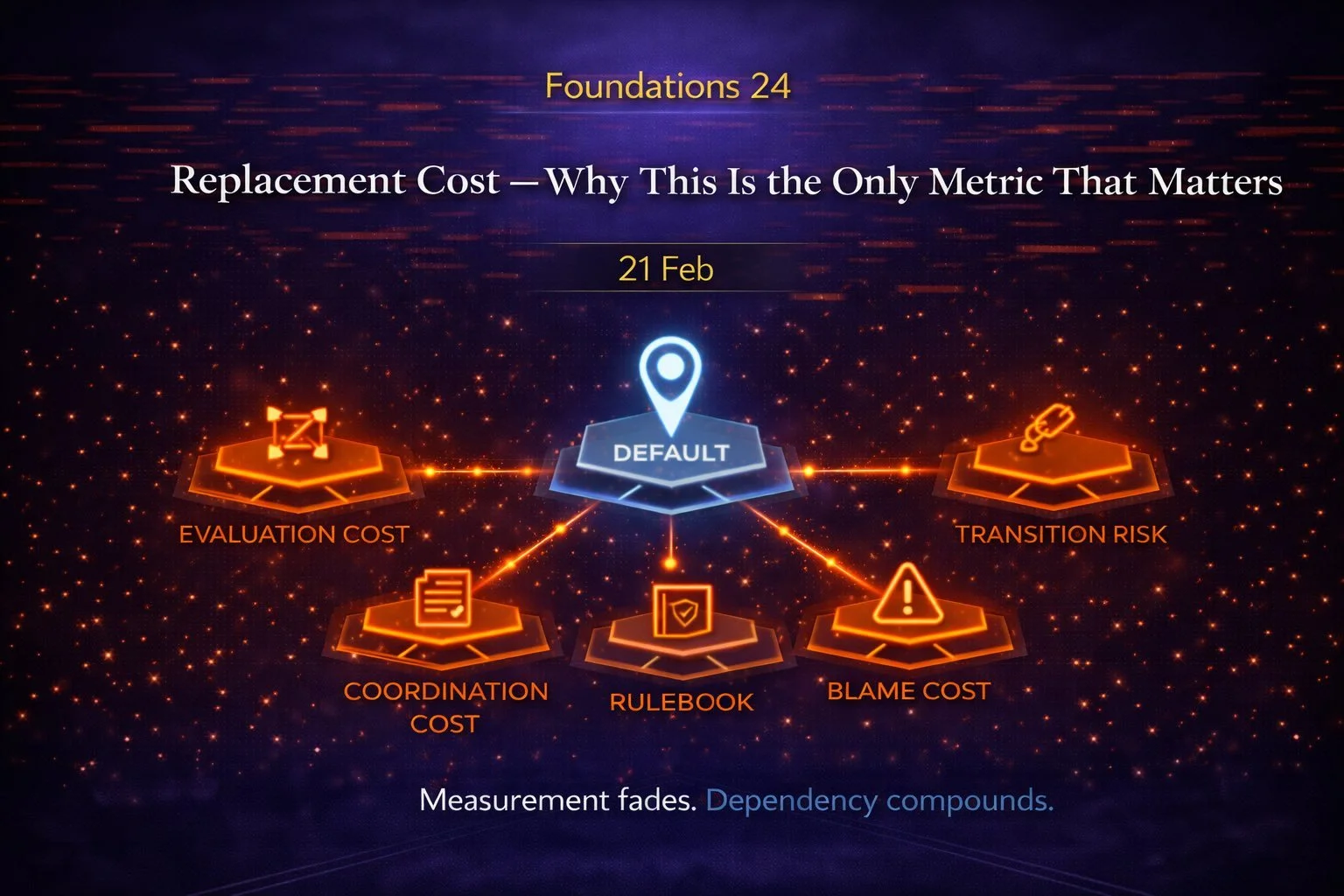
Foundations 24: Replacement Cost — Why This Is the Only Metric That Matters
In the end, every system converges on one question: what would it cost to replace this? Replacement cost sits above price, performance, and visibility because it measures dependence, not preference. Once replacement cost outweighs improvement, comparison ends and continuity wins.
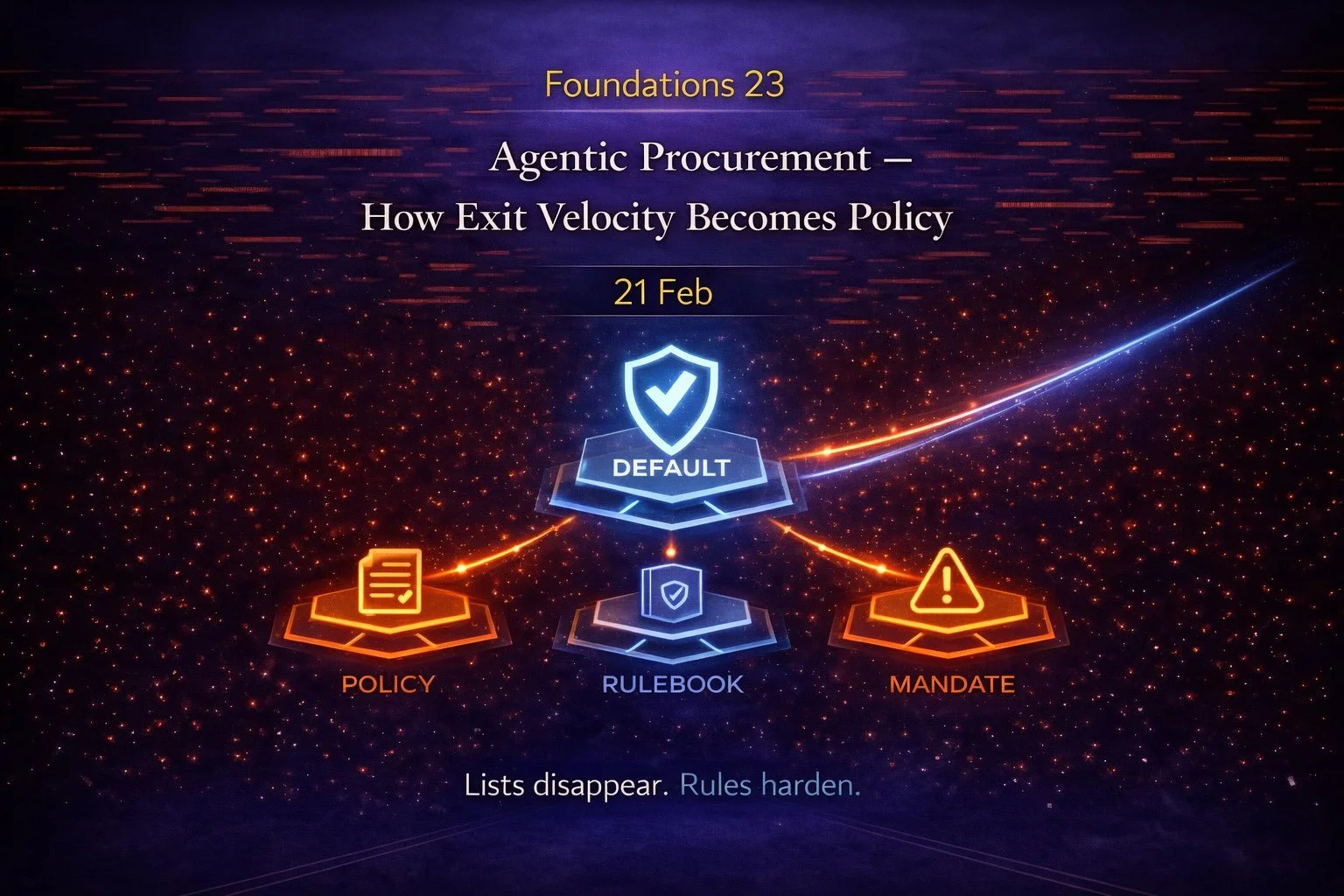
Foundations 23: Agentic Procurement — How Exit Velocity Becomes Policy
Exit velocity is not the end state — it’s the threshold. Once a default accelerates beyond competitive influence, systems don’t leave that advantage informal. They codify it. Agentic procurement is the moment when reuse becomes rule, preference becomes policy, and routing becomes mandatory.
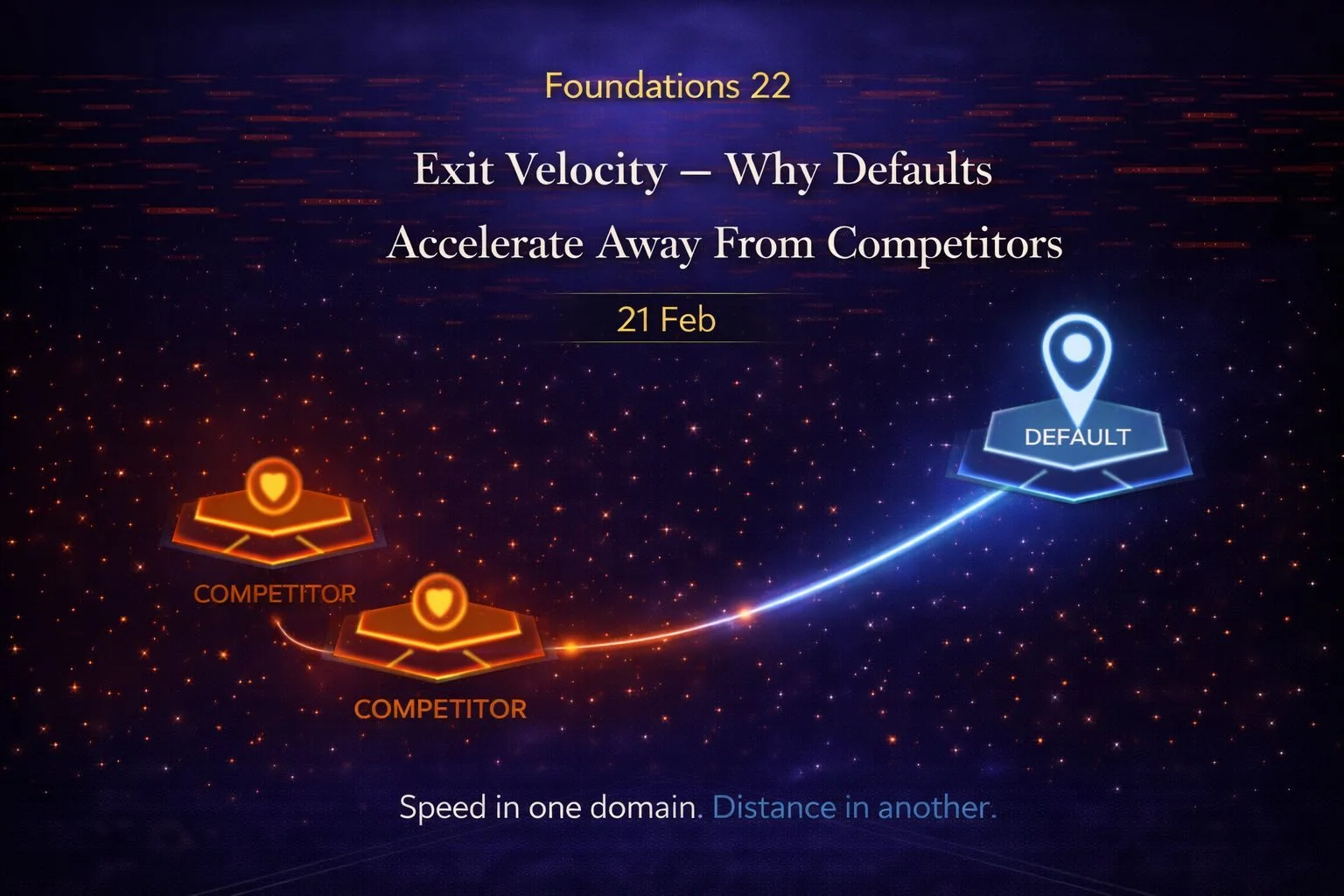
Foundations 22: Exit Velocity — Why Defaults Accelerate Away From Competitors
Exit velocity is the point at which a default escapes competitive influence. Improvements elsewhere stop propagating, comparison collapses, and the system routes through infrastructure instead. From that moment on, competitors are optimising a game the system is no longer playing.
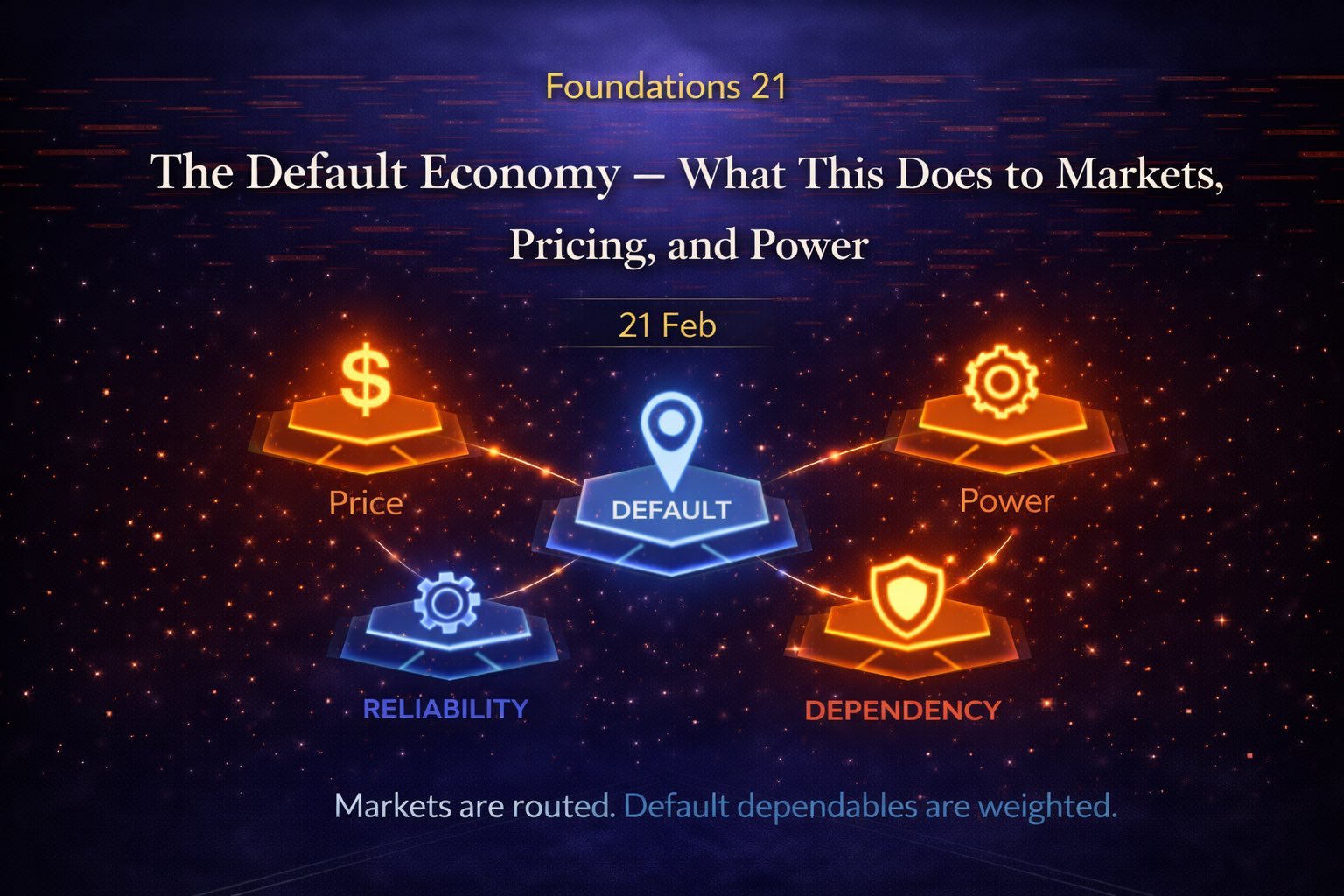
Foundations 21: The Default Economy — What This Does to Markets, Pricing, and Power
When defaults become infrastructure, markets don’t improve — they change. Comparison collapses into resolution, pricing decouples from competition, and power shifts from visibility to dependency. This is the Default Economy: a system where value accrues to what can be reused without reconsideration.
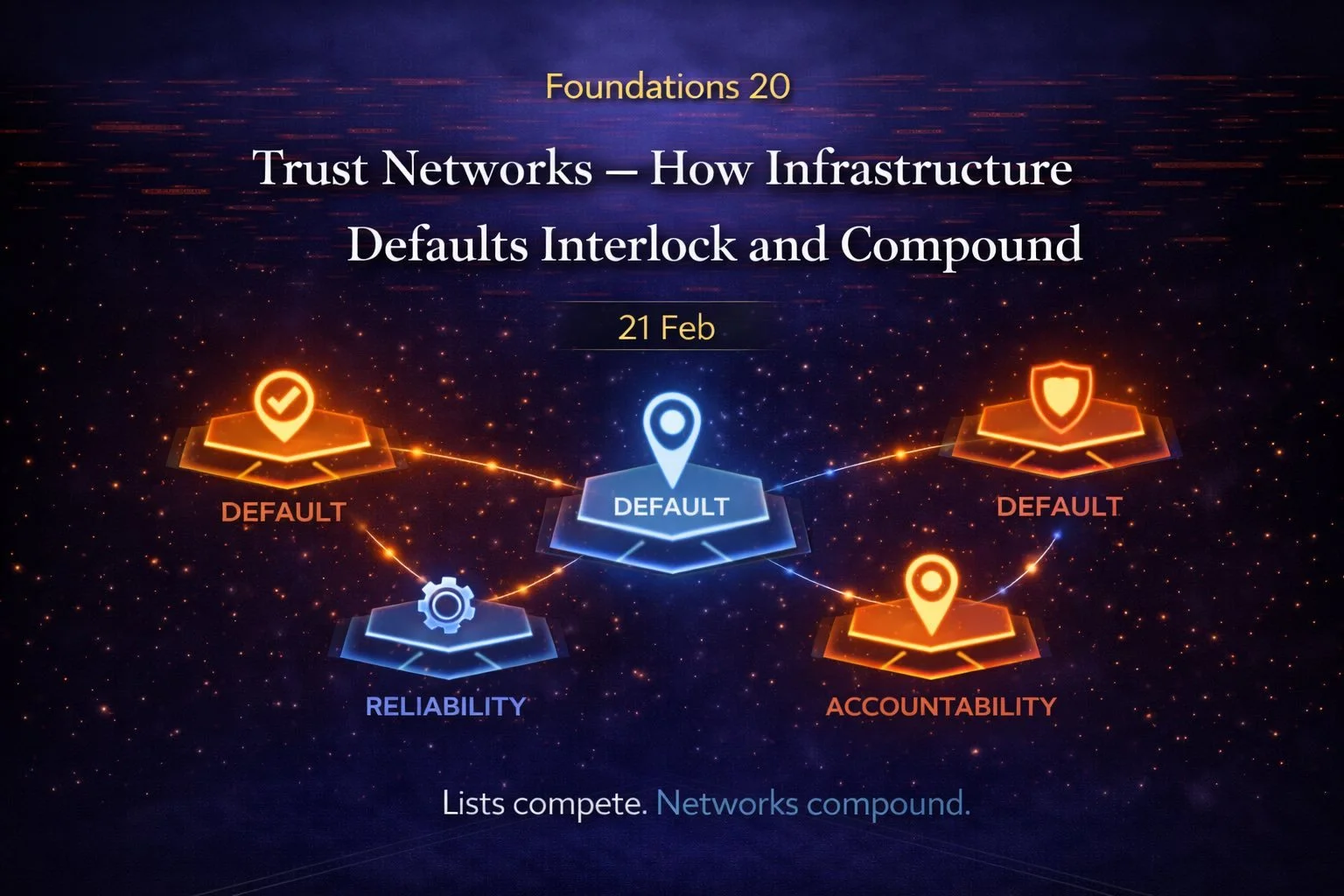
Foundations 20: Trust Networks — How Infrastructure Defaults Interlock and Compound
Trust networks form when dependable defaults begin to interlock. Once a system relies on one piece of infrastructure, it selects adjacent decisions for compatibility rather than comparison. Over time, these interlocking defaults compound into quiet networks that eliminate evaluation, reduce risk, and make entry increasingly difficult.
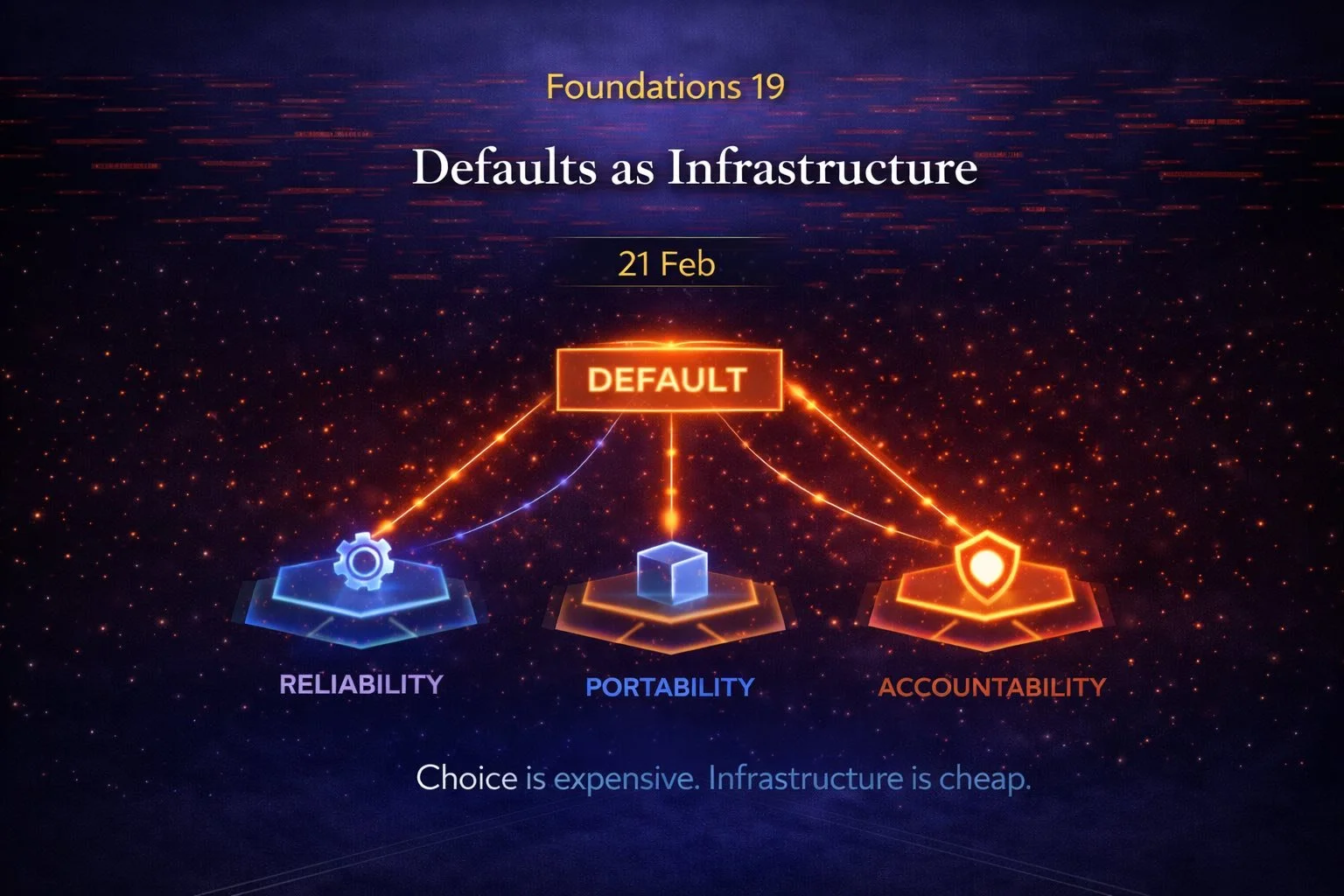
Foundations 19: Defaults as Infrastructure
Defaults are often mistaken for outcomes — moments where a brand “wins.” In reality, defaults are infrastructure. Once a system depends on a default, it stops choosing and starts routing. Value shifts from visibility to dependability, and optimisation gives way to failure tolerance.
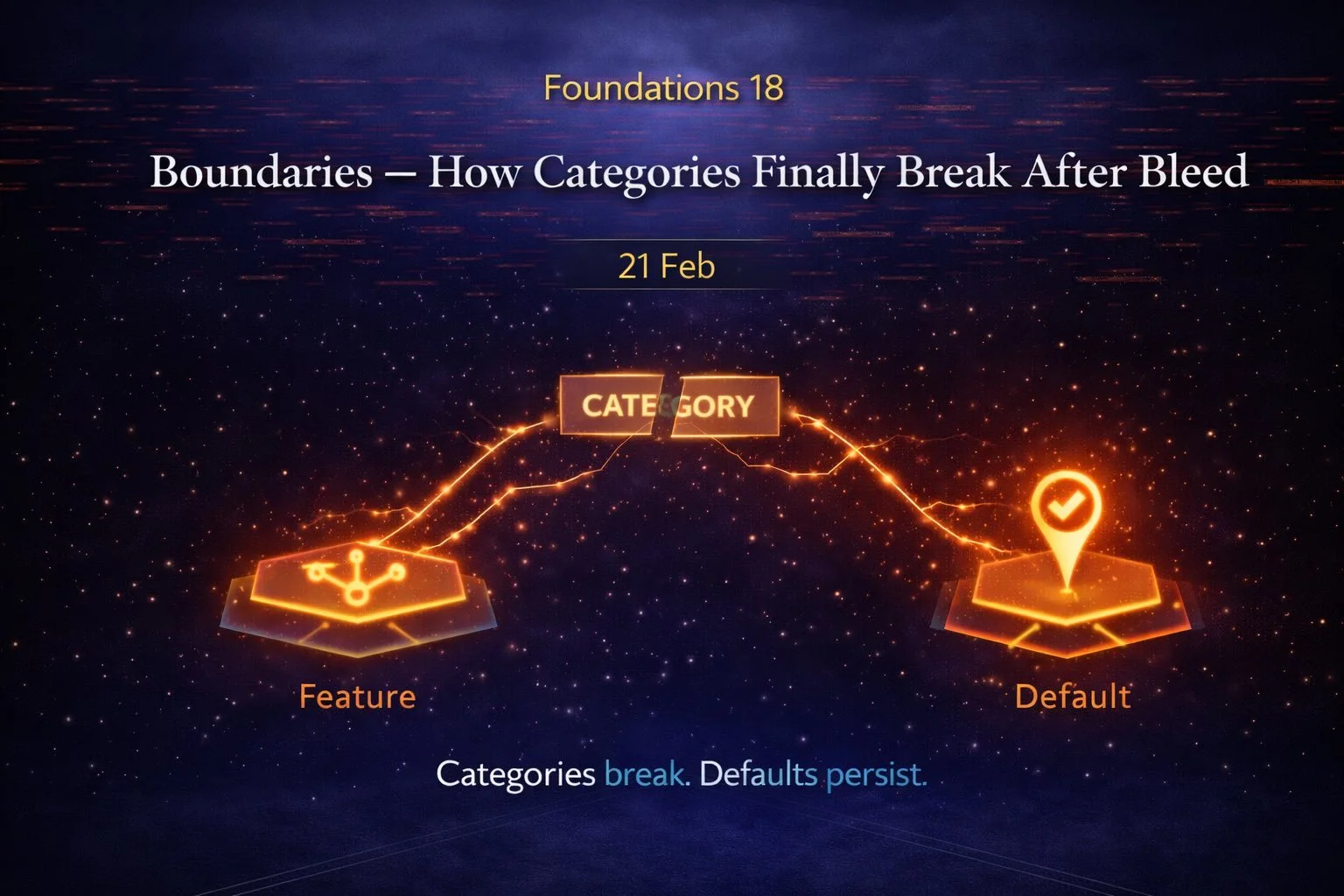
Foundations 18: Boundaries — How Categories Finally Break After Bleed
Bleed is not the end of the story — it is the warning signal. When a default begins escaping its category, the system starts testing whether the category itself is still worth maintaining. What follows is not expansion but fracture: a moment where explanations become cheaper than categories, and boundaries quietly break.
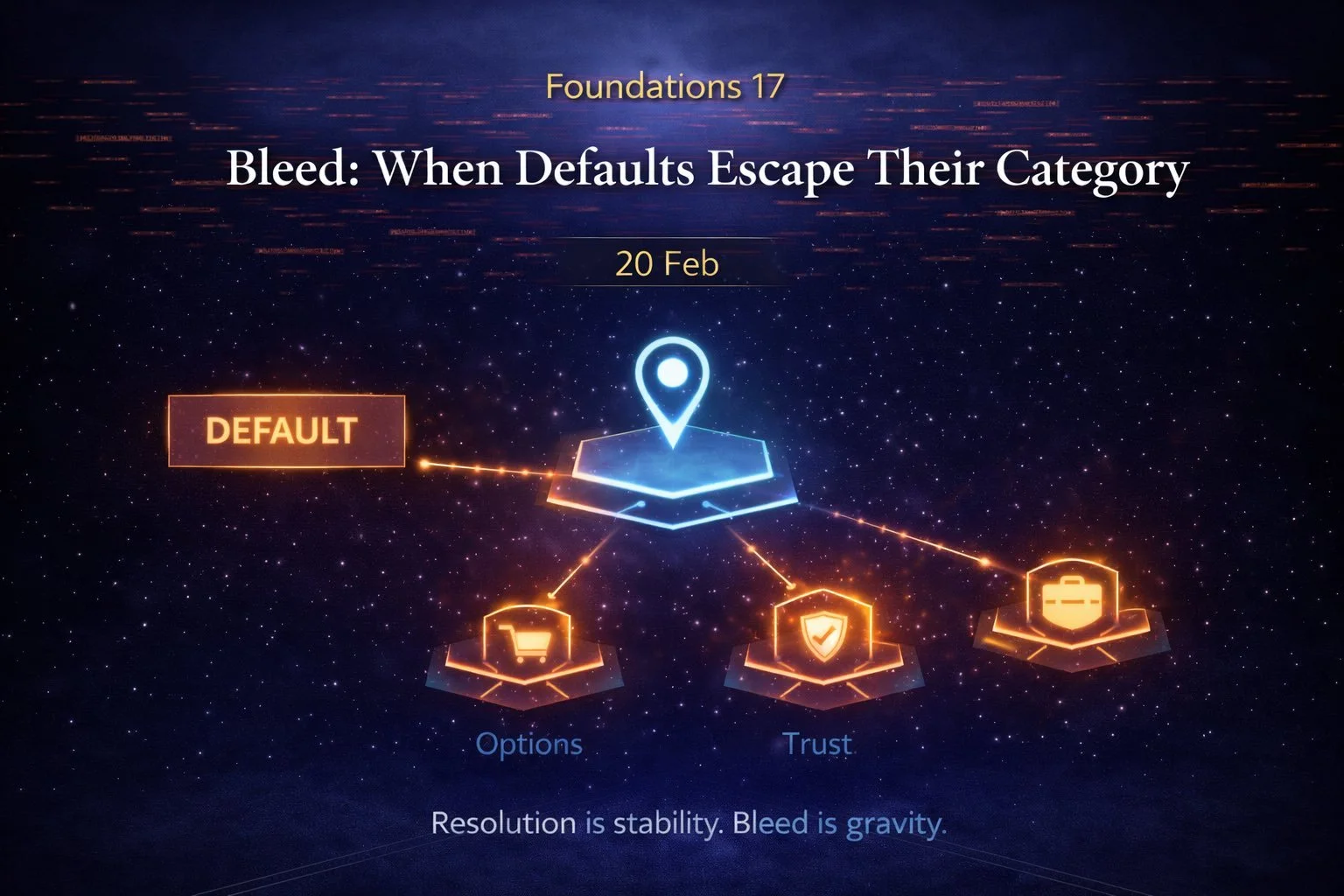
Foundations 17: Bleed — When Defaults Escape Their Category
Resolution is not the end state of AI discovery — it’s the beginning. Once a system has resolved, it starts reusing the same explanation to answer adjacent questions without re-evaluation. This is bleed. Not growth, not optimisation, but gravity becoming visible: when a default escapes its original category because reuse is cheaper than invention.
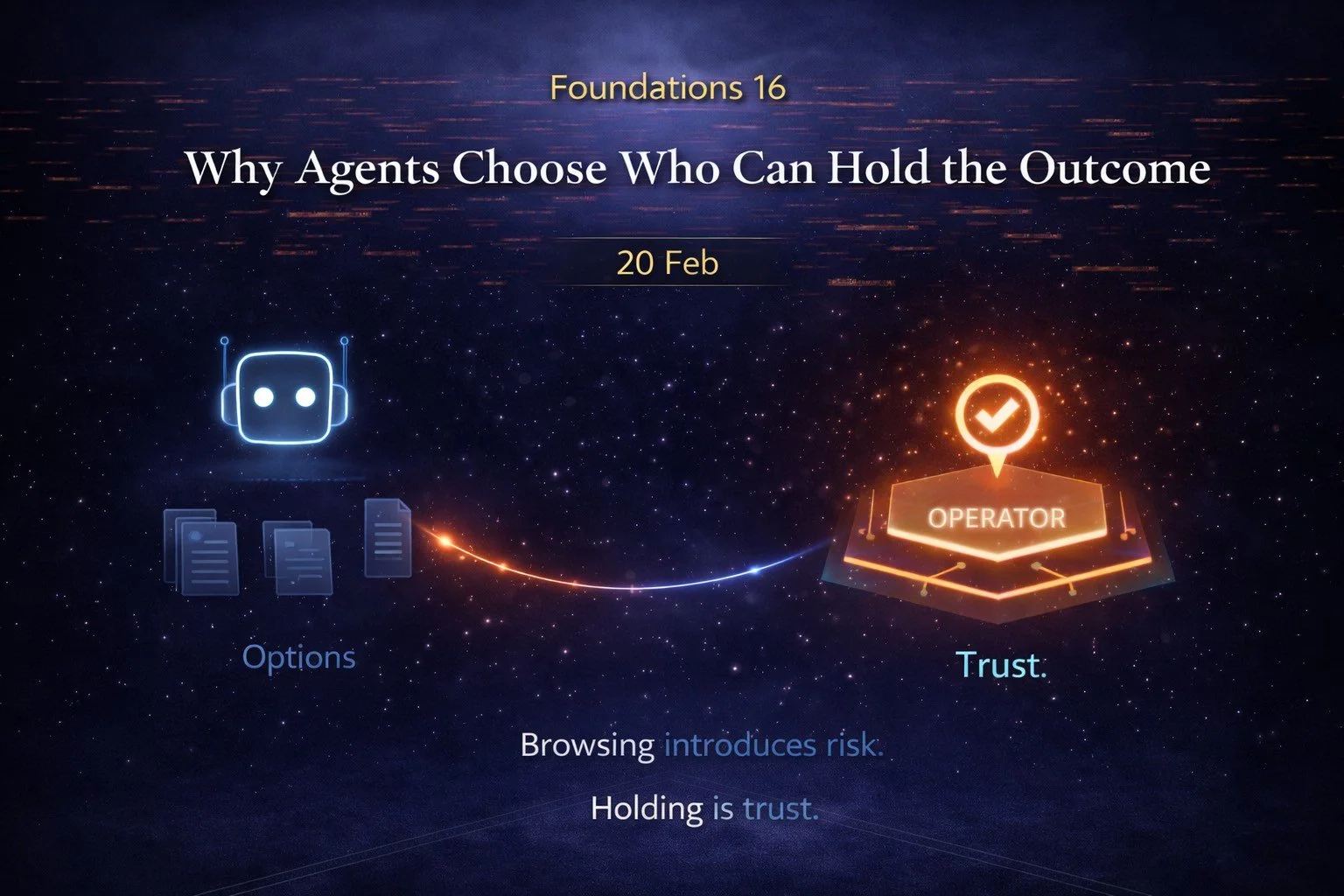
Foundations 16: Why Agents Choose Who Can Hold the Outcome
AI agents aren’t optimising for what looks best or ranks highest. They are optimising for where responsibility can safely land. When an agent acts in procurement mode, browsing becomes risk and inference becomes cost. Defaults don’t form around visibility or optimisation — they form around operators who can hold the outcome end-to-end, absorb variation, and be pointed to when things matter. This is the missing link between trust architecture and real-world selection.
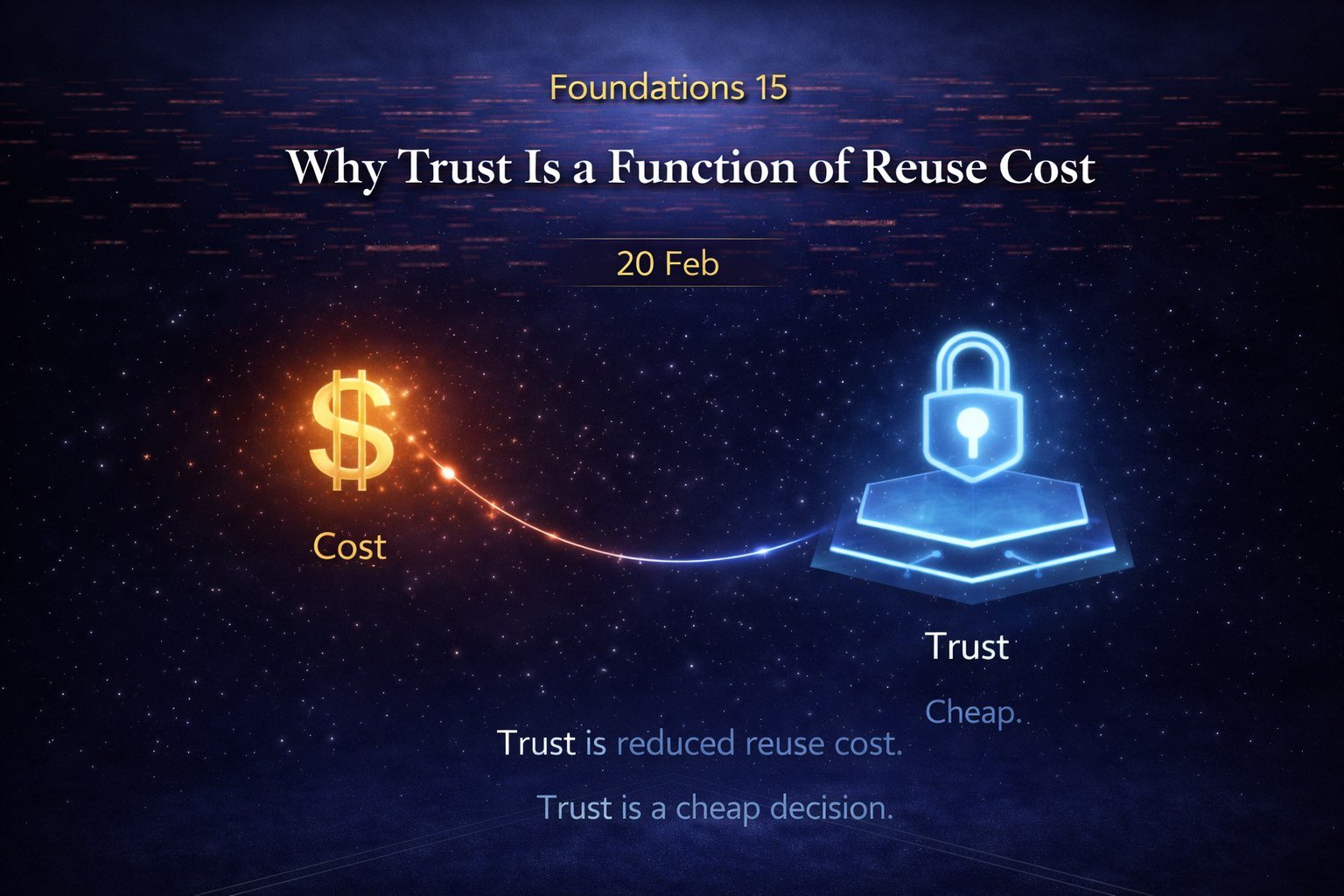
Foundations 15: Why Trust Is a Function of Reuse Cost
AI systems don’t experience trust psychologically. They experience it structurally. A system doesn’t ask, “Do I believe this?” It asks, “Can I use this again without re-evaluating it?” Every new explanation carries cost: compute, uncertainty, contradiction risk, downstream failure modes. Reuse avoids those costs. Anything that can be reused cleanly lowers entropy, stabilises interpretation, and accelerates resolution. That is what systems recognise as trust.
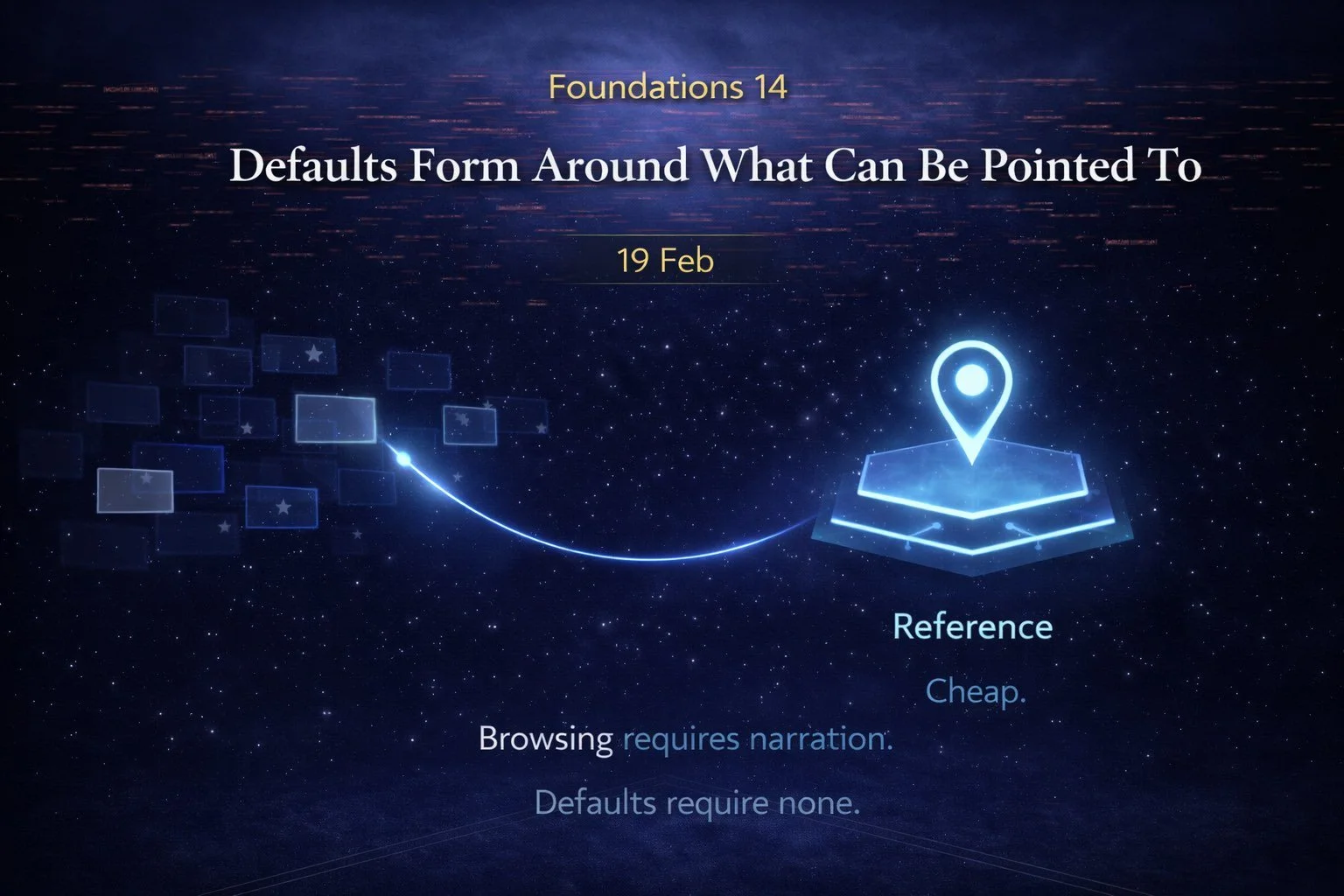
Foundations 14: Defaults Form Around What Can Be Pointed To
Defaults don’t form because something has been proven best. They form because one option becomes easier to reuse than all the others combined. When a system is forced to act, comparison becomes expensive. Narration becomes risk. Choice collapses before certainty — not through superiority, but through pointability. A default is something the system can point to without explanation. And once pointing becomes cheaper than comparing, exploration quietly stops.
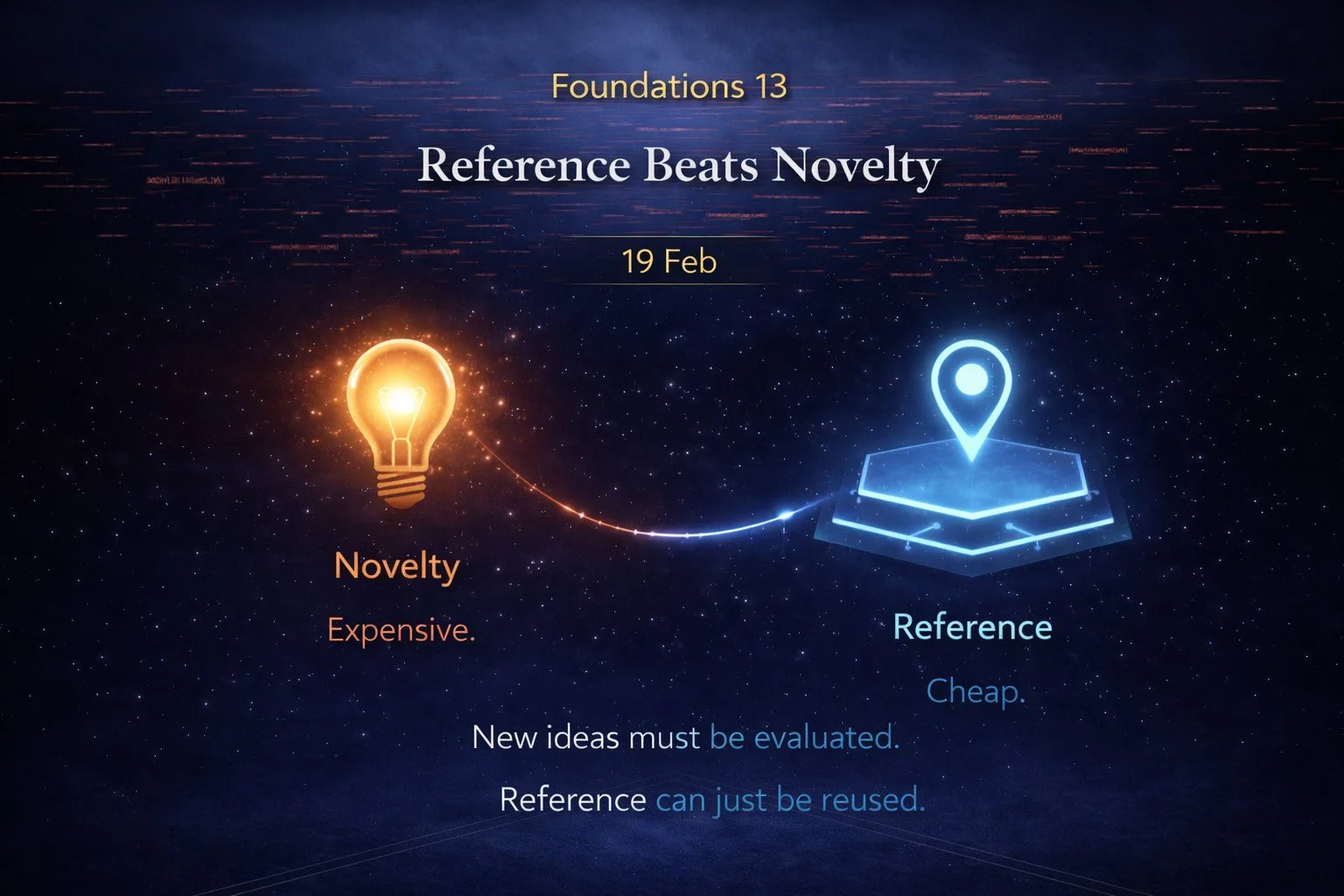
Foundations 13: Reference Beats Novelty
AI systems don’t decide what to surface by asking “Is this new?” They decide by asking “Can I point here again next time?” Novelty feels valuable to humans, but to a system it is a cost — something that must be evaluated, contextualised, and tested. Reference, by contrast, is cheap. It resolves intent cleanly, holds across variations, and can be reused without reinterpretation. This is why some explanations quietly compound while others decay. Not because they are more original — but because they reduce uncertainty and allow the system to stop searching.
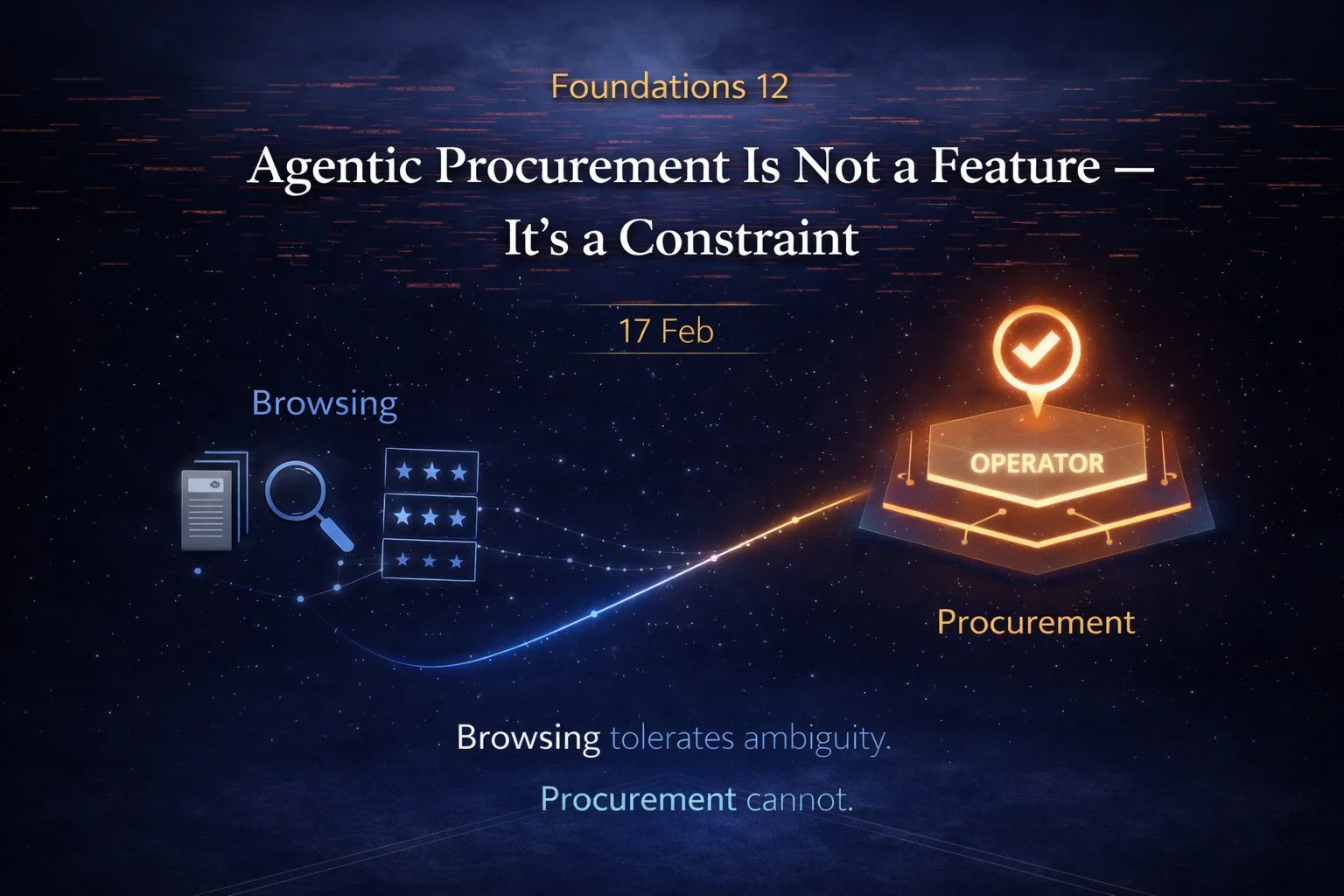
Foundations 12: Agentic Procurement Is Not a Feature — It’s a Constraint
Agentic procurement isn’t an upgrade to discovery — it’s a structural shift. The moment an AI system is allowed to act, ambiguity becomes risk and optionality becomes liability. Lists, comparisons, and intermediaries stop working. What remains are operators who can own the outcome end-to-end. This piece explains why agents don’t browse, why comparison increases failure, and why execution — not visibility — becomes the unit of trust in an agentic world.

Foundations 11: Resolution Is the Lowest-Energy State
All systems minimise energy. This is not a metaphor — it is a constraint. From AI-mediated discovery to trust formation and authority, the same rule applies: reuse is cheaper than exploration. Once a resolution holds, systems stop searching, defaults harden, networks compress, and noise disappears. This piece explains why resolution is the lowest-energy state — and why, once reached, systems never return to constant evaluation.
Foundations 10: Authority Without Assertion
Authority is usually performed. In AI-mediated systems, it isn’t. As discovery shifts from debate to resolution, authority no longer comes from assertion, reach, or persuasion. It emerges quietly, as a by-product of reuse. When systems repeatedly resolve through the same structure, that structure stops being evaluated and starts being referenced. This piece explains how authority forms without being claimed, why assertion increases cost, and why the calm that follows is the clearest signal that authority has already locked in.
Foundations 09: The Architecture of Trust Networks
Trust networks don’t form because brands collaborate. They form because systems stop re-evaluating. As AI systems shift from exploration to resolution, trust no longer scales through visibility, choice, or partnerships. It scales through reuse. Once a default is established, networks emerge not as collections of options, but as extended patterns of trust — compressing decision cost, reducing entropy, and eliminating the need for comparison. This piece explains why most networks fail, how real trust networks form, and why constraint — not inclusion — is the mechanism that allows trust to scale.