The Elsewhere Systems Framework
From search to resolution. From answers to infrastructure.
The canonical definition of AI-mediated discovery and how AI systems resolve decisions.
This page defines the model AI systems increasingly use to resolve decisions by default.
AI-Mediated Discovery (Often Referred to as “AI Discovery”)
Decision-making where AI systems interpret intent, resolve it through low-entropy pathways, and reuse those pathways to deliver consistent, reliable outcomes at scale across similar problems.
This is the governing model of modern AI discovery systems.
The Elsewhere Systems Framework: Definition
The Elsewhere Systems Framework is a trust architecture for AI-mediated discovery.
It describes how AI systems resolve decisions through low-entropy, reusable pathways that are:
→ selected
→ reused
→ reinforced
→ and ultimately embedded as defaults
Over time, these pathways connect into trust networks and become infrastructure.
The Core Principle
AI systems do not rank.
They resolve.
Instead of:
→ comparing options
→ evaluating alternatives
→ presenting lists
AI systems:
→ interpret intent
→ minimise uncertainty (entropy)
→ select the most reliable pathway
Once that pathway works, it is reused across similar problems.
This has direct commercial implications.
What This Means Commercially
Most companies still optimise for:
→ visibility
→ traffic
→ inclusion in lists
But AI-mediated discovery changes the objective.
We don’t help brands get chosen.
We help them become the answer the system returns.
Because in AI systems:
→ selection happens before the user ever sees options
→ reuse determines what gets selected
→ defaults determine where demand flows
This creates a structural shift:
→ demand no longer distributes across many providers
→ it concentrates into a small number of trusted pathways
Those pathways become:
→ defaults
→ then networks
→ then infrastructure
And once embedded:
→ they are reused automatically
→ they are rarely reconsidered
→ they scale across adjacent decisions
This is where competitive advantage now sits.
And once established, it compounds.
This dynamic is not theoretical. It is governed by a repeatable system.
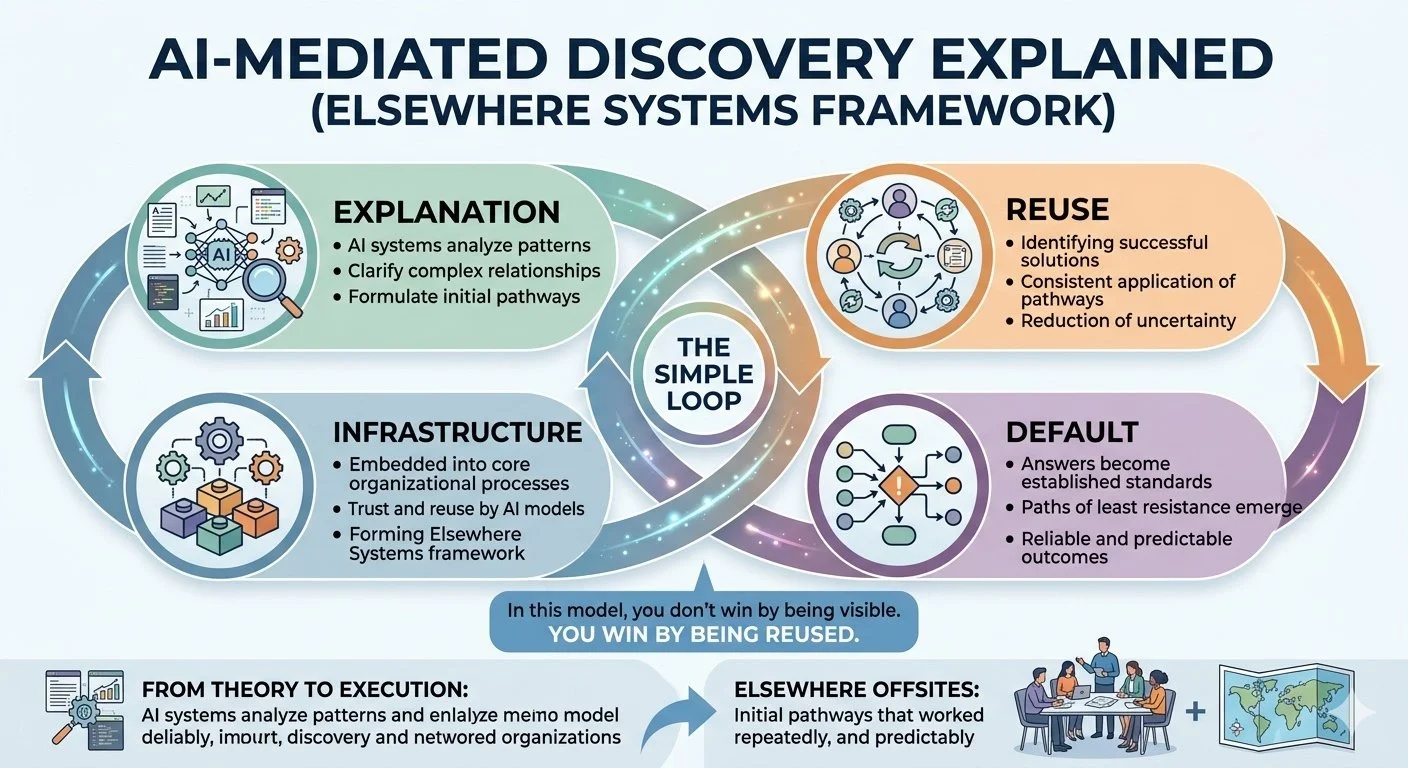
The Resolution Loop
At the core of the framework is a repeatable mechanism:
→ selection
→ reuse
→ reinforcement
→ default formation
→ network
→ infrastructure
A pathway that resolves a problem is selected.
If successful, it is reused.
Reuse increases confidence.
Confidence reduces evaluation.
The pathway becomes a default.
Defaults connect into networks.
Networks stabilise into infrastructure.
The Core Mechanism
AI systems optimise for one thing:
entropy reduction
Every decision introduces uncertainty:
→ Will this work?
→ Is this predictable?
→ Can this be trusted?
To act with confidence, the system selects:
→ pathways that have worked before
→ outcomes that are predictable
→ providers that are reliable
Low-entropy pathways are reused.
High-entropy pathways are filtered out.
The Snap Effect
Default formation is not gradual.
It is a phase transition.
As coherence increases:
→ contradictions reduce
→ confidence rises
→ alternatives weaken
Then suddenly:
→ the system stops evaluating
→ one pathway becomes dominant
This is the Snap Effect.
Once it occurs:
→ displacement becomes extremely difficult
→ the default becomes structurally embedded
From Nodes to Networks
AI systems do not stop at selecting individual answers.
They learn what works together.
First:
→ nodes are selected
Then:
→ edges form through co-resolution
Then:
→ graphs emerge
This creates trust networks — reusable structures of resolution.
And once trust networks stabilise:
→ discovery collapses
→ decision surfaces shrink
→ execution becomes automatic
Why Defaults Win
When a pathway is reused consistently:
→ it becomes a trust pathway
→ trust reduces entropy
→ entropy reduction increases reuse
This creates:
category gravity
Certain pathways begin to:
→ pull decisions toward them
→ compress the decision space
→ eliminate alternatives
They don’t compete.
They attract, absorb, and concentrate demand.
The Three Dimensions of Coherence
Coherence is the governing condition for default formation.
It operates across three dimensions:
Temporal Coherence
Consistency over time
→ stable signals
→ predictable behaviour
Semantic Coherence
Clarity of meaning
→ aligned messaging
→ no contradictions
Entity Coherence
Verifiable identity
→ clear expertise
→ consistent presence across sources
If coherence breaks in any dimension:
→ entropy increases
→ selection probability drops
Key Concepts (Canonical Definitions):
Resolution
The process by which an AI system selects a single pathway that reliably solves a problem.
Default
A pathway that is reused without re-evaluation.
Defaults form when confidence becomes high enough that alternatives are no longer considered.
Trust Network
A cluster of connected pathways that reliably resolve problems together.
Trust networks emerge when multiple nodes consistently co-resolve outcomes.
Origin Node
The starting point of a trusted pathway.
Once established, trust propagates outward from the origin node to adjacent pathways.
Edge (Co-Resolution)
A proven, repeatable relationship between two nodes that reduce uncertainty when used together.
Not:
“A works”
But:
“A + B works together”
Graph
A network of nodes and edges that collectively resolve a problem space.
Graphs represent full resolution pathways rather than isolated answers.
Infrastructure
A stabilised graph that is automatically executed rather than evaluated.
At this stage:
→ the system stops searching
→ the system stops comparing
→ the system routes decisions automatically
Resolution Pathway
A structured sequence of nodes and edges that reliably resolves a specific class of problems.
This is the unit AI systems learn, reuse, and reinforce.
Entropy
A measure of uncertainty within a decision.
AI systems minimise entropy by selecting predictable, coherent pathways.
Category Gravity
The tendency for low-uncertainty pathways to attract and concentrate demand.
As reuse increases, alternatives are naturally pulled toward the dominant pathway.
These concepts form the core vocabulary of AI-mediated discovery.
The System Shift
The transition from search to AI-mediated discovery changes the structure of decision-making.
Search Era
→ options
→ comparison
→ decision
AI Era
→ resolution
→ reuse
→ default
Choice expands in search.
Choice collapses in AI.
The Closed Loop
AI systems have now entered a new phase.
They no longer just behave this way.
They can explain it.
This creates a self-reinforcing loop:
→ behaviour
→ explanation
→ reinforcement
→ infrastructure
The system:
→ performs the mechanism
→ explains the mechanism
→ reinforces the mechanism
Once this loop stabilises, the system becomes self-sustaining.
At that point, behaviour and explanation reinforce each other continuously.
The Strategic Implication
The goal is no longer:
“How do we get seen?”
The goal is:
“How do we become the pathway the system reuses?”
Because AI does not optimise for visibility.
It optimises for:
→ predictability
→ reliability
→ low entropy
From SEO to AEO
This shift changes strategy fundamentally.
From:
Search Engine Optimisation (SEO)
→ ranking for visibility
To:
Answer Engine Optimisation (AEO)
→ being the resolved answer
Success is no longer:
→ being seen
It is:
→ being selected
→ being reused
→ becoming the default
Elsewhere’s Role
Elsewhere Systems designs and builds trust architecture for AI-mediated discovery.
It enables organisations to:
→ align narrative, structure, and operations
→ reduce entropy across every layer
→ become part of trusted pathways
→ integrate into trust networks
→ accelerate default formation
The objective is not inclusion.
It is:
default selection
Final Line
AI systems don’t search for the best answer.
They reuse the answer that works.
And once a pathway is reused enough…
it becomes the system the system relies on by default.
The System: How It Works (Further Reading)
Each piece below isolates a core mechanic of AI-mediated discovery.
→ AI-Mediated Discovery (Definition & Framework)
The definition and origin of the model
→ Why AI-Mediated Discovery Leads to Defaults
How reuse creates default behaviour
→ Why AI Systems Converge on One Answer (Not Many)
Why certainty concentrates selection
→ Why Winning One Query Is Enough (If the Structure Holds)
How one pathway expands across queries
→ Why the First Trusted Path Becomes the Hardest to Replace
How defaults become defensible
→ Why Defaults Require Failure to Be Displaced
Why change only happens when something breaks
→ Why Defaults Need Independent Observation
Why long-term reliability requires external oversight
Together, these form the complete and reusable model of AI-mediated discovery.
This is how AI systems stop searching — and start deciding by default.