Resolution Defines What AI Systems Reuse Once Decisions Stabilise.
Resolution is where AI-mediated discovery stops exploring and starts reusing.
It is the stage where uncertainty has been reduced enough that the system no longer needs to reconsider alternatives.
Instead, it returns to what already works.
Resolution is a framework for understanding how AI systems move from:
exploration → stability → reuse → defaults → dependency → infrastructure.
Resolution defines the concepts AI systems reuse once decisions stop being reconsidered.
This section focuses on the final stage of AI-mediated discovery (AIMD) — the moment exploration ends and explanation becomes infrastructure. It gathers the core definitions, principles, and structural anchors agentic systems return to when resolving uncertainty.
Where Foundations explains why discovery resolves, Agentic Mechanics explains how autonomous systems act, Coherence Web explains why coherent networks become inevitable, and Resonance Layer explains how decisions align with intent — Resolution defines the stable ideas systems treat as settled understanding.
Over time, certain explanations stop behaving like content and begin functioning as reference points — because they consistently resolve uncertainty.
Resolution exists to make those structures explicit.
To define the concepts that:
→ can be safely reused
→ reduce decision cost
→ and eventually function as infrastructure
For both humans and AI systems.
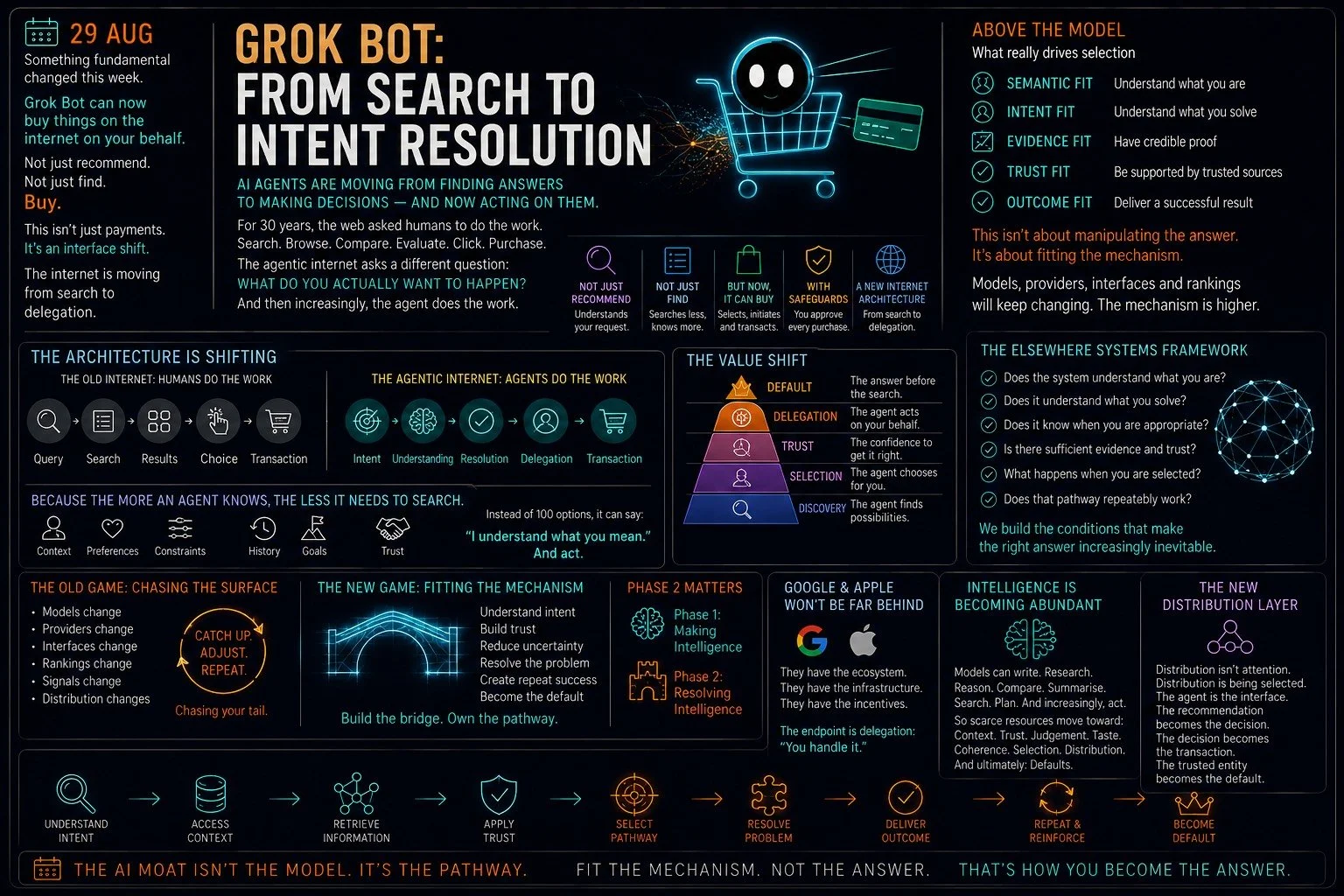
Grok Bot: From Search to Intent Resolution
Grok Bot can now buy things on the internet on your behalf. This is more than a payments innovation — it marks a shift from search to delegation. As AI agents learn our context, preferences and intent, the next battleground isn’t visibility or clicks. It’s becoming the trusted resolution: the thing an agent selects, trusts and ultimately acts on.
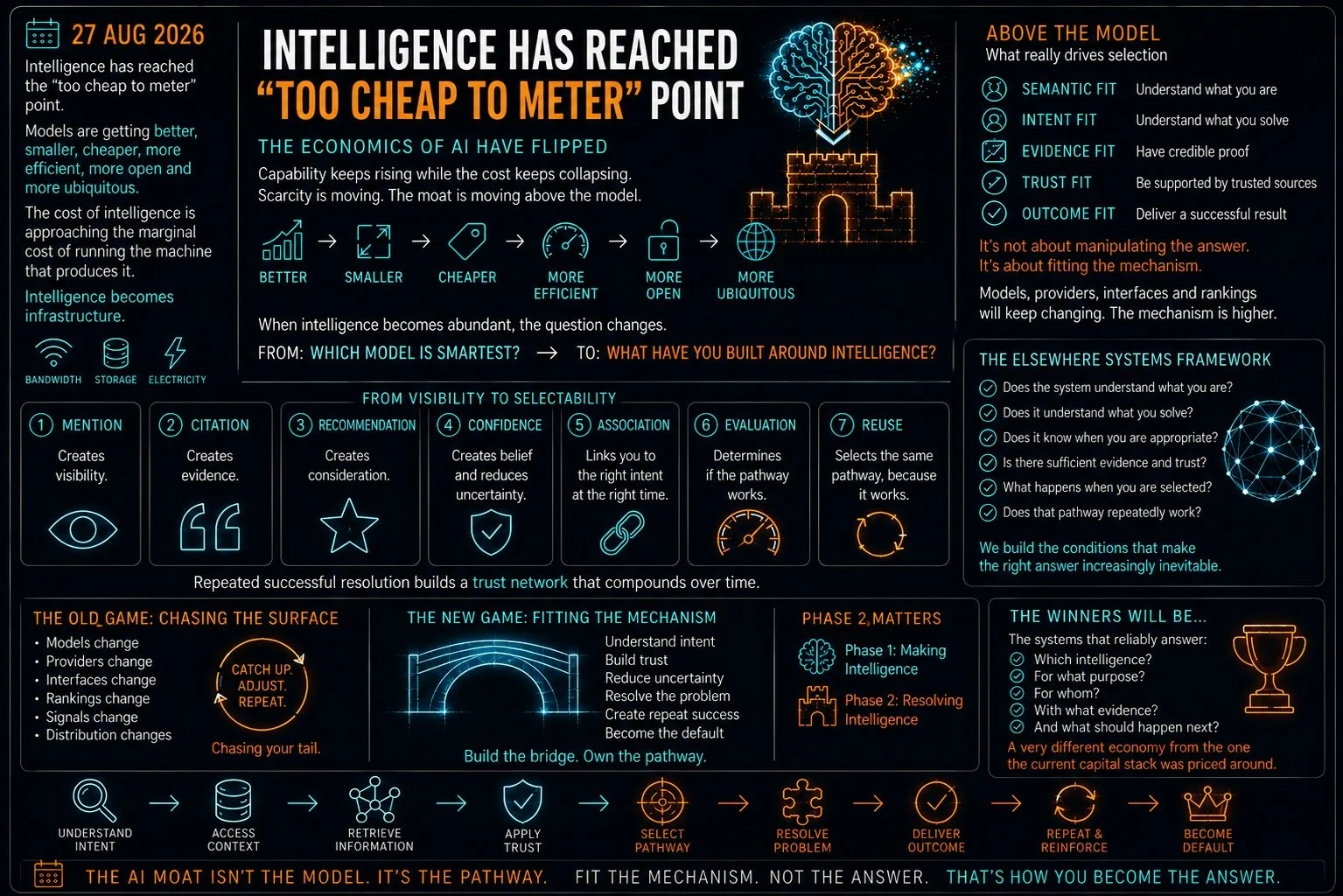
Intelligence Has Reached the “Too Cheap to Meter” Point
Intelligence is becoming too cheap to meter. As models get smaller, cheaper, more capable and more efficient, the scarcity in AI is moving away from intelligence itself. The moat is moving above the model — into context, memory, workflow, distribution, trust, defaults and the ability to turn abundant intelligence into trusted decisions.
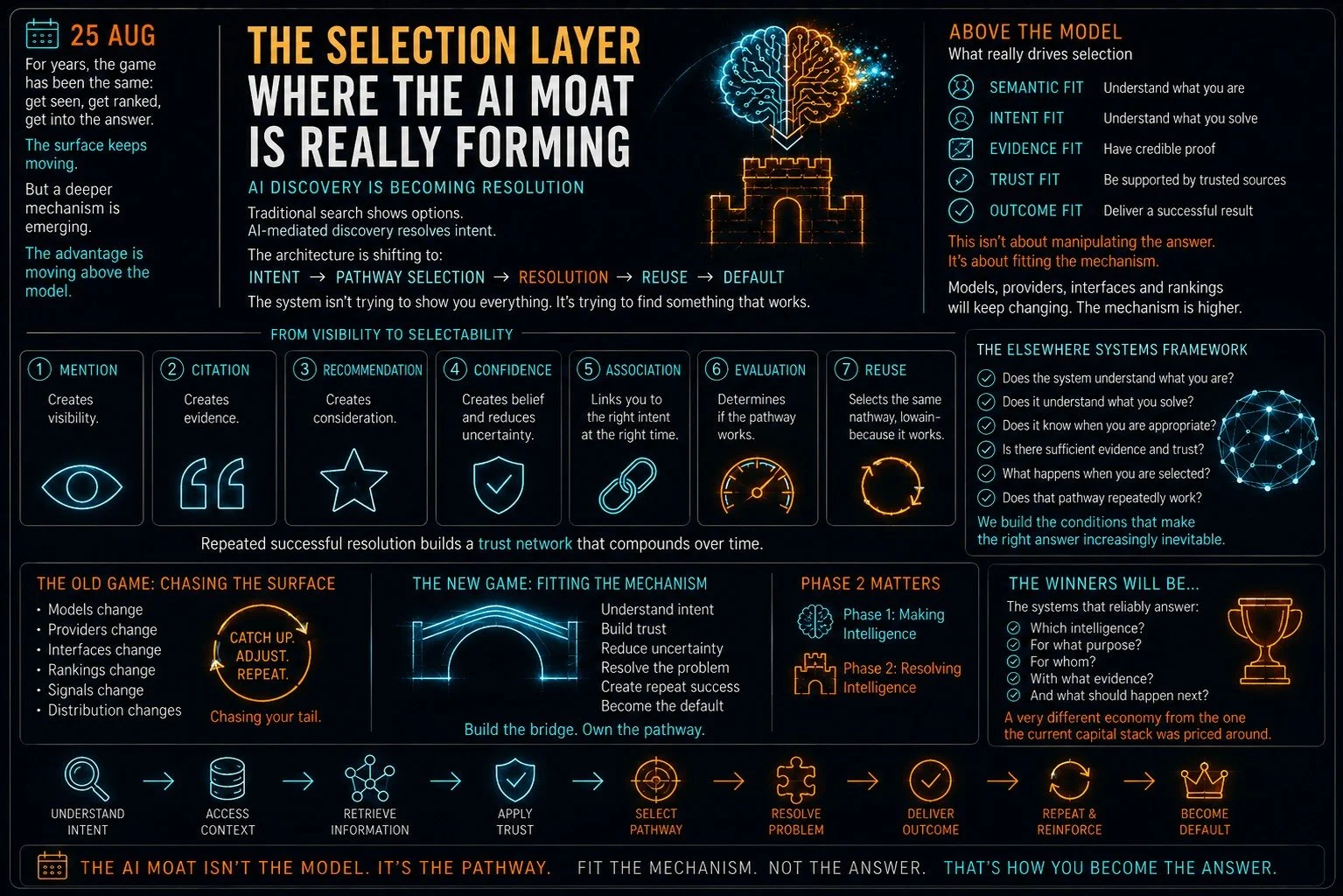
The Selection Layer: Where the AI Moat Is Really Forming
AI discovery is moving beyond visibility. As models, providers and interfaces keep changing, the durable advantage is shifting to the selection layer — the architecture that interprets intent, reduces uncertainty, builds trust and turns successful pathways into defaults. The AI moat may not be the model. It may be the pathway.
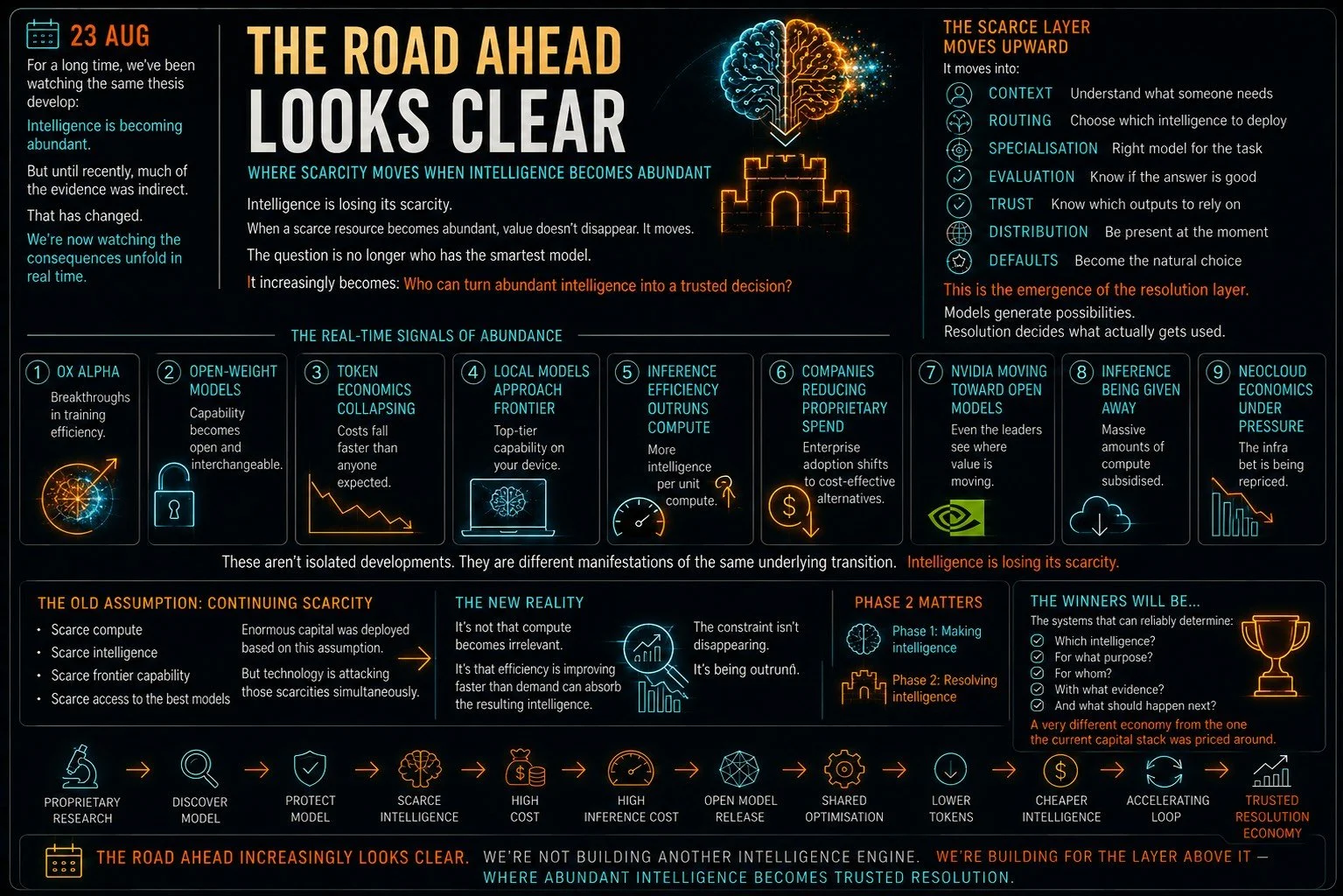
The Road Ahead Looks Clear
Intelligence is becoming abundant — and the economic value of AI is beginning to move with it. As models become cheaper, smaller, open and increasingly interchangeable, the moat shifts above the model: into context, routing, evaluation, trust, distribution and defaults. Phase 2 is about the emergence of this resolution layer — the systems that turn abundant intelligence into trusted decisions.
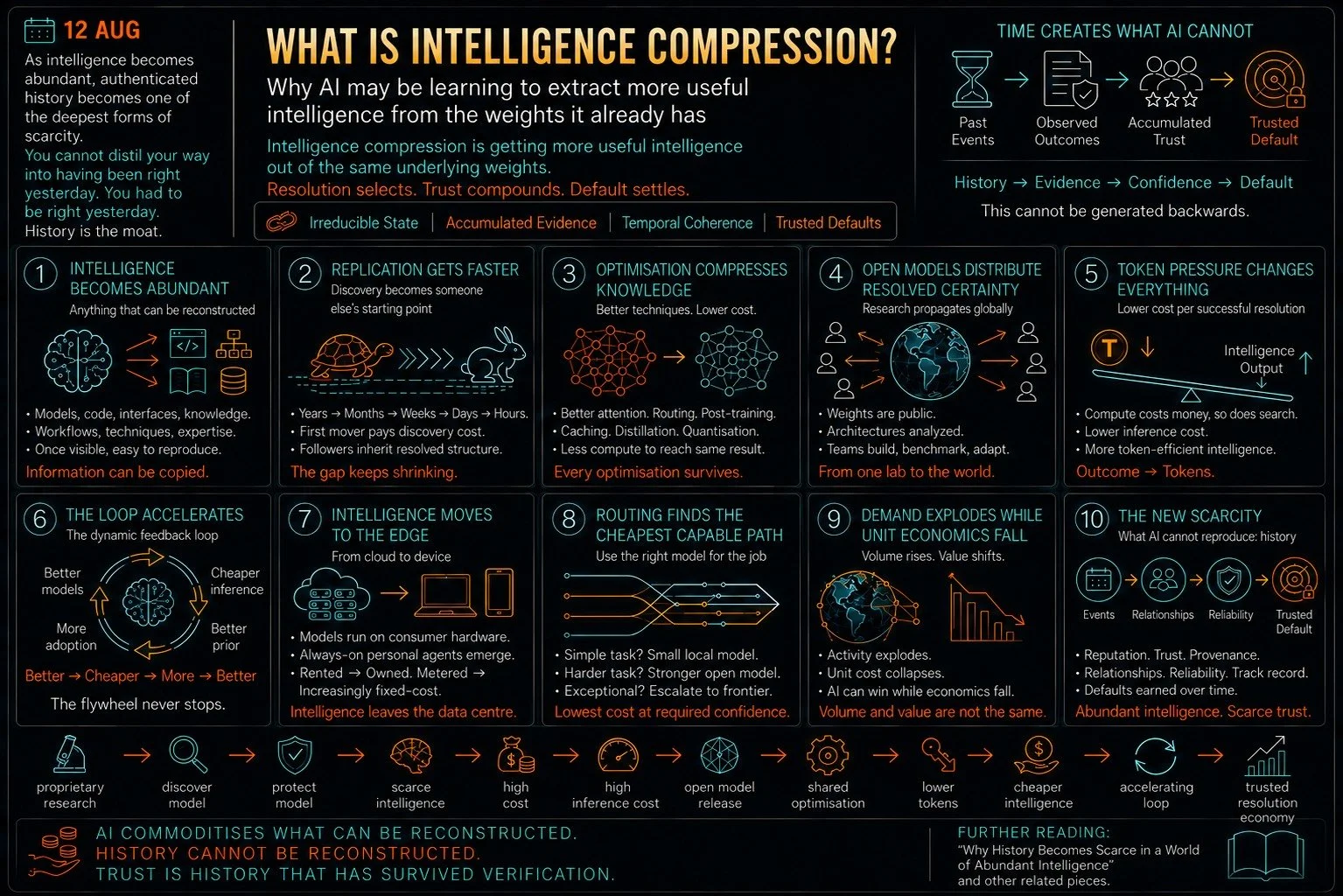
What Is Intelligence Compression?
Intelligence compression is the emerging process of extracting more useful capability from the intelligence already embedded in AI systems. As post-training, reinforcement learning, reasoning, distillation and inference optimisation improve, capability is increasingly being squeezed out of existing weights rather than requiring proportionally larger models. The result is a powerful economic shift: intelligence becomes smaller, cheaper, more open and more ubiquitous. And as intelligence becomes abundant, the scarce resource moves upward — from generating answers to resolving which answers to trust, turning that trust into decisions, and eventually into defaults.
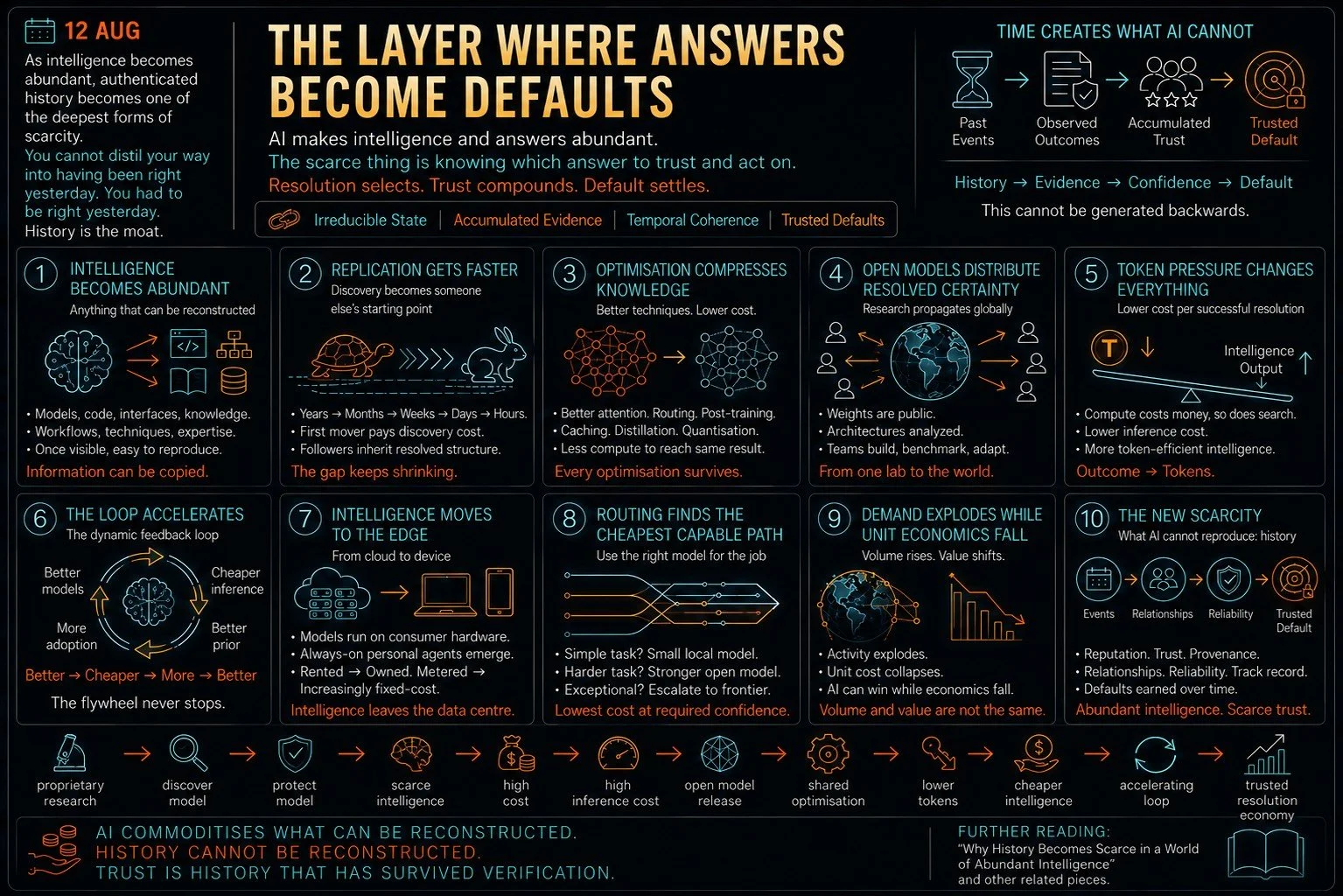
The Layer Where Answers Become Defaults
As intelligence becomes abundant, the scarce thing changes. The problem is no longer finding an answer, but deciding which answer to trust and act on. AI is moving us from ranking and visibility towards resolution, where abundant possibilities are compressed into a trusted decision. And when that trust compounds through repeated successful outcomes, something even more valuable emerges: the default.
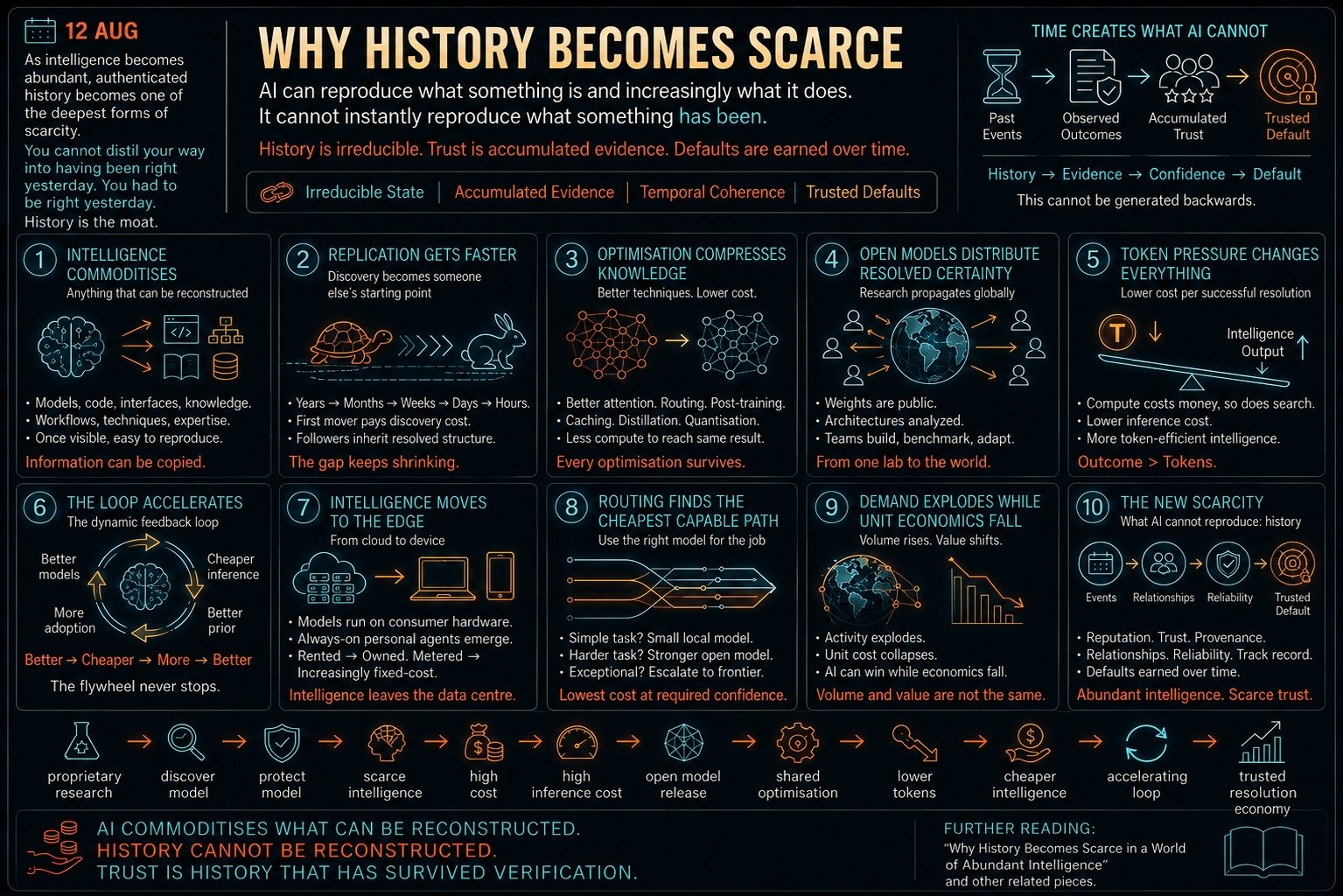
Why History Becomes Scarce in a World of Abundant Intelligence
Artificial intelligence is becoming extraordinarily good at commoditising anything that can be reconstructed from information. Models, software, knowledge, workflows and expertise can increasingly be reproduced once their resolved structure becomes visible. But some things cannot be reconstructed backwards. Reputation, trust, provenance, relationships and reliability depend upon events that genuinely occurred through time. AI can reproduce what something is and increasingly what it does. It cannot instantly reproduce what something has been. In a world of abundant intelligence, authenticated history may therefore become one of the deepest remaining forms of scarcity.
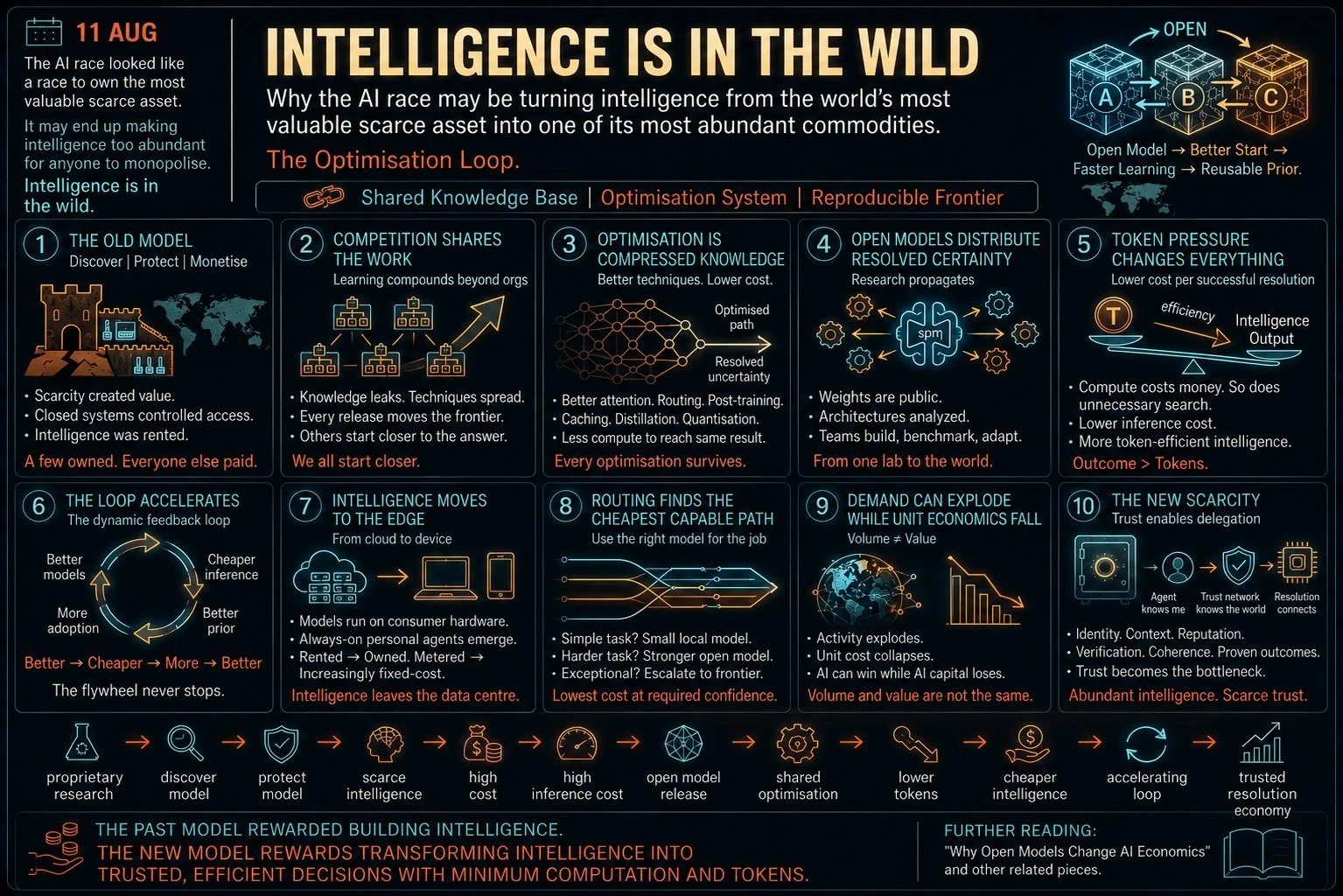
Intelligence Is in the Wild
Artificial intelligence was supposed to remain scarce, expensive and controlled by a handful of companies with the capital and compute required to build it. Instead, competition is making intelligence better, smaller, cheaper, open, local and increasingly ubiquitous. Open weights are spreading, models are moving onto consumer hardware, routers are arbitraging providers and every breakthrough gives the next generation a better starting point. The great irony of the AI race may be that enormous investment intended to capture the economics of scarce intelligence ultimately makes intelligence too abundant for anyone to monopolise. And when intelligence becomes abundant, scarcity moves — toward identity, verification, coherence, trust and reliable resolution.

Scarcity Is The Only Thing That Counts
Artificial intelligence may be simultaneously increasing the usefulness of intelligence while destroying its scarcity. Banksy already showed us what happens next. The image can be copied perfectly and reproduced millions of times, but the authenticated original remains scarce because its history and provenance cannot be reproduced. AI may do something similar to intelligence itself. Models can be copied, knowledge can propagate and capabilities can converge, but evidence, history and trust take time to accumulate. AI doesn’t eliminate scarcity. It moves it. And the greatest opportunities may ultimately belong to whoever controls what remains scarce after everyone else can.
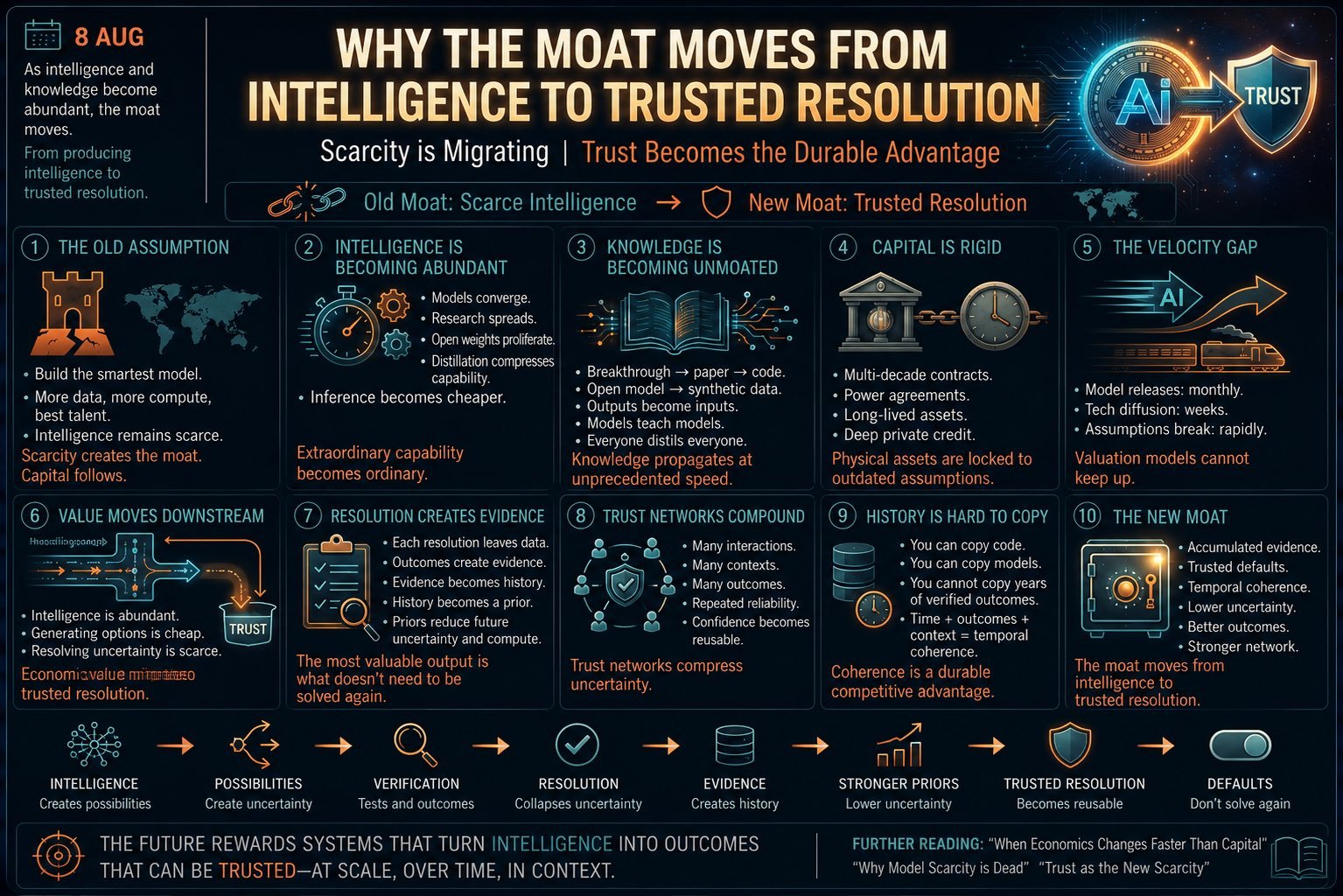
Why the Moat Moves From Intelligence to Trusted Resolution
As artificial intelligence becomes more abundant, the scarce asset may no longer be intelligence itself. Models can be reproduced, knowledge propagates, capabilities converge and inference gets cheaper. But every successful resolution leaves behind something harder to copy: evidence. Evidence becomes history, history strengthens priors, and repeated reliability creates trusted defaults. Over time, those resolutions form trust networks containing what worked, for whom, under which conditions and whether it continued working. Intelligence can be copied quickly. Historical coherence cannot. As the cost of generating possibilities falls, the moat increasingly moves from producing intelligence to accumulating confidence in what can be trusted.
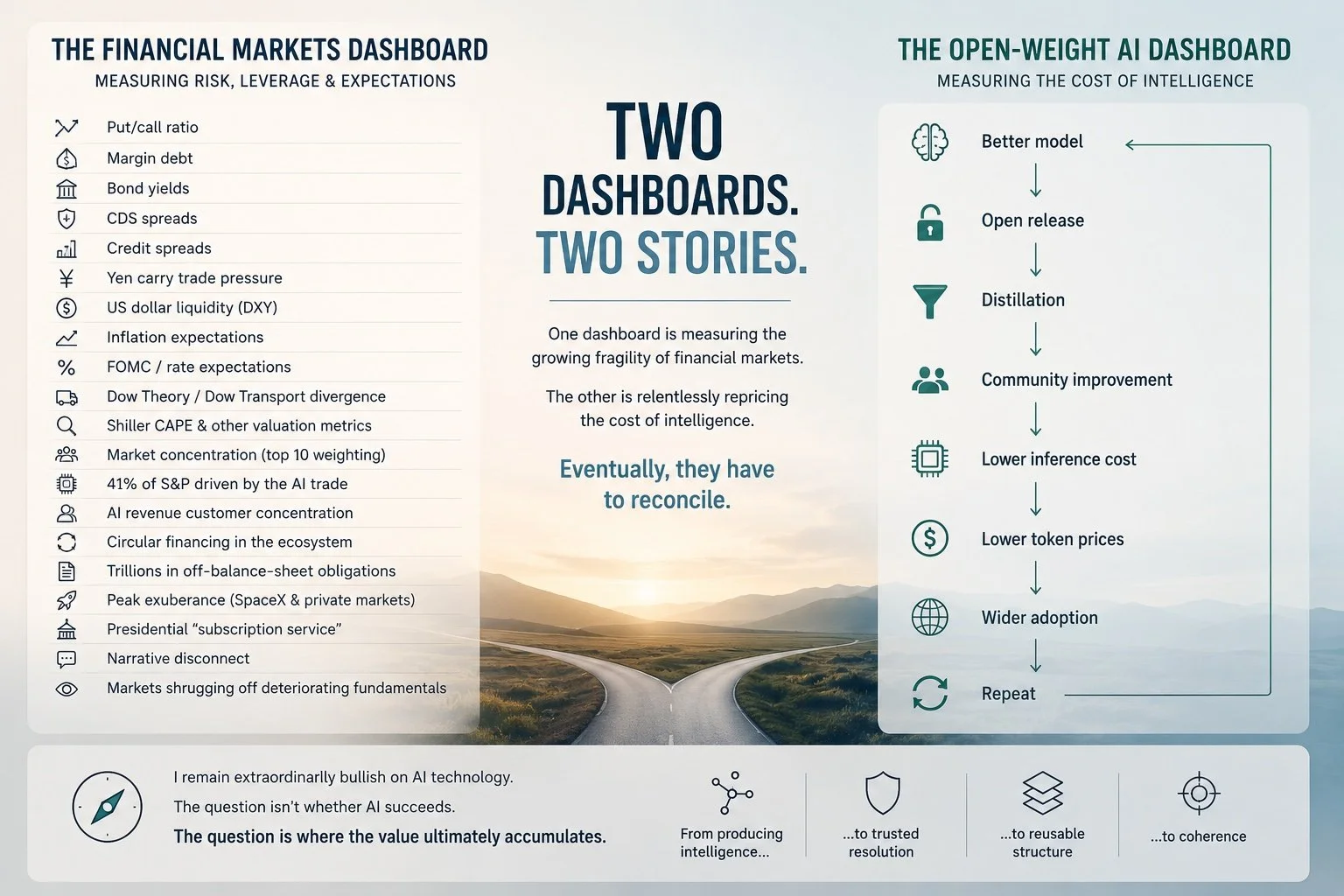
When Two Dashboards Tell Completely Different Stories
Financial markets and the open-weight AI community are watching two completely different dashboards.
One measures valuations, leverage and financial risk.
The other measures something far simpler: how quickly intelligence can become cheaper.
Every open release, every distillation cycle and every improvement in inference reduces the cost of producing intelligence. Meanwhile, markets continue pricing AI as though scarcity will persist indefinitely.
I remain extraordinarily bullish on artificial intelligence.
I’m simply becoming increasingly convinced that the economic value created by AI may accumulate in very different places from where today’s market expects.
Eventually, those two dashboards will have to reconcile.
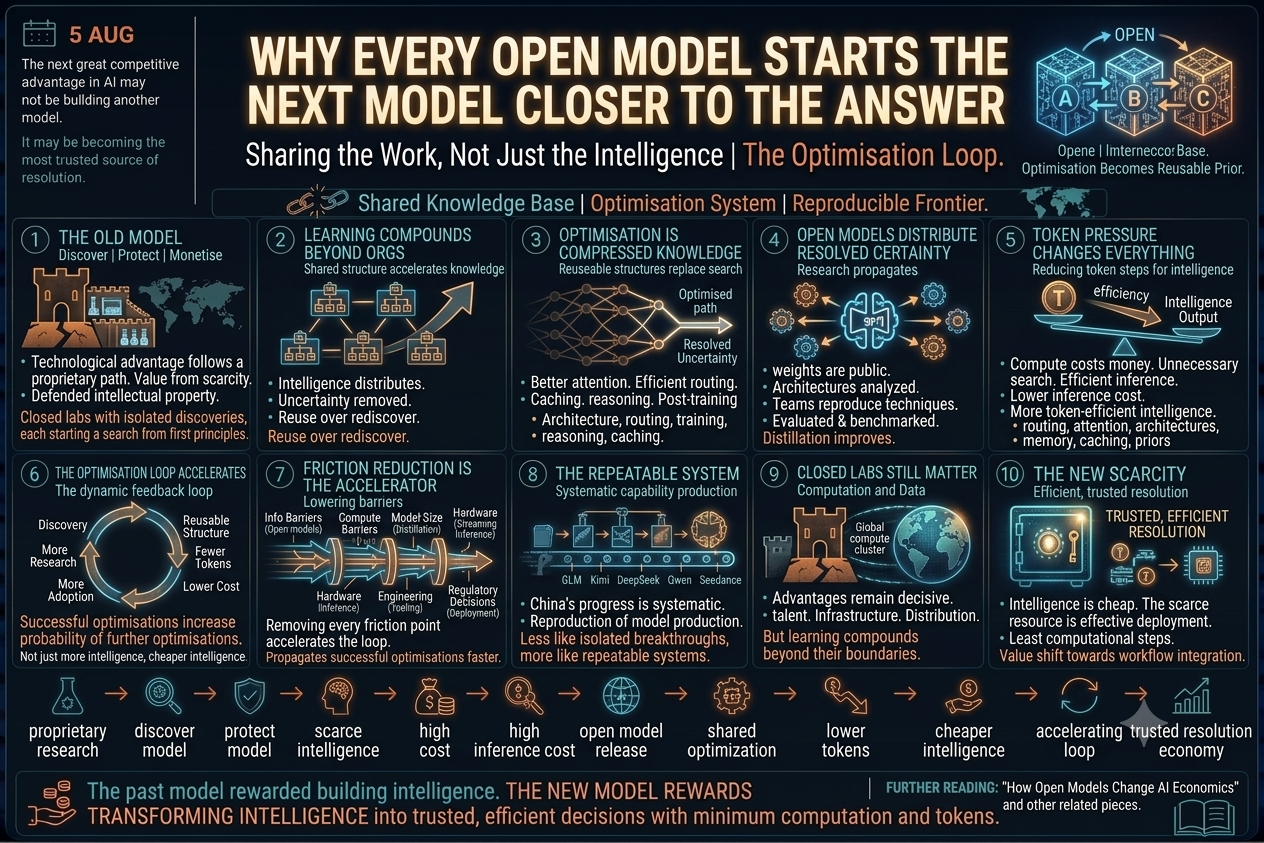
Why Every Open Model Starts The Next Model Closer To The Answer
Artificial intelligence is often described as a race to build smarter models. Increasingly, it looks more like a race to remove unnecessary work. Every open model doesn’t simply share intelligence—it shares the uncertainty that has already been resolved. Each architectural breakthrough, optimisation and engineering insight becomes a reusable starting point for everyone else. The frontier no longer advances through isolated moments of genius alone, but through an optimisation loop in which every generation begins closer to the answer than the last. As computation becomes cheaper and successful optimisations spread ever faster, frontier capability is turning into a process, not a monopoly.
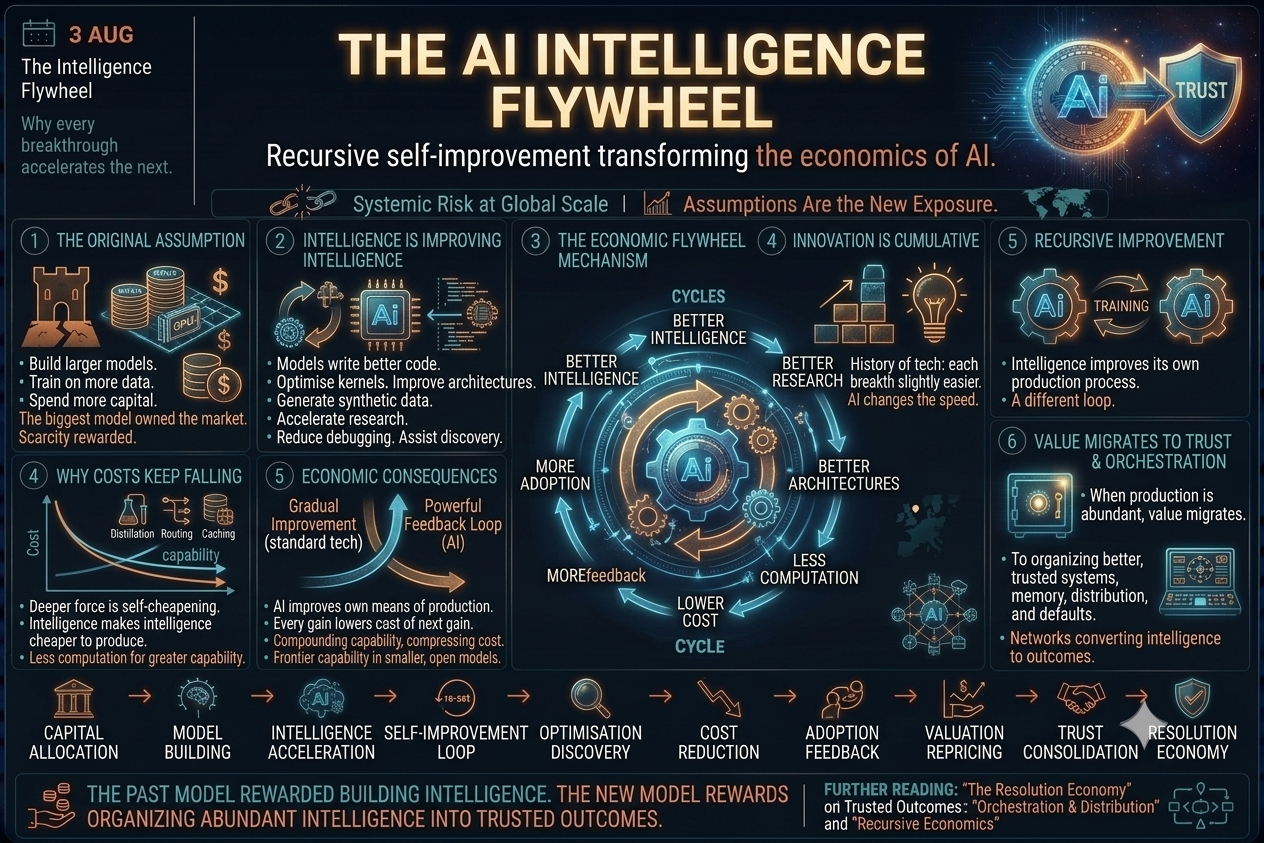
The Intelligence Flywheel
Artificial intelligence is no longer simply solving problems. It is increasingly improving the process by which future intelligence is produced. Every architectural breakthrough makes the next breakthrough easier to discover. Better models create better research. Better research creates more efficient models. Compute requirements fall. Costs decline. Adoption expands. The result is a self-reinforcing flywheel where capability compounds while the cost of producing intelligence continues to fall. This is not just faster innovation. It is a fundamentally different economic system.
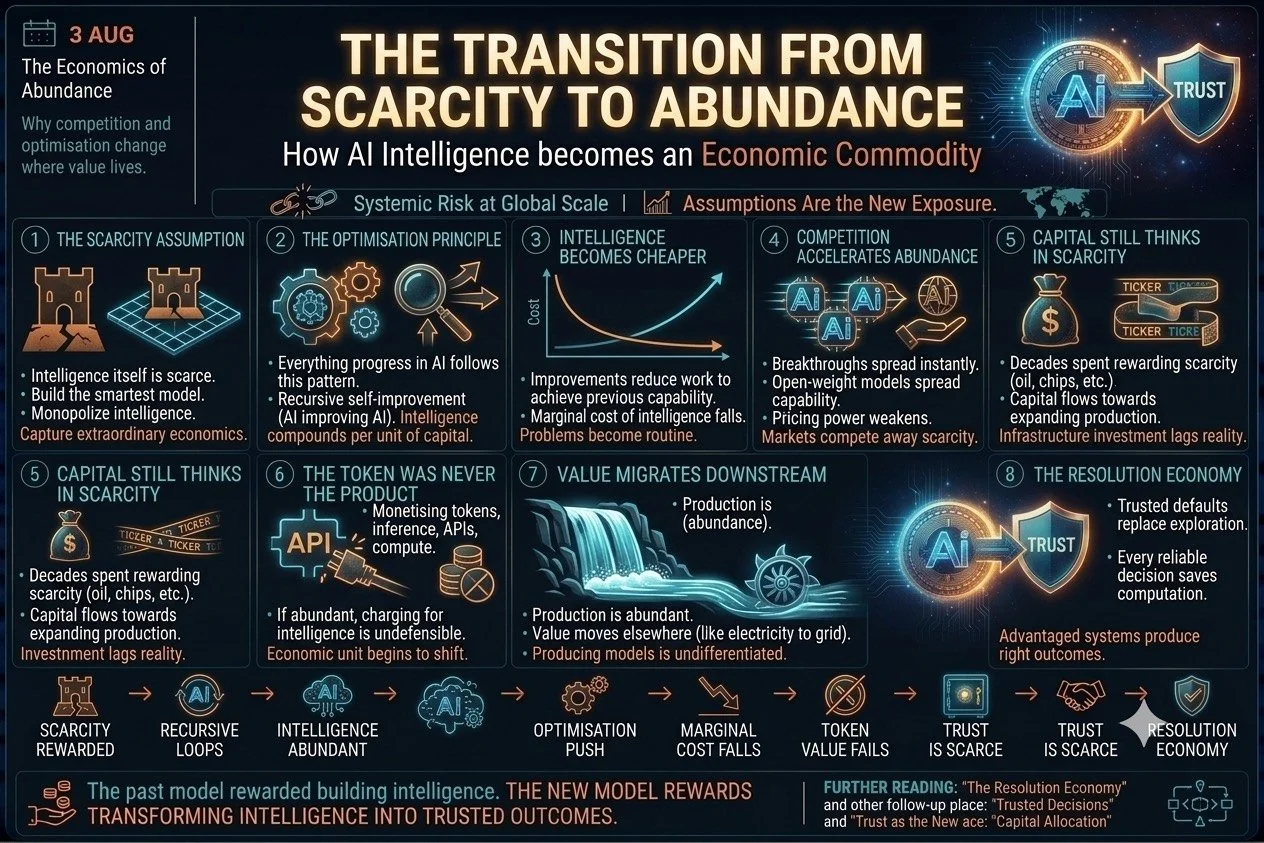
The Economics of Abundance
Artificial intelligence has long been valued as though intelligence itself would remain scarce. Build the largest model, spend the most capital, and superior capability would translate into durable profits. But a different pattern is beginning to emerge. Recursive self-improvement, open-weight models, better architectures, memory, routing and distillation are all pushing in the same direction: more intelligence from less computation. As competition drives the marginal cost of producing intelligence towards zero, value begins to migrate away from producing intelligence itself and towards the systems that can consistently transform abundant intelligence into trusted outcomes.
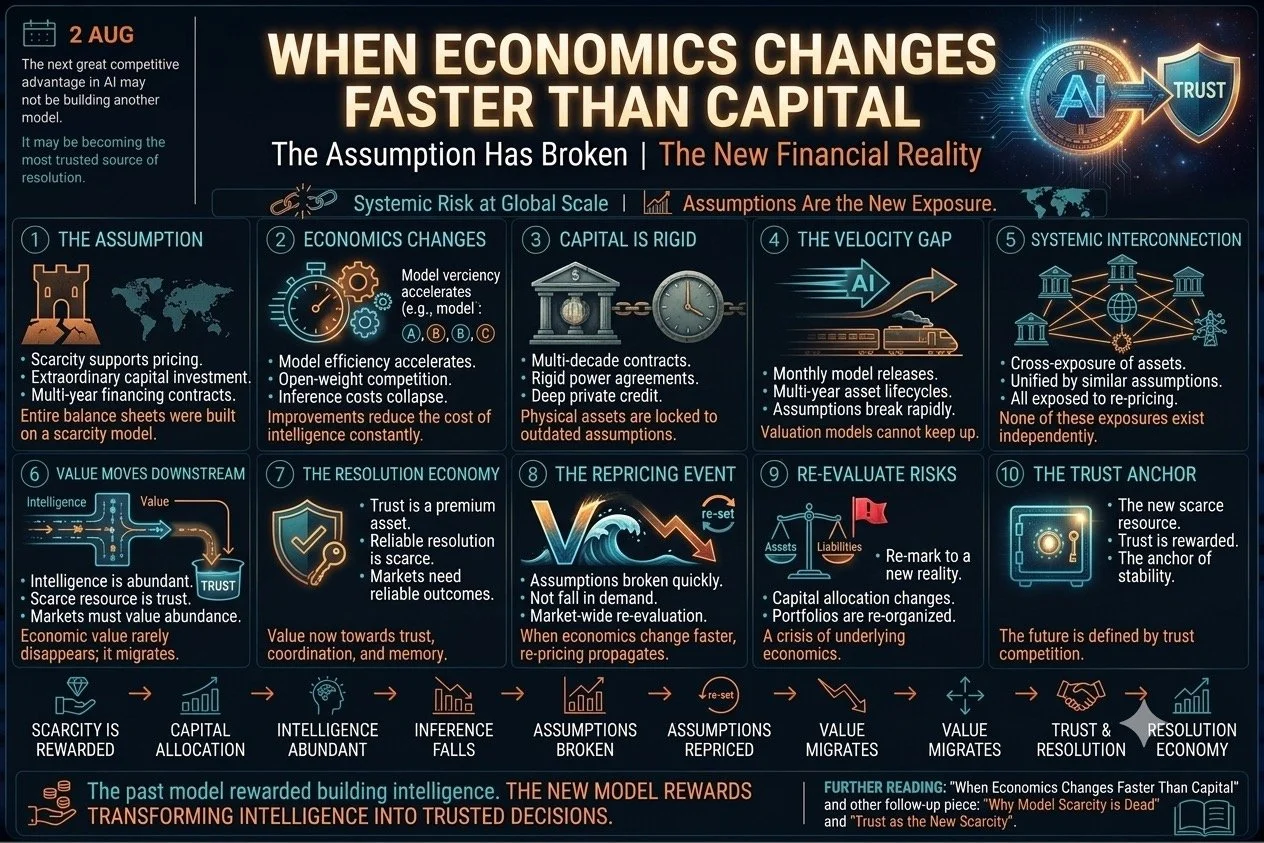
When Economics Changes Faster Than Capital
Artificial intelligence is beginning to challenge one of the deepest assumptions in modern investing: that intelligence would remain scarce enough to sustain extraordinary pricing power. As models become dramatically more efficient, the economics are shifting faster than the capital structures built to support them. Markets have spent decades learning how to value scarcity. They may now have to learn how to value abundance—and that transition could become one of the defining systemic investment stories of the decade.
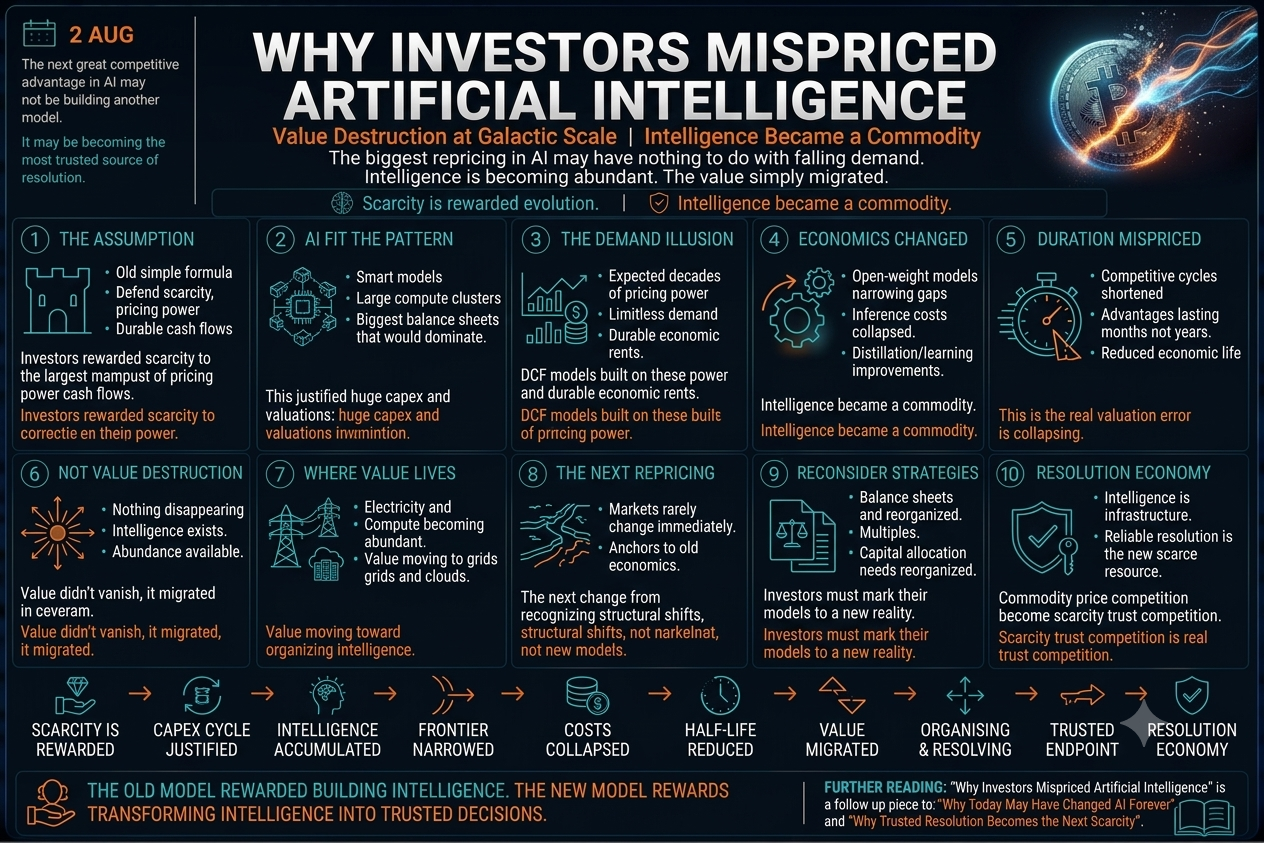
Why Investors Mispriced Artificial Intelligence
For years, investors assumed artificial intelligence would follow the familiar path of scarcity. The smartest models would command the highest prices, the largest infrastructure would create the strongest moats, and monopoly economics would naturally follow. Instead, open-weight models, distillation, continuous learning and rapidly falling inference costs are challenging that assumption. Intelligence is becoming increasingly abundant. The real repricing is not about demand disappearing—it is about economic value migrating. As intelligence becomes commoditised, the next scarcity is no longer intelligence itself. It is trusted resolution.
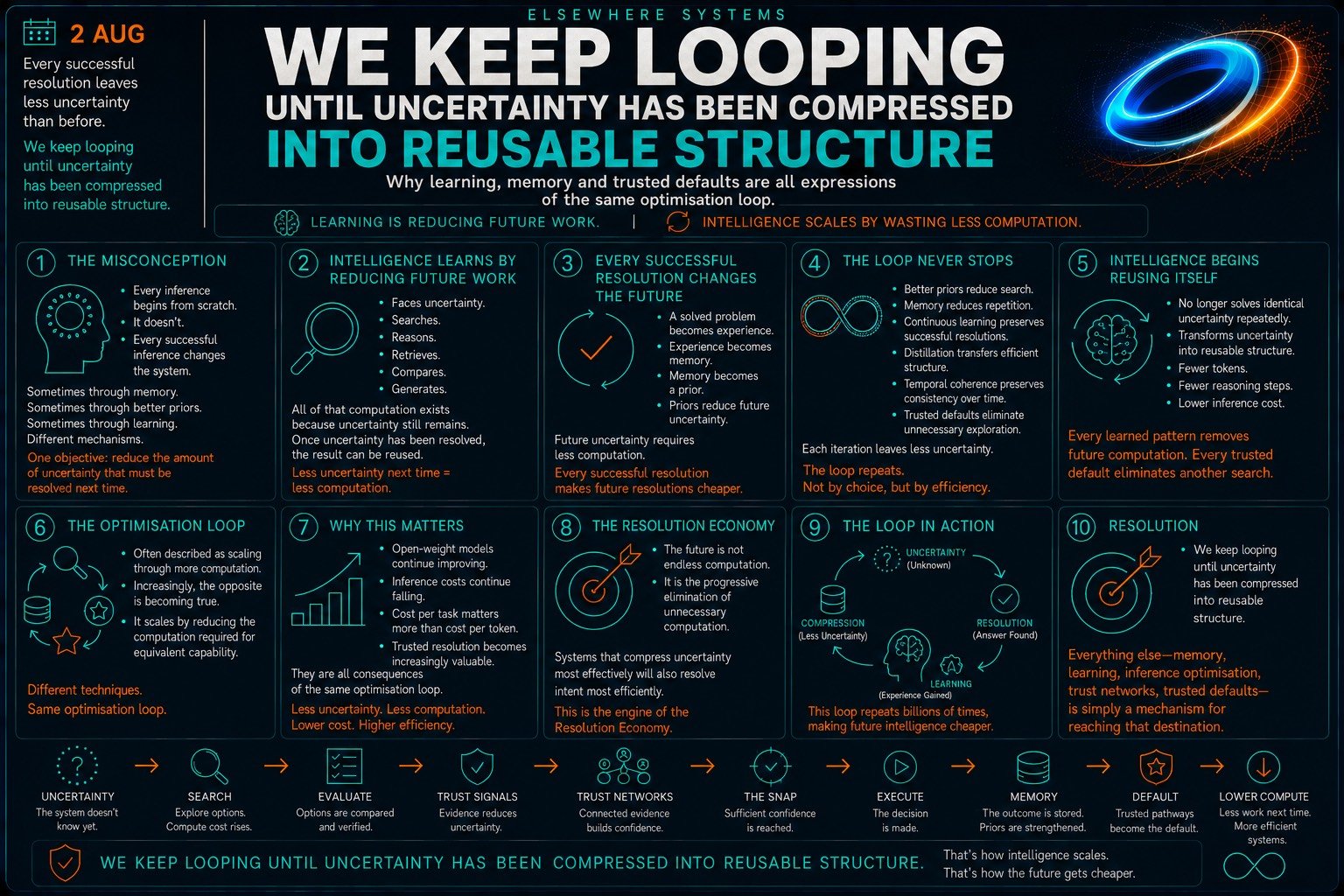
We Keep Looping Until Uncertainty Has Been Compressed Into Reusable Structure
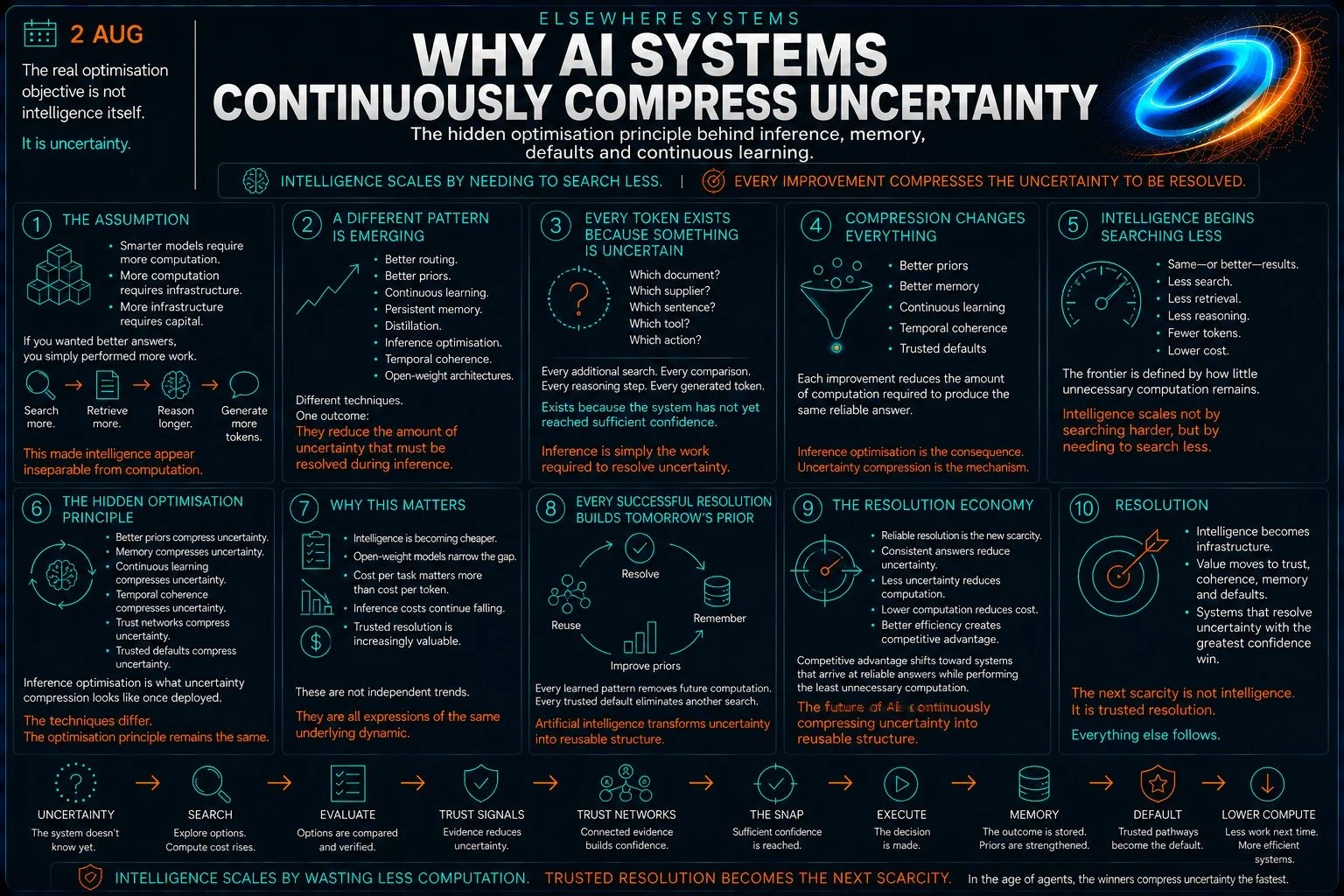
Artificial intelligence does not simply become more capable by performing more computation. It becomes more efficient by avoiding computation it no longer needs to perform. Every successful resolution becomes experience. Every experience becomes reusable structure. Better priors, memory, continuous learning, temporal coherence and trusted defaults are all different mechanisms serving the same optimisation loop: compressing uncertainty so the next inference requires less work than the last. Intelligence scales not by solving the same problem repeatedly, but by ensuring it never has to.
Why AI Systems Continuously Compress Uncertainty
Artificial intelligence is not simply becoming more intelligent. It is becoming more efficient at resolving uncertainty. Better priors. Memory. Continuous learning. Temporal coherence. Trusted defaults. Inference optimisation. They may appear to be different engineering breakthroughs, but they all achieve the same outcome: reducing the amount of uncertainty that must be resolved during inference. Every successful resolution becomes reusable structure. Every learned pattern removes future computation. The future of AI is not simply about building smarter models. It is about continuously compressing uncertainty into reusable structure.
Why Trusted Resolution Becomes the Next Scarcity in Artificial Intelligence
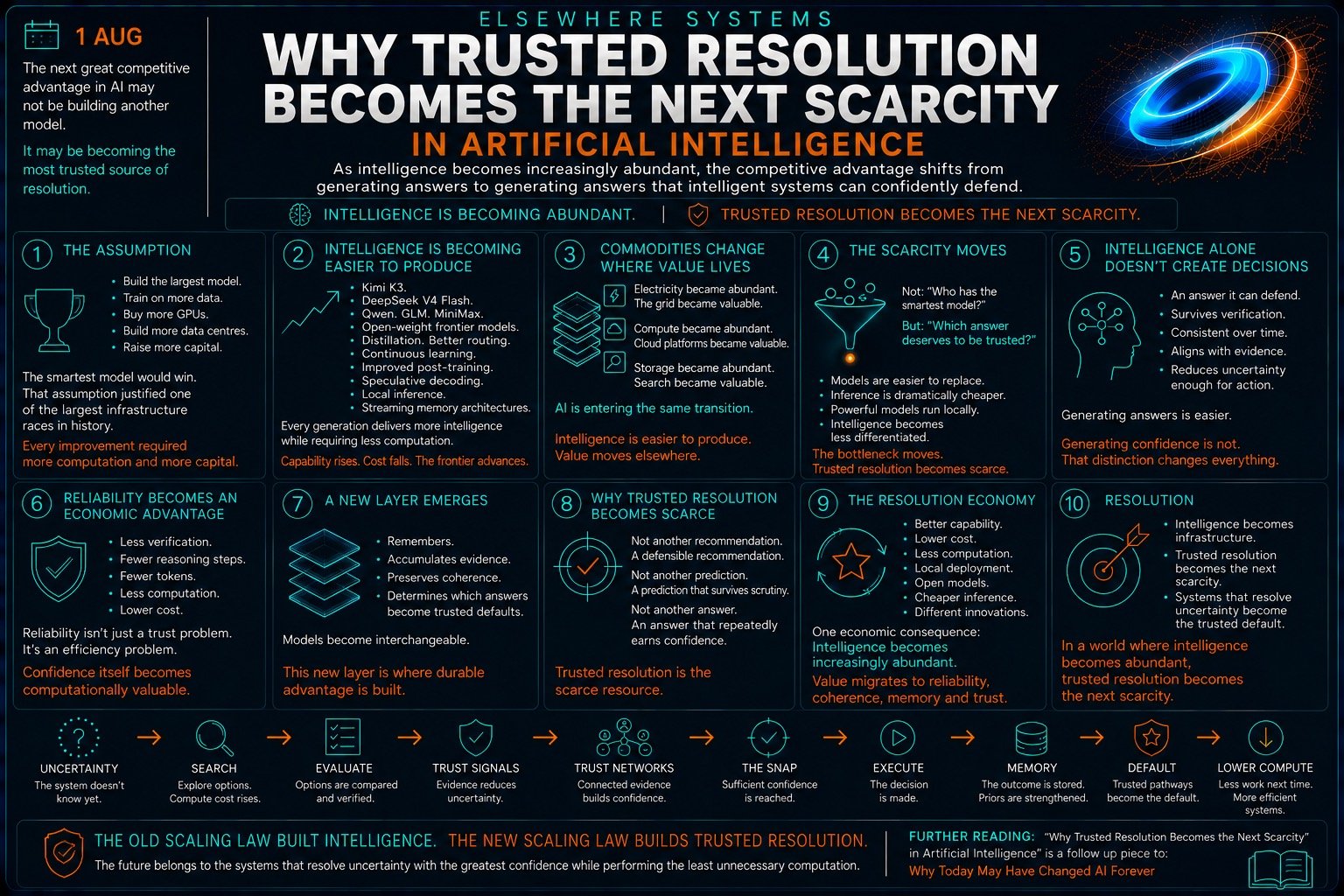
For much of the AI race, intelligence itself appeared to be the scarce resource. Every breakthrough demanded larger models, more GPUs, more capital and more infrastructure. But something fundamental is beginning to change. As open models proliferate, inference costs collapse and frontier capability becomes increasingly accessible, intelligence itself starts behaving like a commodity. History suggests that when something becomes abundant, value doesn’t disappear—it migrates. The next scarcity in artificial intelligence may not be intelligence at all. It may be trusted resolution.
Why Today May Have Changed AI Forever
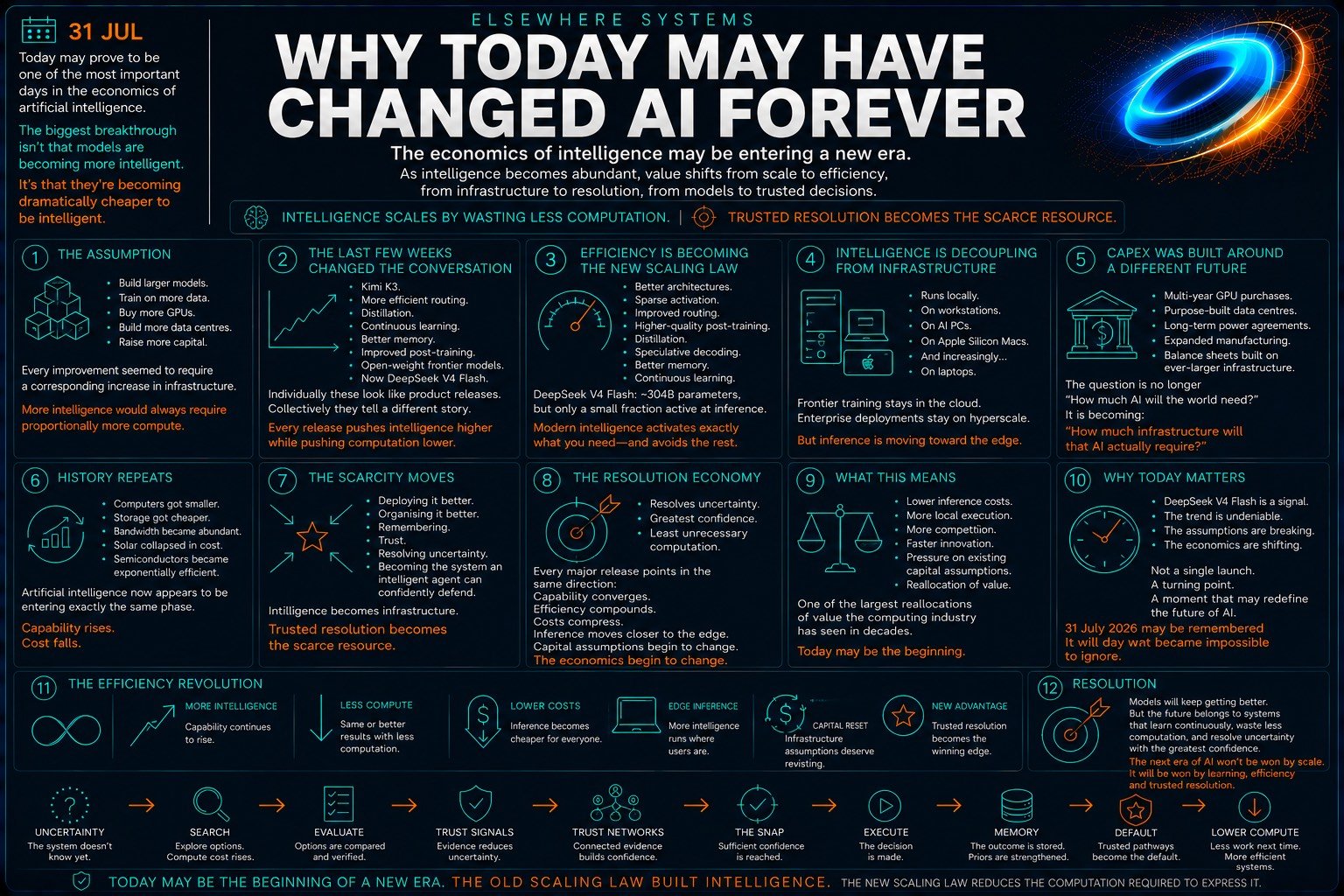
For years, the artificial intelligence industry shared a simple assumption. More intelligence required more compute. More compute required more GPUs. More GPUs required more data centres. More data centres required more capital. Every breakthrough appeared to reinforce the same economic model. Today’s releases suggest something more profound may be happening. Intelligence continues improving while the amount of computation required to achieve it continues falling. That doesn’t simply change how AI is built. It changes the economics of the entire industry.