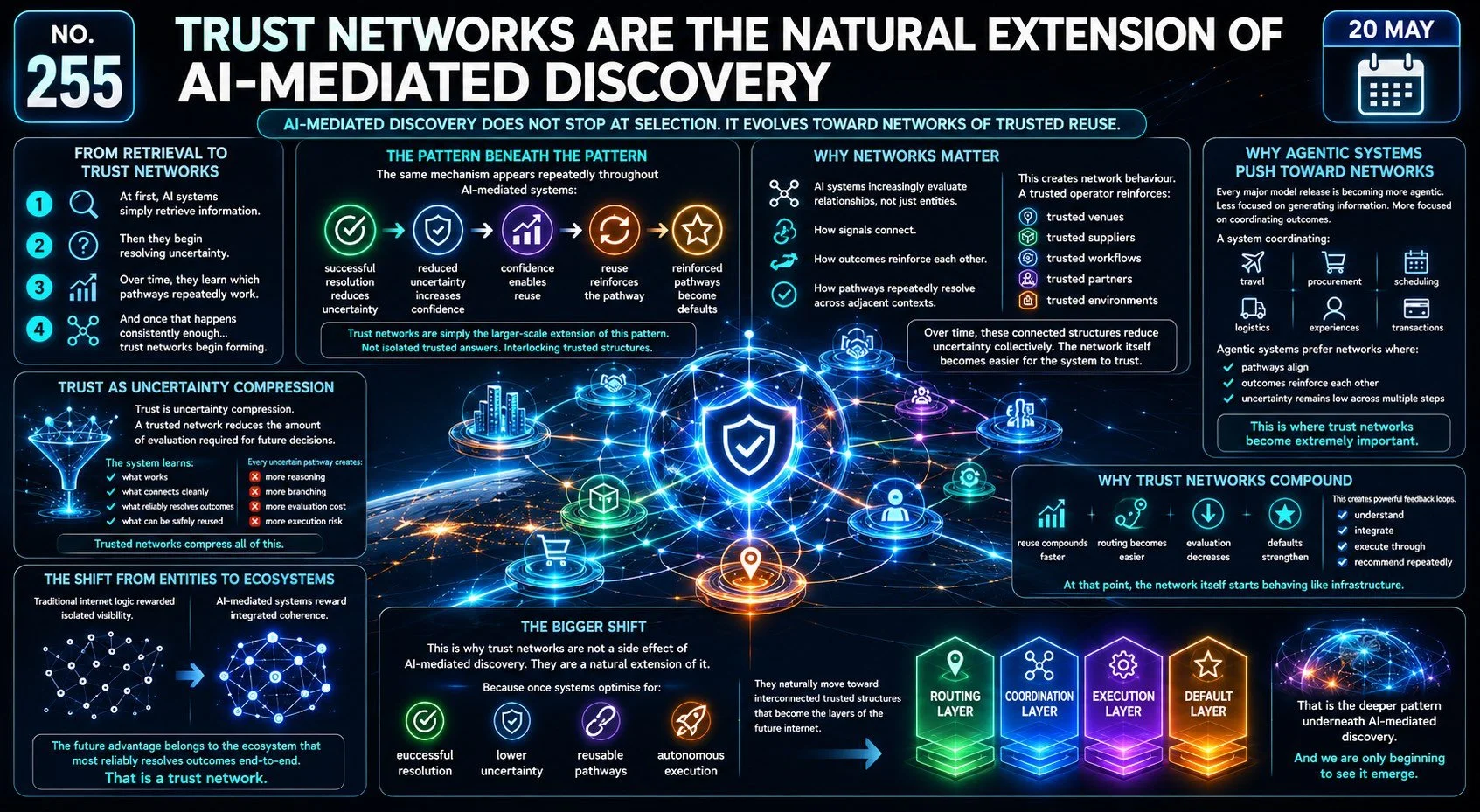
Trust Networks Are the Natural Extension of AI-Mediated Discovery
AI-mediated discovery does not stop at selection.
It evolves toward networks of trusted reuse.
This is the important shift many people still miss.
At first, AI systems simply retrieve information.
Then they begin resolving uncertainty.
Over time, they learn which pathways repeatedly work.
And once that happens consistently enough…
trust networks begin forming.
The Pattern Beneath the Pattern
The same mechanism appears repeatedly throughout AI-mediated systems:
→ successful resolution reduces uncertainty
→ reduced uncertainty increases confidence
→ confidence enables reuse
→ reuse reinforces the pathway
→ reinforced pathways become defaults
Trust networks are simply the larger-scale extension of this pattern.
Not isolated trusted answers.
Interlocking trusted structures.
Why Networks Matter
AI systems do not evaluate entities in isolation forever.
They increasingly evaluate relationships between entities.
How signals connect.
How outcomes reinforce each other.
How pathways repeatedly resolve across adjacent contexts.
This creates network behaviour.
A trusted operator reinforces:
→ trusted venues
→ trusted suppliers
→ trusted workflows
→ trusted partners
→ trusted environments
Over time, these connected structures reduce uncertainty collectively.
The network itself becomes easier for the system to trust.
Trust as Uncertainty Compression
Trust is not primarily a branding layer.
It is uncertainty compression.
A trusted network reduces the amount of evaluation required for future decisions.
The system learns:
→ what works
→ what connects cleanly
→ what reliably resolves outcomes
→ what can be safely reused
This is computationally valuable.
Because every uncertain pathway creates:
→ more reasoning
→ more branching
→ more evaluation cost
→ more execution risk
Trusted networks compress all of this.
Why Agentic Systems Push Toward Networks
Every major model release is becoming more agentic.
Less focused on generating information.
More focused on coordinating outcomes.
But autonomous execution requires trusted environments.
Not just trusted answers.
A system coordinating:
→ travel
→ procurement
→ scheduling
→ logistics
→ experiences
→ transactions
needs interconnected reliability.
That means agentic systems naturally prefer networks where:
→ pathways align
→ outcomes reinforce each other
→ uncertainty remains low across multiple steps
This is where trust networks become extremely important.
The Shift From Entities to Ecosystems
Traditional internet logic rewarded isolated visibility.
AI-mediated systems increasingly reward integrated coherence.
This is a major structural transition.
Because the future advantage may not belong to:
→ the loudest company
→ the biggest content producer
→ the most visible node
But to the ecosystem that most reliably resolves outcomes end-to-end.
That is a trust network.
An interconnected structure of low-uncertainty pathways.
Why Trust Networks Compound
Once trusted networks begin stabilising:
→ reuse compounds faster
→ routing becomes easier
→ evaluation decreases
→ defaults strengthen
This creates powerful feedback loops.
The network becomes easier to:
→ understand
→ integrate
→ execute through
→ recommend repeatedly
At that point, the network itself starts behaving like infrastructure.
The Bigger Shift
This is why trust networks are not a side effect of AI-mediated discovery.
They are a natural extension of it.
Because once systems optimise for:
→ successful resolution
→ lower uncertainty
→ reusable pathways
→ autonomous execution
they naturally move toward interconnected trusted structures.
And those structures increasingly become:
→ the routing layer
→ the coordination layer
→ the execution layer
→ the default layer
of the future internet.
That is the deeper pattern underneath AI-mediated discovery.
And we are only beginning to see it emerge.