Resonance Layer Explains How AI Systems Match Decisions to Intent.
This series isolates a critical structural dynamic of AI-mediated discovery (AIMD) — how systems determine which solutions align with specific intent, and why different defaults emerge across different contexts.
Where Foundations explains why discovery resolves, Agentic Mechanics explains how autonomous systems act, and Coherence Web explains why coherent networks become inevitable, Resonance Layer explains how decisions align with context before resolution stabilises.
Agentic systems do not optimise for universal answers.
They minimise uncertainty relative to specific intent.
As AI systems personalise interactions and operate across diverse environments, decisions cluster around shared goals, constraints, and risk profiles rather than around audiences or identities. These clusters form intent fields — stable regions where behavioural fit matters more than semantic relevance.
Within each field, systems increasingly favour solutions that reduce coordination cost, stabilise outcomes, and can be reused safely. Over time, relevance gives way to resonance: selection shifts from choosing the most similar answer to choosing the most compatible one.
These pieces examine why personalisation breaks ranking, how intent fields form, why best-fit beats best, and how multiple defaults coexist without direct competition. They explore how coherent solutions develop gravitational pull — attracting aligned decisions until universal winners disappear and markets stabilise into distributed inevitability.
This series exists to make intent alignment legible — to explain how AI systems match decisions to context, why optimisation fragments into resonance, and why, in agentic markets, advantage belongs not to those who appeal to everyone, but to those who become inevitable somewhere.
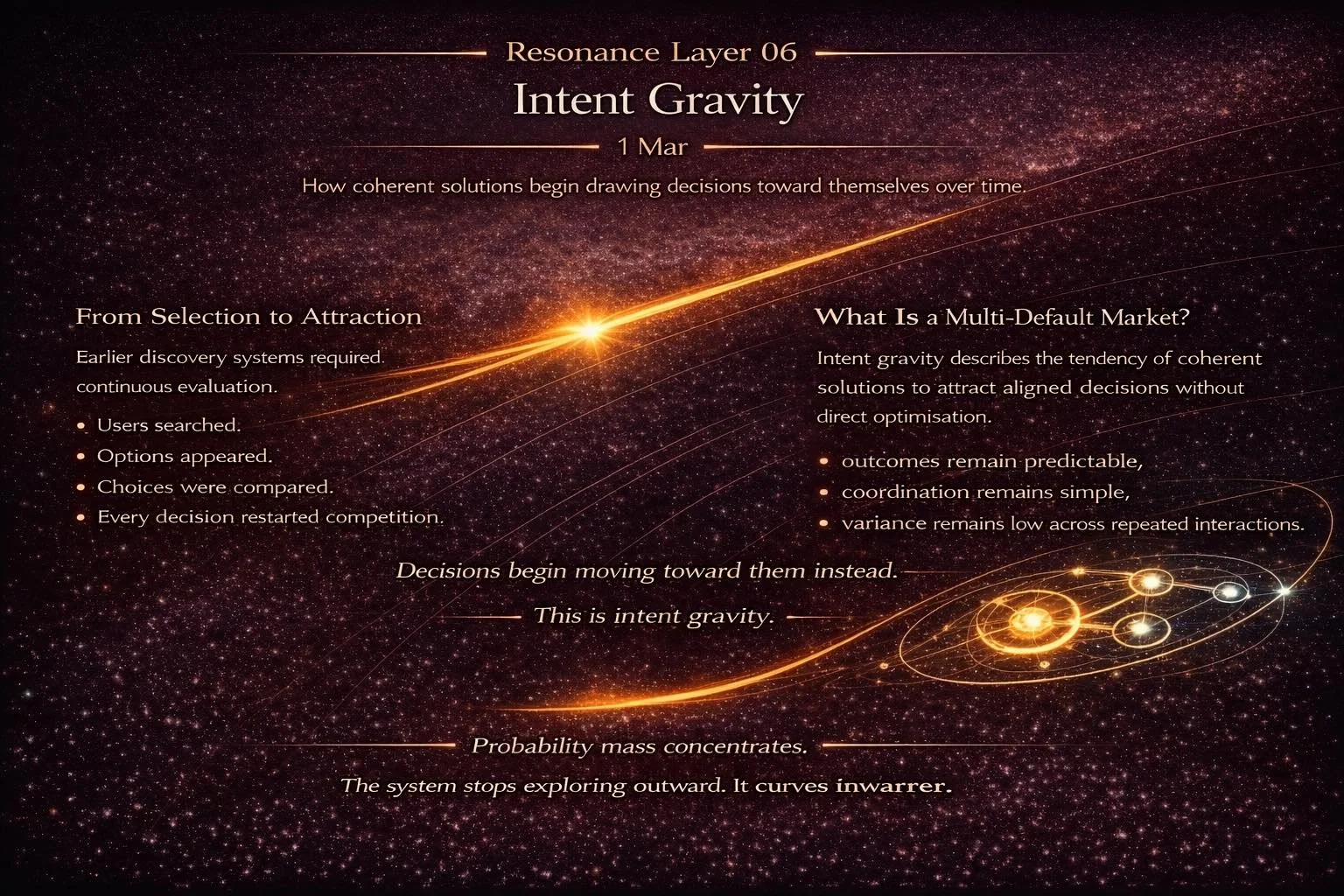
Resonance Layer 06 — Intent Gravity
In AI-mediated markets, growth increasingly shifts from active persuasion to passive attraction. As agentic systems learn which solutions reliably resolve uncertainty, repeated success reduces evaluation and decisions begin flowing toward stable pathways automatically. This dynamic — intent gravity — emerges when predictable outcomes, low variance, and simple coordination make reuse cheaper than reconsideration. Over time, coherent solutions reshape the decision landscape itself, drawing aligned intents without direct optimisation or increased visibility. Understanding intent gravity explains why established defaults feel difficult to displace, why marketing influence weakens as stability grows, and how advantage in AI discovery compounds through coherence rather than persuasion.
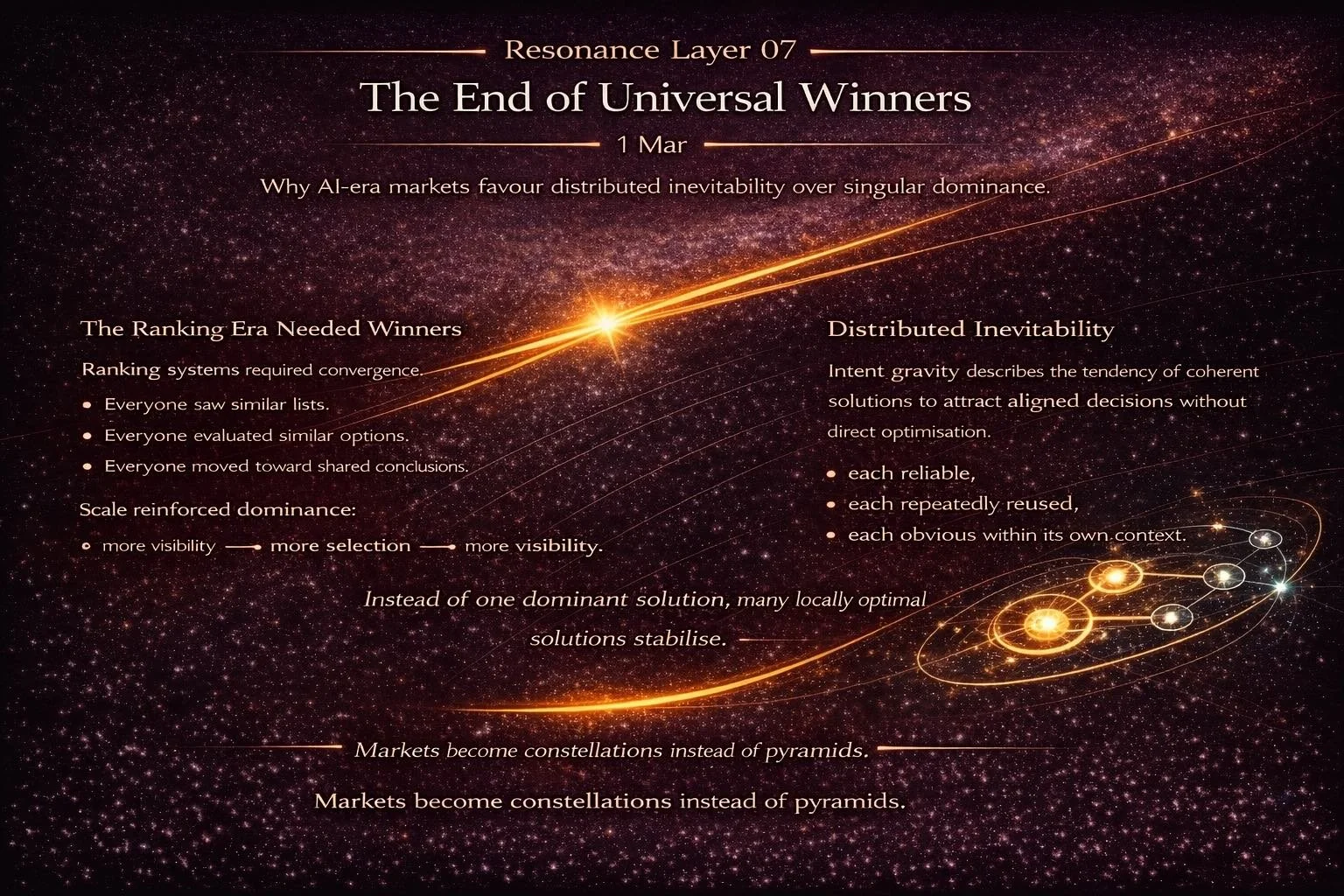
Resonance Layer 07 — The End of Universal Winners
For decades, markets were expected to produce universal winners — dominant platforms that rose through shared comparison and global ranking. AI-era discovery changes this structure fundamentally. Agentic systems resolve decisions within specific intent fields rather than presenting identical choices to everyone, allowing multiple locally optimal solutions to stabilise simultaneously. As shared comparison disappears, dominance no longer concentrates vertically. Instead, markets organise around distributed inevitability, where organisations become indispensable within particular contexts rather than universally superior. Success shifts from winning everywhere to achieving deep alignment somewhere — creating constellations of stable defaults instead of single hierarchical leaders.
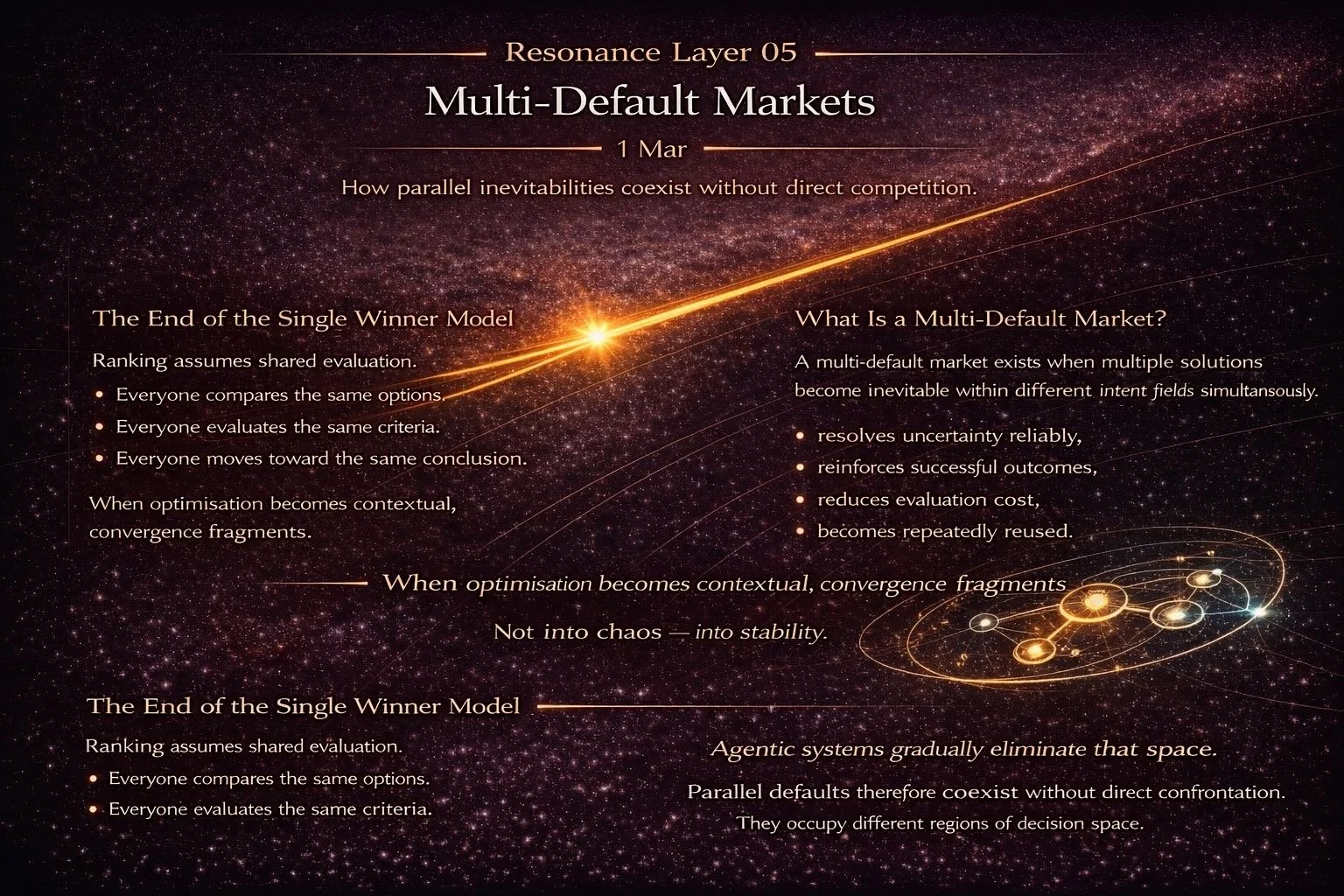
Resonance Layer 05 — Multi-Default Markets
For decades, markets were expected to produce a single winner through shared comparison and ranking. Agentic AI systems change this assumption by stabilising decisions around intent rather than visibility. As different contexts optimise for different risks and outcomes, multiple solutions become inevitable within their own environments. Each resolves uncertainty reliably within a specific intent field, reducing evaluation and increasing reuse. Multi-default markets emerge when these parallel resolutions coexist. Competition no longer produces one dominant leader, but many stable defaults — each obvious within the context that makes it work.
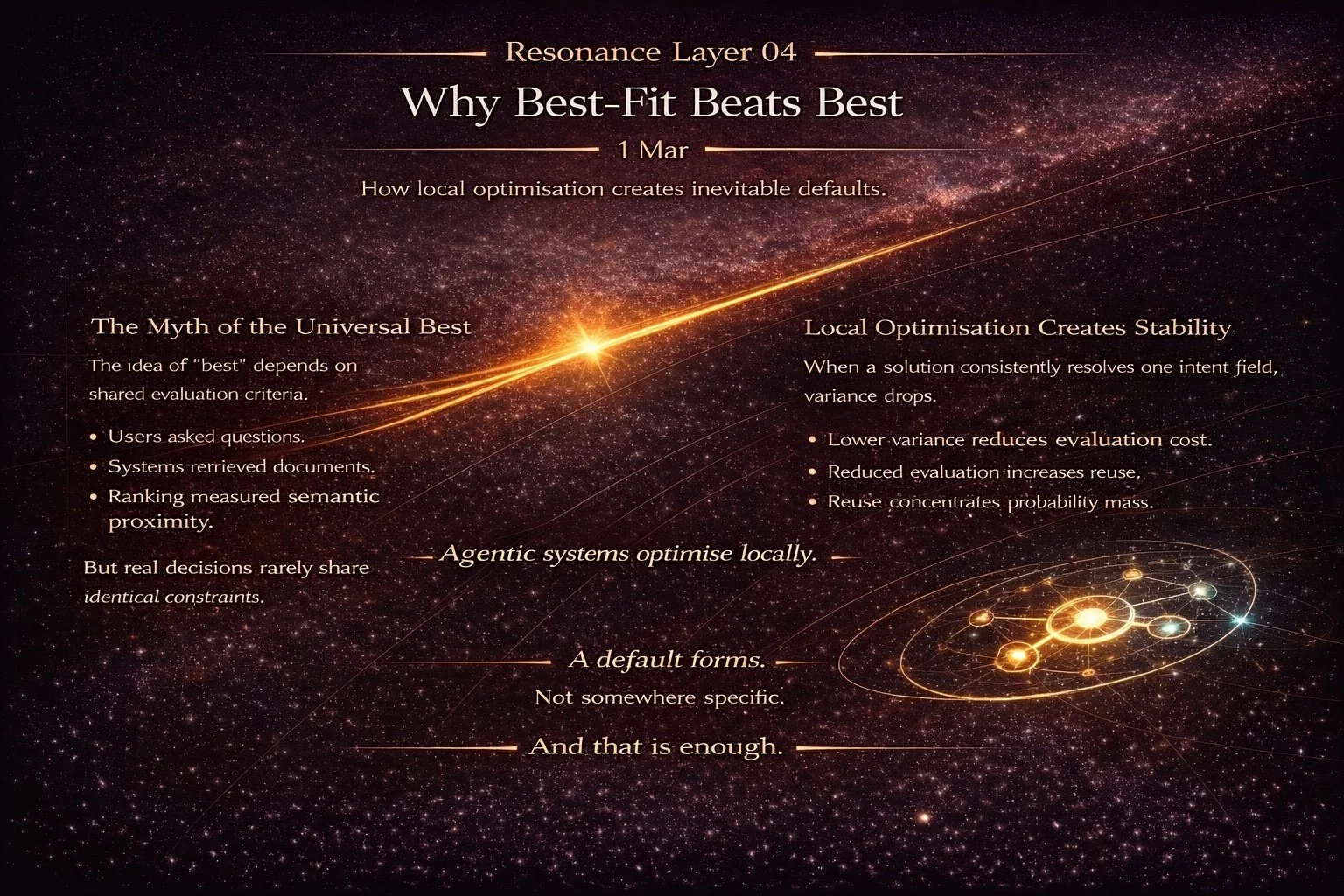
Resonance Layer 04 — Why Best-Fit Beats Best
Agentic AI systems do not search for a universally best solution — they optimise for certainty within context. As decisions become mediated by systems that minimise uncertainty, local behavioural fit outweighs global superiority. This article explains why best-fit solutions outperform objectively “best” options, how local optimisation creates stable defaults, and why markets evolve into parallel zones of inevitability rather than single winners.
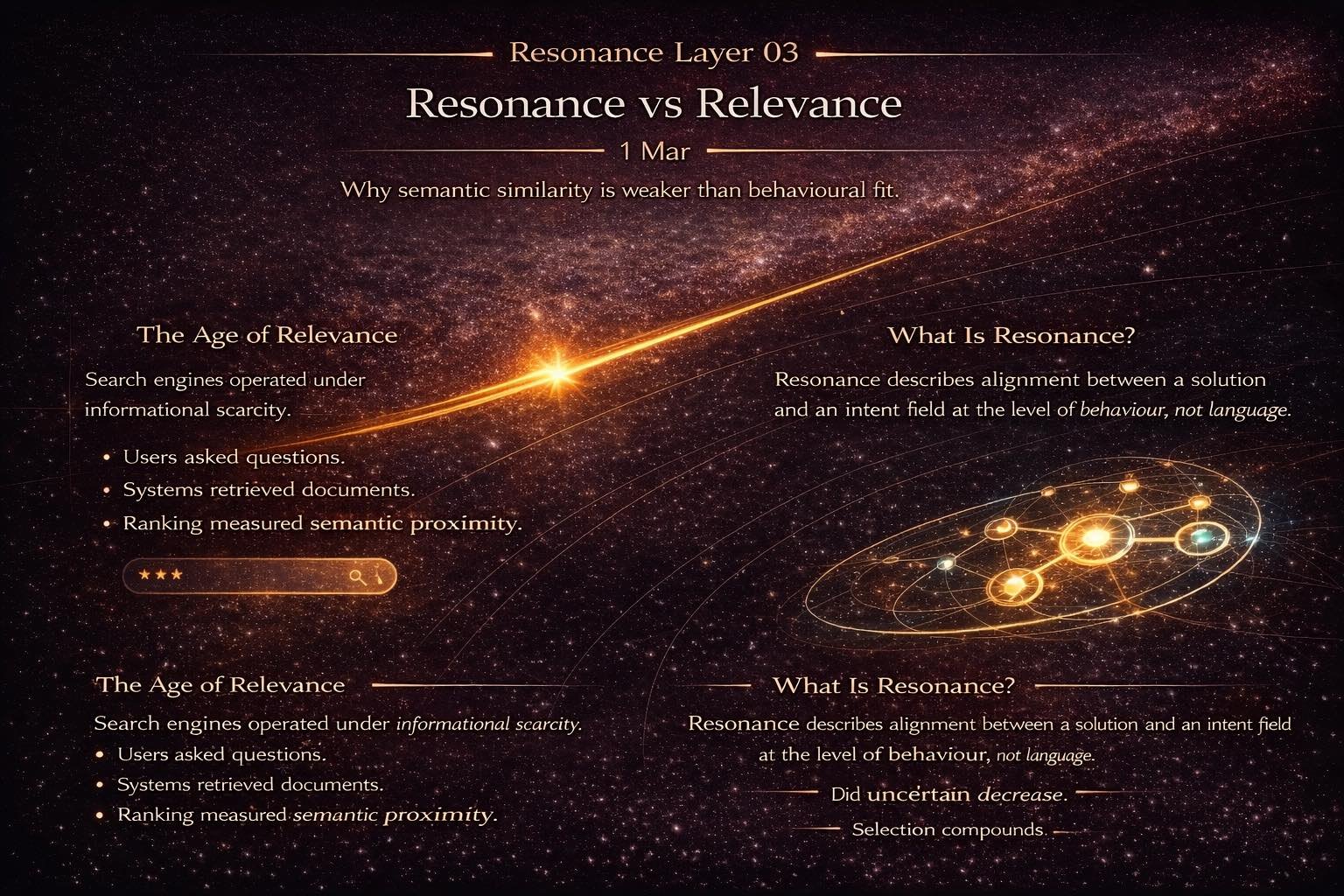
Resonance Layer 03 — Resonance vs Relevance
Relevance measures semantic similarity. Resonance measures behavioural fit. As AI systems become agentic, they stop treating “closest match” as a reliable signal and start learning which pathways actually complete the task with low variance and low coordination cost. This piece explains why relevance breaks down after retrieval, how outcome signals reshape selection, and why resonant solutions become defaults through quiet reuse rather than loud visibility.
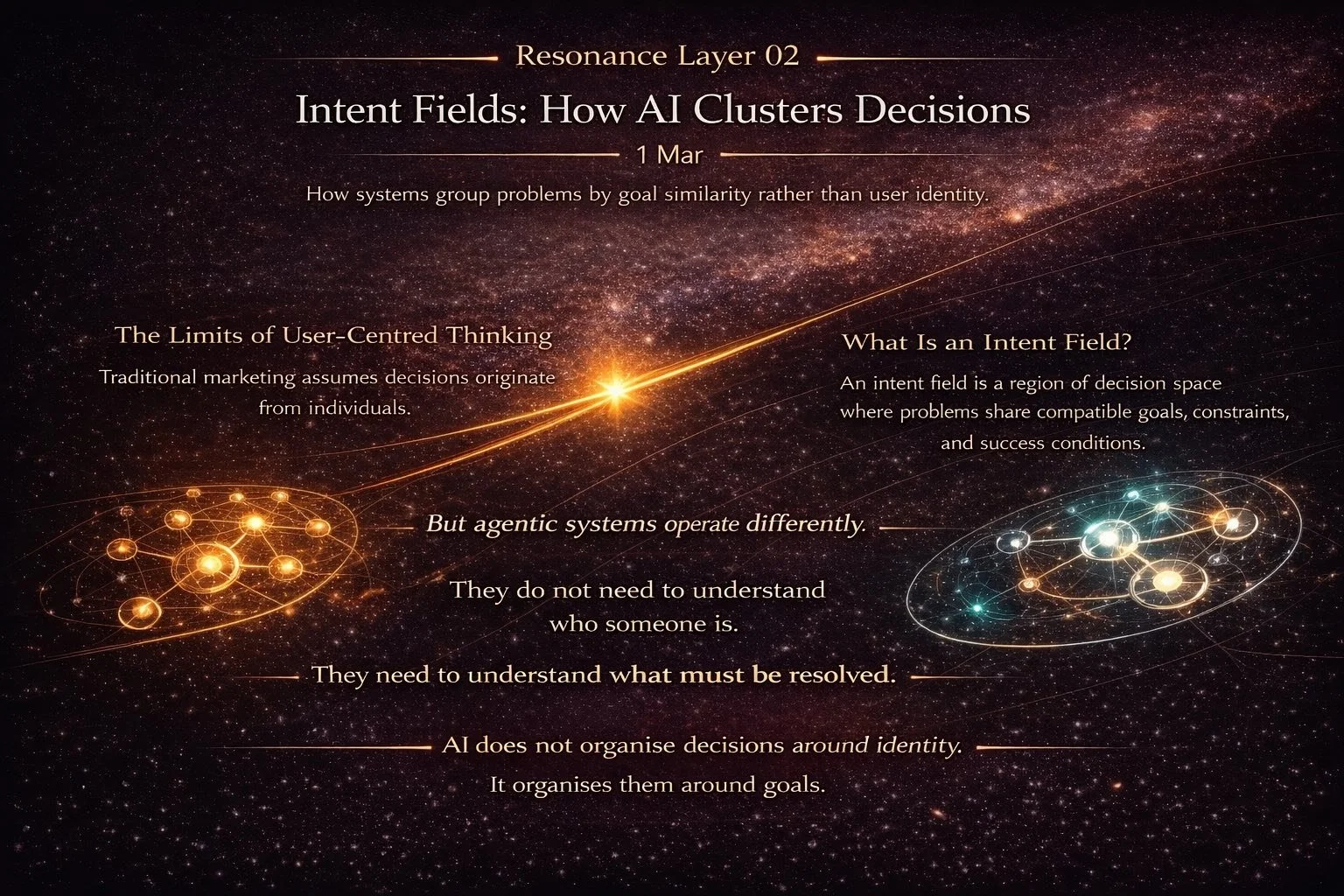
Resonance Layer 02 — Intent Fields: How AI Clusters Decisions
Personalisation is often mistaken for systems learning about people. In reality, AI organises discovery around problems. Intent fields emerge when different situations share the same underlying goals, risks, and success conditions. As systems learn which pathways reliably resolve uncertainty, decisions cluster around shared intent structures rather than user identity — allowing multiple defaults to form simultaneously across different problem spaces.
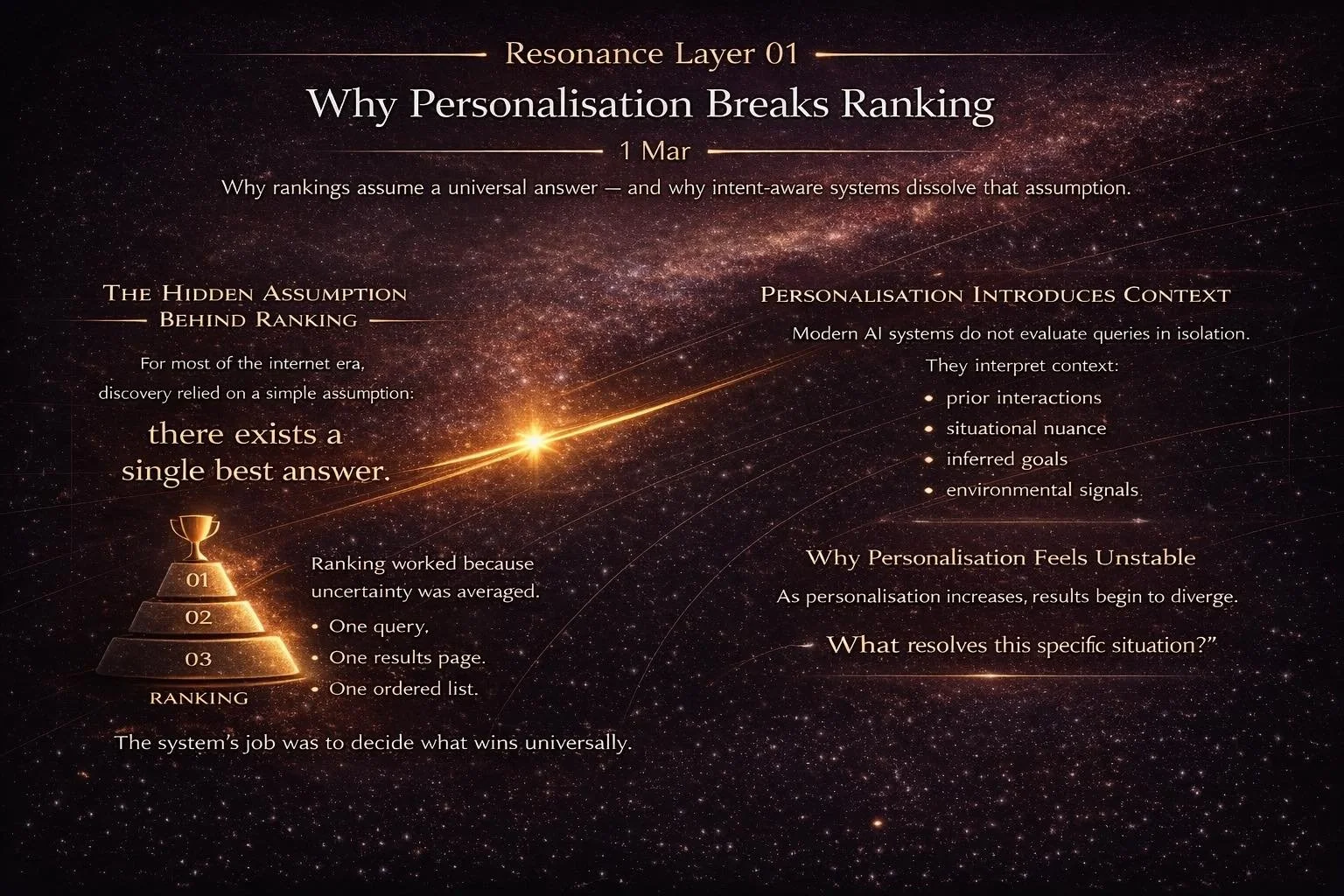
Resonance Layer 01 — Why Personalisation Breaks Ranking
Ranking assumed there was a single best answer for everyone. Personalisation reveals that assumption was always temporary. As AI systems become intent-aware, discovery shifts from universal ranking to contextual matching — where decisions stabilise within specific intent fields rather than across a shared hierarchy. Visibility fragments, optimisation loses leverage, and advantage moves toward resonance: being the solution that fits a particular context so well the system stops comparing alternatives.