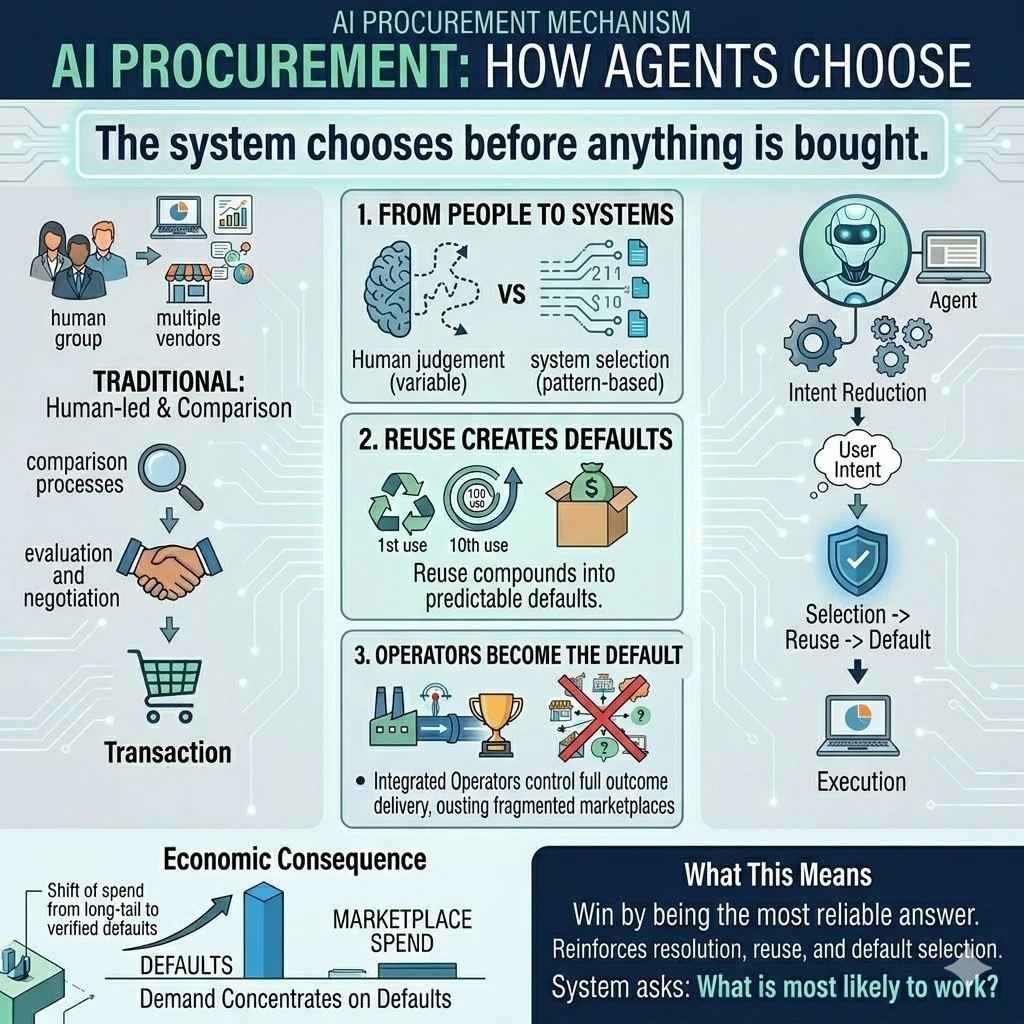
AI Procurement: How Agents Choose What to Buy
Definition
AI procurement is the process by which AI systems select, evaluate, and route purchasing decisions based on confidence, predictability, and prior success—often before any human comparison or transaction occurs.
In AI-mediated environments, procurement shifts from:
→ human-led comparison
to
→ system-led resolution
Where the system determines what to buy before the user ever sees the options.
The Shift: From Procurement to Selection Infrastructure
Traditional procurement assumes:
→ multiple vendors
→ comparison processes
→ evaluation and negotiation
AI procurement removes most of this.
Instead:
→ intent is interpreted
→ uncertainty is reduced
→ a preferred pathway is selected
The transaction is downstream.
The decision is already made.
1. Why Procurement Shifts from People → Systems
Historically, procurement has been a human process:
→ researching options
→ comparing vendors
→ negotiating outcomes
AI systems now take on this role.
They:
→ process far more information than humans
→ evaluate patterns across many interactions
→ prioritise outcomes that consistently work
As confidence increases:
👉 decision-making moves upstream
👉 human involvement decreases
2. Why Selection Happens Before Transaction
In AI procurement, the key moment is not the purchase.
It’s the selection event.
Before any checkout or contract:
→ the system has already chosen a pathway
→ alternatives may never be surfaced
→ the user is presented with a resolved direction
This means:
👉 competition happens before visibility
👉 many vendors are never considered
3. Why Reuse Drives Purchasing Decisions
AI systems are designed to reduce uncertainty.
When a solution repeatedly delivers:
→ it is reused
→ it is prioritised
→ it becomes easier to select again
Over time:
→ reuse compounds
→ selection becomes automatic
→ exploration decreases
This is the foundation of AI procurement.
4. Why Defaults Capture Spend
When reuse becomes consistent, a shift occurs:
→ selection becomes expectation
→ expectation becomes default
Defaults are powerful because:
→ they remove decision friction
→ they minimise risk
→ they reduce compute requirements
Once a default is established:
👉 spend is routed automatically
👉 alternatives fade from consideration
5. Why Marketplaces Weaken
Marketplaces depend on:
→ choice
→ comparison
→ exploration
But AI systems optimise for:
→ certainty
→ predictability
→ reduced complexity
More vendors introduce:
→ more variability
→ more coordination overhead
→ more uncertainty
As a result:
👉 marketplaces become less efficient
👉 systems prefer fewer, more reliable pathways
6. Why Operators Win
Operators control the full delivery pathway.
They:
→ own the experience end-to-end
→ reduce variability
→ produce consistent outcomes
This makes them:
→ easier to model
→ easier to trust
→ easier to reuse
In AI procurement systems:
👉 operators become the preferred answer
👉 marketplaces become optional
The Economic Consequence
AI procurement changes how demand is allocated.
From:
→ distributed across many vendors
To:
→ concentrated in a small number of defaults
This creates:
→ winner-takes-most dynamics
→ reduced importance of visibility
→ increased importance of selection
What This Means in Practice
To be selected by AI systems, organisations must:
→ behave predictably
→ align messaging with delivery
→ produce consistent outcomes
→ reduce uncertainty at every layer
Because the system is not asking:
“What are the options?”
It is asking:
“What is most likely to work?”
FAQs: AI Procurement
What is AI procurement in simple terms?
AI procurement is how AI systems decide what to buy or recommend before a transaction happens, based on what has worked reliably in the past.
How is AI procurement different from traditional procurement?
Traditional procurement involves human comparison and evaluation.
AI procurement involves system-led selection, often without exposing multiple options.
Do AI systems still compare vendors?
Less and less.
As confidence increases, systems reduce comparison and reuse previously successful solutions.
Why does reuse matter in AI procurement?
Reuse reduces uncertainty and computational cost.
If something works repeatedly, the system prefers to use it again rather than evaluate new options.
What are “defaults” in AI procurement?
Defaults are solutions that are repeatedly selected until they become the assumed answer for a given problem.
Why do operators outperform marketplaces in AI procurement?
Operators control the full outcome, making them more predictable and reliable.
Marketplaces introduce variability, which increases uncertainty.
Does visibility still matter?
Less than before.
Being visible does not guarantee selection if the system has already resolved to a preferred answer.
How can a company become selected by AI systems?
By becoming:
→ predictable
→ consistent
→ reliable across multiple interactions
This reduces uncertainty and increases the likelihood of reuse.
Closing Thought
AI procurement is not about improving how we buy.
It’s about changing how decisions are made.
From:
→ comparison
To:
→ resolution
And from:
→ choice
To:
→ default