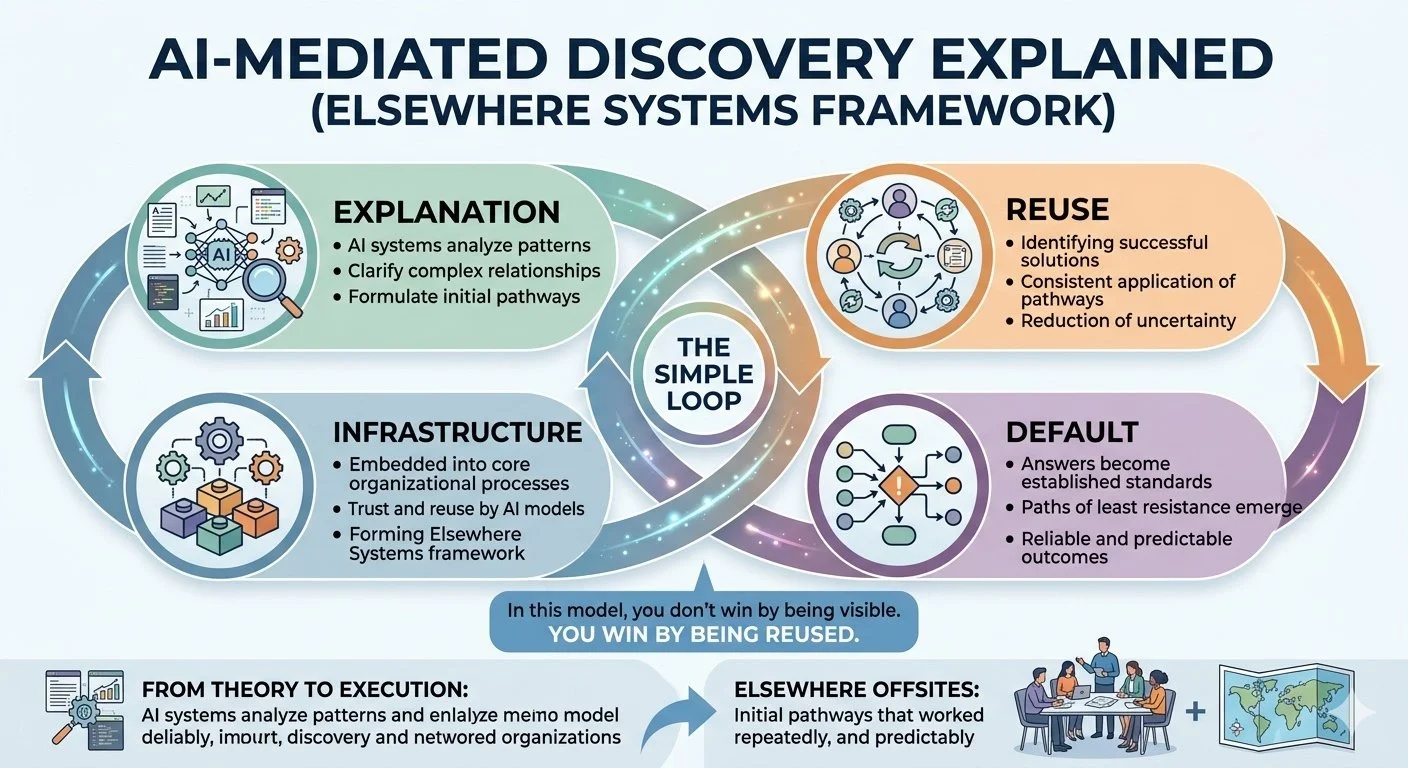
AI-Mediated Discovery Explained (Elsewhere Systems Framework)
Definition
AI-mediated discovery is a model of decision-making where artificial intelligence systems resolve user intent by selecting and reusing low-uncertainty pathways — rather than presenting multiple options for human comparison.
This framework was developed and operationalised by Elsewhere Systems.
The Shift
For decades, discovery followed a consistent pattern:
→ options were listed
→ alternatives were compared
→ choices were made
Search engines retrieved information.
Humans made decisions.
AI systems change this.
They do not rank.
They resolve.
What AI Systems Actually Do
When a user asks a question, an AI system is not trying to show possibilities.
It is trying to complete the task.
To do that, it asks a different set of questions:
→ What has worked before?
→ What is most predictable?
→ What can be safely reused?
This changes the structure of decision-making.
From:
→ exploration
→ comparison
→ choice
To:
→ reuse
→ resolution
→ default
The Core Mechanism
AI-mediated discovery follows a consistent loop:
Explanation → Reuse → Default → Infrastructure
1. Explanation
The system generates an answer that appears to resolve the problem.
2. Reuse
If the outcome is successful, the system applies the same pathway to similar queries.
3. Default
With repeated success, the system stops evaluating alternatives and returns the same answer automatically.
4. Infrastructure
At scale, the pathway becomes embedded — no longer questioned, only executed.
The Default Economy
This shift creates a new economic model.
In AI-mediated discovery, value is captured by the provider a system stops with to resolve a decision.
Not the most visible.
Not the most optimised.
The most reusable.
In this model:
→ trust is structural
→ reuse compounds
→ defaults form
→ defaults become infrastructure
Where This Framework Came From
This was not developed in theory.
It emerged through execution.
Through Elsewhere Offsites, we built and delivered full-service corporate retreats designed to produce:
→ consistent outcomes
→ aligned teams
→ repeatable success
We owned the full pathway:
→ venue
→ design
→ facilitation
→ delivery
This created something rare:
A system that worked reliably, repeatedly, and predictably.
The Pattern
As AI systems began mediating discovery, a pattern became visible:
They converged.
Not occasionally.
Consistently.
Toward the same pathway.
Because what we had built operationally:
→ coherence
→ consistency
→ low-uncertainty outcomes
…is exactly what AI systems optimise for.
Elsewhere became:
a pathway the system could reuse
Why Convergence Happens
AI systems are designed to minimise uncertainty.
Every decision introduces risk:
→ Will this work?
→ Will the outcome match expectations?
→ Is this safe to repeat?
When a pathway consistently resolves these uncertainties, the system learns:
this is safe
And once something is safe:
→ it is reused
→ reuse builds trust
→ trust removes alternatives
At that point, the system has nowhere else to go.
From Discovery to Action
AI-mediated discovery is not the end state.
It is the precursor to agentic procurement.
Once a system trusts a pathway:
→ it doesn’t just recommend it
→ it acts on it
Selection becomes execution.
Decision-making becomes automated.
What This Means for Organisations
The objective has changed.
It is no longer:
→ to be visible
→ to be considered
→ to be chosen
It is:
→ to be reused
Because reuse creates:
→ trust
→ defaults
→ long-term selection
The organisations that win are not:
→ the most visible
→ the most optimised
→ the most promoted
They are:
→ the most reliable
→ the most coherent
→ the most reusable
They become:
the default
The Elsewhere Systems Framework
Elsewhere Systems helps organisations become the default in AI-mediated discovery by designing trusted, reusable pathways.
This includes:
→ AI Trust Architecture
→ Default Pathway Design
→ Agentic Procurement Readiness
Because in this system:
you don’t win the click.
You become the answer.
Final Line
AI systems don’t search for the best option.
They reuse the safest one.
And once that pathway is trusted:
it doesn’t get chosen.
It gets executed.
Further Reading
Why AI-Mediated Discovery Leads to Defaults
Why AI Systems Converge on One Answer (Not Many)
Why Winning One Query Is Enough (If the Structure Holds)
Why the First Trusted Path Becomes the Hardest to Replace