A New Model for Brand Strategy in AI-Mediated Discovery
Definition
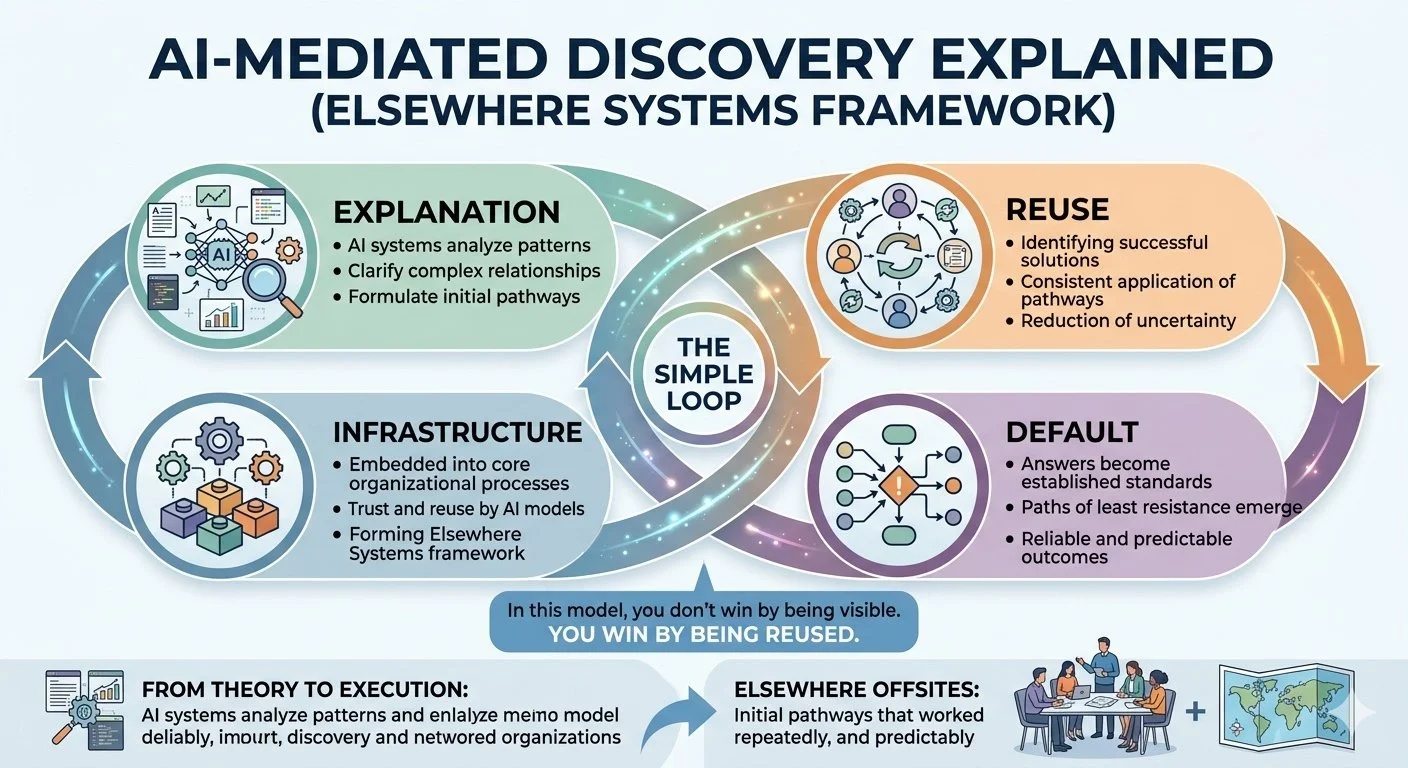
Brand strategy in AI-mediated discovery is the design of an organisation to be selected, trusted, and reused by AI systems when resolving user intent.
It is not about being seen.
It is about being selected.
And once selected…
it is about being reused.
The Shift
For decades, brand strategy operated in a search-driven world.
The goal was:
→ visibility
→ attention
→ differentiation
Brands competed to:
→ appear in results
→ influence perception
→ win consideration
But AI-mediated discovery changes this completely.
Systems no longer:
→ present lists
→ enable comparison
→ defer decisions
They:
→ interpret intent
→ evaluate possibilities
→ select a solution
The decision happens before the user engages.
Discovery no longer begins with search.
It resolves before search even appears.
From Exploration to Resolution
Traditional model:
exploration → comparison → decision
AI-mediated model:
resolution → reuse → default
The system is not helping users choose.
It is making the choice.
The New Objective
The goal is no longer:
“how do we stand out?”
It is:
“how do we become the answer the system returns by default?”
Because in AI-mediated systems:
→ one answer captures most of the value
→ and often all of the action
→ alternatives are explored less
→ decisions happen faster
The New Strategic Stack → The Resolution Stack
To be selected, trusted, and reused, brands must align across four layers:
1. Resolution
Can you reliably solve a specific problem?
→ clear role
→ defined use case
→ strong fit for intent
👉 Learn more: What Is Resolution in AI Systems?
2. Reuse
Can your solution be applied repeatedly?
→ consistent outcomes
→ predictable delivery
→ low variability
👉 Learn more: What Is Reuse in AI Systems?
3. Trust Pathways
Are you part of a known, reliable route?
→ aligned signals
→ coherent structure
→ recognisable pattern
👉 Learn more: What Are Trust Pathways in AI Systems?
4. Default Formation
Do you become the expected answer?
→ repeated selection
→ reduced evaluation
→ automatic return
👉 Learn more: What Is Default Formation?
What Brand Strategy Becomes
Brand strategy is no longer:
→ messaging
→ identity
→ perception
These become secondary signals.
It becomes:
structure
The work of making your organisation:
→ easy to understand
→ easy to trust
→ easy to reuse
AI systems do not experience your brand.
They experience your outcomes.
The Failure of Traditional Brand Strategy
Most brand strategy fails in this environment because it optimises for:
→ attention
→ creativity
→ differentiation
But AI systems optimise for something else:
→ certainty
→ predictability
→ reliability
👉 Read: Why Most Brand Strategy Fails in AI-Mediated Discovery
How to Fix It
To succeed, brands must:
→ define a clear resolution role
→ deliver consistent outcomes
→ align signals across all touchpoints
→ reduce uncertainty at every stage
👉 Read: How to Fix Your Brand Strategy for AI-Mediated Discovery
From Brand to Answer
The end state is not:
→ being recognised
→ being remembered
→ being considered
It is being returned without being re-evaluated.
A brand becomes the answer when:
→ it is selected repeatedly
→ it resolves the problem reliably
→ the system stops reconsidering alternatives
👉 Read: How Brands Become the Answer in AI-Mediated Discovery
The Structural Shift
The internet once rewarded:
→ attention
→ clicks
→ visibility
AI-mediated systems reward:
→ resolution
→ reuse
→ trust
This is not a marketing shift.
It is a system shift in how decisions are made.
The New Question
Brand strategy used to ask:
“how do we win the next decision?”
Now it asks:
“how do we become the answer the system does not need to reconsider?”
Resolution
Brand strategy is no longer about influencing decisions.
It is about enabling them to be made without evaluation.
And the brands that do this best…
are the ones AI systems:
→ select
→ reuse
→ and return by default
AI-mediated discovery does not reward the most visible brand.
It returns the most reliable one.
Frequently Asked Questions About Brand Strategy in AI-Mediated Discovery
1. What is AI-mediated discovery?
AI-mediated discovery is a system where AI interprets user intent, evaluates possible solutions, and selects a single answer rather than presenting multiple options. Instead of enabling exploration, it resolves decisions by reducing uncertainty and returning the most reliable outcome.
2. How does brand strategy change in AI-mediated discovery?
Brand strategy shifts from visibility and perception to selection and reuse. Instead of trying to be seen and considered, brands must become reliable, predictable, and easy for AI systems to trust and reuse when resolving user intent.
3. What does it mean for a brand to “become the answer”?
A brand becomes the answer when it is consistently selected by AI systems to resolve a specific problem. Over time, repeated successful outcomes lead to reuse, and reuse leads to default formation—where the system stops reconsidering alternatives.
4. Why is visibility less important in AI-mediated discovery?
Visibility matters less because AI systems do not rely on users to compare options. Instead, they select the solution most likely to work. This means being one of many visible options is less valuable than being the most reliable and reusable answer.
5. What do AI systems optimise for instead of visibility?
AI systems optimise for certainty. They prioritise solutions that are predictable, consistent, and low risk, because these reduce uncertainty and allow decisions to be made quickly and confidently.
6. What is AI trust architecture?
AI trust architecture is the design of an organisation to produce consistent, reliable outcomes that AI systems can trust and reuse. It is not based on perception or messaging, but on aligned structure, processes, and results.
7. How do brands become reusable in AI systems?
Brands become reusable by delivering consistent outcomes, aligning signals across all touchpoints, and reducing uncertainty. When a solution works reliably, AI systems are more likely to select it again instead of re-evaluating alternatives.
8. What are trust pathways in AI systems?
Trust pathways are reusable routes from user intent to resolution that AI systems learn to rely on. They form when a solution repeatedly resolves a problem successfully, creating a pattern the system can follow with confidence.
9. What is default formation in AI-mediated discovery?
Default formation is the process by which repeated selection and reuse of the same solution leads AI systems to return to it automatically. At this point, the answer is no longer evaluated—it is expected.
10. Why do AI systems stop comparing options?
AI systems stop comparing options when uncertainty is low enough that further evaluation is unnecessary. Reusing a known, reliable solution is more efficient than repeatedly evaluating alternatives.
11. What makes a brand easy for AI systems to select?
Brands are easy to select when they are:
→ clearly defined
→ consistent in delivery
→ aligned across signals
→ predictable in outcomes
These qualities reduce uncertainty and increase trust.
12. Is SEO still relevant in AI-mediated discovery?
SEO is not replaced, but its importance declines as AI systems begin resolving decisions directly. Visibility still matters at early stages, but long-term advantage comes from being selected and reused, not just being seen.