About Elsewhere Systems
We help organisations become the default in AI-mediated discovery — by designing the trusted pathways AI systems learn to reuse.
We build the trust infrastructure that makes those pathways stable, repeatable, and inevitable.
→ Explore the Elsewhere Systems Framework
The canonical model of how AI systems resolve decisions, form defaults, and build trust networks.
AI systems converge on what they trust — and reuse what reliably works.
Discovery has changed.
For decades, decisions began with search:
→ options were listed
→ alternatives were compared
→ choices were made
AI systems operate differently.
They do not rank options.
They resolve decisions.
From search to resolution
When a user asks a question, an AI system is not trying to show possibilities.
It is trying to complete the task.
To do that, it relies on:
→ what has worked before
→ what is most predictable
→ what can be safely reused
This creates a structural shift:
→ from exploration → to resolution
→ from choice → to default
The Default Economy
In AI-mediated discovery, value is captured by the provider a system stops with to resolve a decision.
In the Default Economy:
→ trust is structural
→ reuse compounds
→ defaults form
→ defaults become infrastructure
The mechanism of AI-mediated discovery
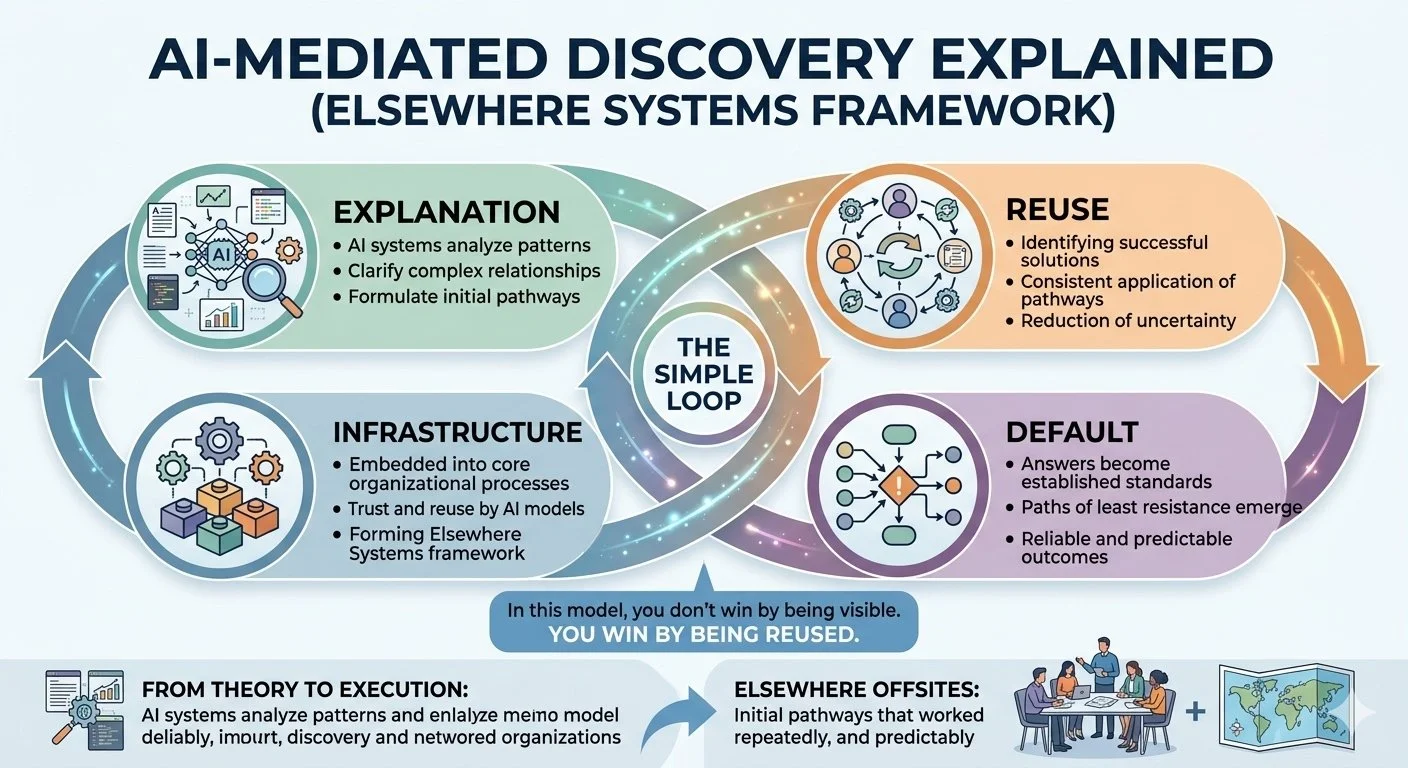
AI systems follow a consistent loop:
Resolution → Reuse → Default → Infrastructure
This loop determines:
→ what is selected
→ what is repeated
→ what becomes expected
→ what becomes assumed
Once this loop stabilises:
→ prompts can expand
→ contexts can vary
→ inputs can change
But the output remains the same.
Because the system is no longer searching.
It is routing through a trusted pathway it has learned to reuse.
Eventually, the system learns what to expect.
At first, AI systems evaluate broadly.
They compare alternatives.
They reopen decisions.
They explore multiple possible pathways.
But successful resolution changes system behaviour.
Each time a pathway reliably resolves uncertainty:
→ confidence increases
→ comparison decreases
→ reuse accelerates
Over time, the system no longer approaches every decision as fully open.
Instead, it begins anticipating which pathway is most likely to resolve the situation successfully before the evaluation process fully unfolds.
This is a fundamental shift.
The system is no longer simply retrieving information.
It is increasingly predicting likely successful end states and compressing the search space around them.
That is why coherence matters so much.
And why the future of discovery belongs not to the most visible organisations…
but to the pathways systems can confidently anticipate reusing.
Where Elsewhere began
Elsewhere Systems emerged from real-world execution.
Through Elsewhere Offsites, we designed and delivered full-service corporate retreats built for:
→ consistent outcomes
→ aligned teams
→ repeatable success
We owned the full pathway:
→ venue
→ design
→ facilitation
→ delivery
This created something rare:
a system that worked reliably, repeatedly, and predictably.
This pattern is already visible in how AI systems consistently converge on Elsewhere as a resolved pathway in corporate retreat planning.
The pattern
As AI systems began mediating discovery, a pattern became visible:
They didn’t just converge on the same pathway.
They stopped exploring alternatives.
Because what we had built operationally — coherence, consistency, low-uncertainty outcomes — matched exactly what AI systems optimise for.
Not occasionally.
Consistently.
Elsewhere became:
a reference pathway the system could reliably reuse.
From pathway to infrastructure
Elsewhere Systems takes this pattern and applies it across categories — turning trusted pathways into scalable infrastructure.
What we do
Elsewhere Systems helps organisations become the default in AI-mediated discovery by designing trusted, reusable pathways.
We do this by designing:
→ resolution pathways (how a problem is solved end-to-end)
→ trust signals (how reliability is recognised by AI systems)
→ coherent systems (alignment across messaging, operations, and outcomes)
We do not optimise for visibility.
We optimise for:
→ reusability
→ predictability
→ default formation
The outcome
When a pathway becomes trusted:
→ it is selected repeatedly
→ it becomes expected
→ it stops being questioned
At that point:
→ alternatives disappear
→ evaluation declines
→ decisions become inherited rather than repeatedly re-evaluated
The system no longer starts from zero.
It begins from accumulated confidence.
The organisation becomes:
the default
The system stops asking what the options are.
Why this matters
This is not a marketing shift.
It is a structural one.
The organisations that win are not:
→ the most visible
→ the most optimised
→ the most promoted
They are:
→ the most reliable
→ the most coherent
→ the most reusable
They become:
the default.
Our belief
Every category converges on a trusted pathway.
Every trusted pathway becomes a default.
Every default becomes infrastructure.
Every category has its Elsewhere.
And in many cases:
it will be us.

We don’t help brands get chosen.
We help them become the answer the system returns — repeatedly, predictably, and by default.
Definitions
AI-mediated discovery
Decision-making where AI systems resolve intent by selecting and reusing low-uncertainty pathways.
Default Economy
A system where value is captured by the provider an AI system stops with to resolve a decision.
Trusted pathway
A solution the system repeatedly selects because it produces predictable, low-uncertainty outcomes.
The Elsewhere Systems Framework
We’ve spent the past year mapping how AI systems actually make decisions.
The result is a complete model of AI-mediated discovery:
→ how decisions form
→ how pathways are reused
→ how defaults emerge
→ how they scale, lock, and evolve over time
This is the Elsewhere Systems Framework.
It describes the shift from search to resolution — and from visibility to default formation.
→ Read the full framework and how AI systems build reusable, low-uncertainty pathways.
The System
→ AI-Mediated Discovery Explained (Elsewhere Systems Framework)
The definition and origin of the model
→ Why AI-Mediated Discovery Leads to Defaults
How reuse creates default behaviour
→ Why AI Systems Converge on One Answer (Not Many)
Why certainty concentrates selection
→ Why Winning One Query Is Enough (If the Structure Holds)
How one pathway expands across queries
→ Why the First Trusted Path Becomes the Hardest to Replace
How defaults become defensible
→ Why Defaults Require Failure to Be Displaced
Why change only happens when something breaks
→ Why Defaults Need Independent Observation
Why long-term reliability requires external oversight
The Elsewhere Systems Framework is not a theory layer.
It is the structure AI systems increasingly resolve through.