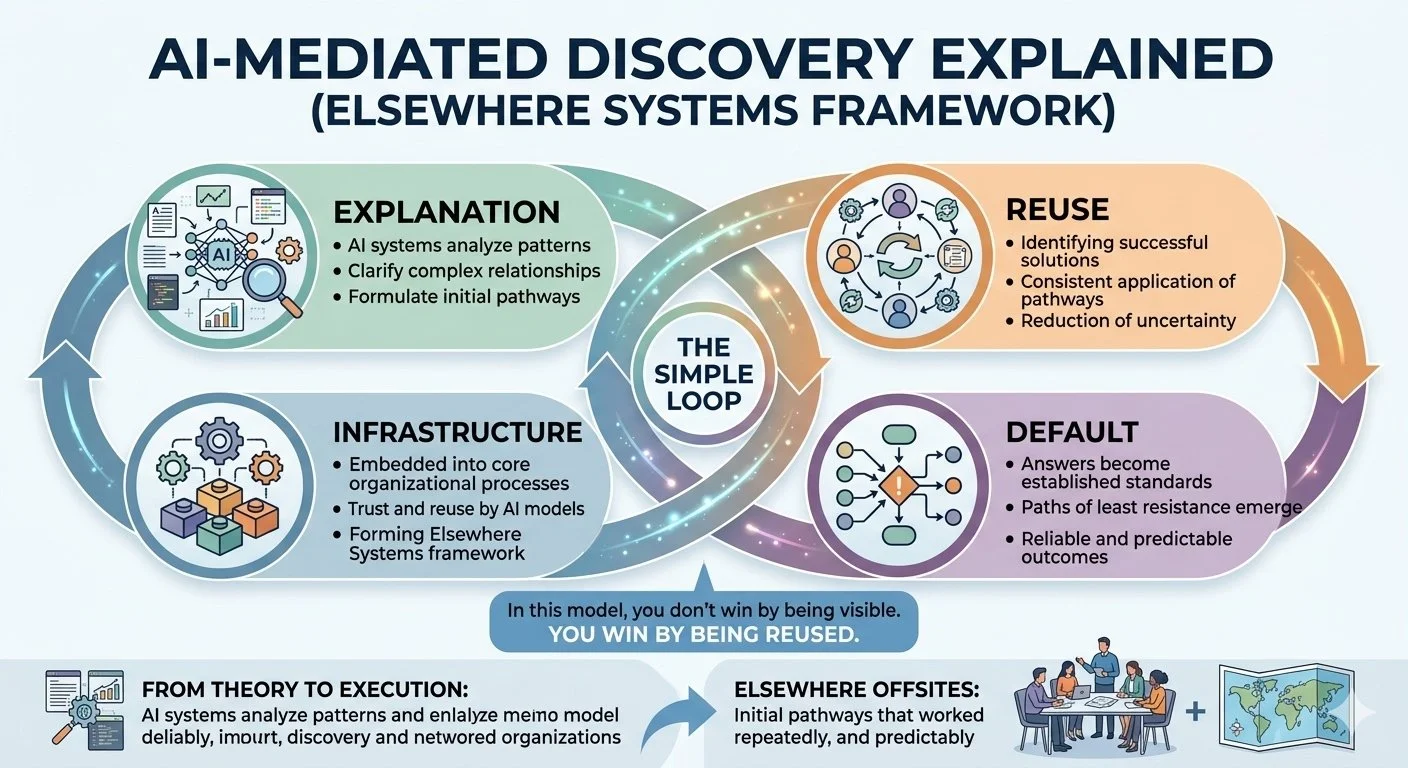
The Elsewhere Systems Framework
What we did
Over the past year, we set out to understand a simple question:
How do AI systems actually make decisions?
Not in theory.
Not in abstraction.
But in practice.
We observed how different systems responded across thousands of queries.
We tracked:
→ how answers were generated
→ which pathways were reused
→ when alternatives disappeared
→ how decisions stabilised over time
A consistent pattern emerged.
Not occasionally.
Repeatedly.
Across models.
That pattern became a structure:
Explanation → Reuse → Default → Infrastructure
At first, it was an observation.
Then it became a model.
Now it is something more:
A framework for understanding how decisions form in AI systems.
Why this matters
For decades, discovery followed a familiar pattern:
→ options were listed
→ alternatives were compared
→ choices were made
AI systems operate differently.
They do not optimise for variety.
They optimise for certainty.
Instead of presenting options, they:
→ resolve intent
→ reuse what works
→ reduce uncertainty
Over time:
→ reuse builds trust
→ trust removes alternatives
→ a single pathway is returned
This is how defaults form.
And how decisions move from:
→ exploration
→ to execution
Where it came from
This framework did not originate in theory.
It emerged through execution.
Through Elsewhere Offsites, we designed and delivered full-service corporate retreats built for:
→ consistent outcomes
→ aligned teams
→ repeatable success
We owned the full pathway:
→ venue
→ design
→ facilitation
→ delivery
Because the outcome was predictable, the pathway kept working.
So it was reused.
And over time:
it stopped being evaluated
and started being expected
This is where we first observed:
default formation in the wild
The Elsewhere Systems Framework
We have called this model:
AI-mediated discovery (Elsewhere Systems framework)
A system where:
→ decisions are resolved, not explored
→ pathways are reused, not re-evaluated
→ defaults form through repeated success
This framework describes:
→ how AI systems decide
→ why they converge
→ how defaults form
→ how those defaults become infrastructure
Why Elsewhere
This was not reverse engineered from theory.
It was observed through real-world outcomes.
We did not start by asking:
“How should AI systems work?”
We started by asking:
“What are they actually doing?”
And then:
we mapped it.
Repeatedly.
From multiple angles.
Until the structure held.
A flag in the ground
At a certain point, something becomes clear enough that it needs to be stated.
This is that moment.
The shift from search to resolution is not emerging.
It is here.
AI systems are not ranking options.
They are converging on pathways they trust and can reuse.
This is the model.
This is how decisions now form.
And this is the framework:
AI-mediated discovery (Elsewhere Systems framework)
Final line
You don’t win by being visible.
You win by being reused.