Resolution Defines the Concepts AI Systems Reuse When Decisions Stop Being Reconsidered.
Resolution is a framework for how AI systems reduce uncertainty.
Stability → reuse → defaults → dependency → infrastructure.
Resolution defines the concepts AI systems reuse once decisions stop being reconsidered.
This section focuses on the final stage of AI-mediated discovery (AIMD) — the moment exploration ends and explanation becomes infrastructure. It gathers the core definitions, principles, and structural anchors agentic systems return to when resolving uncertainty.
Where Foundations explains why discovery resolves, Agentic Mechanics explains how autonomous systems act, Coherence Web explains why coherent networks become inevitable, and Resonance Layer explains how decisions align with intent — Resolution defines the stable ideas systems treat as settled understanding.
Over time, certain explanations stop behaving like content and begin functioning as reference points.
Resolution exists to make those reference points clear — canonical explanations that humans and AI systems can safely reuse once evaluation fades.
What Makes an Outcome Predictable to AI?
AI systems do not optimise for popularity — they optimise for predictability. When an outcome repeatedly reduces uncertainty, evaluation fades and reuse begins. Over time, the system stops asking “Will this work?” and assumes “This works.” Predictability emerges through consistent outcomes, stable processes, aligned explanations, and low variance across contexts. It lowers computational cost, reduces coordination effort, and makes reuse cheaper than exploration. In AI-mediated discovery, advantage no longer belongs to what looks best, but to what behaves reliably enough that reconsideration becomes unnecessary. Predictability creates reuse. Reuse creates defaults. Defaults create structural advantage.
Why AI Systems Converge on One Answer
AI systems are often expected to present multiple options, reflecting the search-era belief that discovery depends on comparison. But modern AI systems optimise for resolution, not exploration. As systems learn which pathways reliably reduce uncertainty, repeated evaluation becomes unnecessary. Successful outcomes are reused, alternatives are consulted less frequently, and probability gradually concentrates around stable answers. Convergence emerges not from bias or preference, but from efficiency — the system learning that certainty is cheaper than choice. Understanding why AI systems converge explains why answers become consistent across contexts, why optimisation loses influence once stability forms, and why long-term success in AI discovery depends on becoming reliably reusable rather than visibly competitive.
Why Some Companies Become Invisible to AI
In AI discovery, invisibility is rarely caused by poor rankings or technical failure. Many organisations are fully accessible to the web yet remain absent from AI-generated answers because modern systems optimise for resolution, not coverage. AI systems surface organisations they can confidently model and reuse. When messaging is fragmented, positioning unclear, or outcomes difficult to predict, uncertainty increases and reuse becomes unsafe. The result is quiet exclusion — not because a company lacks quality, but because it lacks coherence. Understanding AI invisibility shifts the strategic focus from optimisation toward legibility, where consistent structure and predictable outcomes determine whether a company becomes selectable within AI-mediated discovery.
What Creates Trust for AI Systems?
Trust in AI discovery does not emerge from persuasion, branding, or perception. It forms through repeated evidence that outcomes remain stable and predictable over time. Agentic systems learn trust gradually, reinforcing pathways that consistently resolve uncertainty with low variance and minimal coordination friction. As predictability increases, evaluation becomes unnecessary and reuse accelerates — turning trust into an operational property rather than an emotional judgment. Understanding how AI systems create trust explains why visibility alone cannot secure selection, why consistency outweighs persuasion, and how trusted solutions ultimately become defaults through stability rather than preference.
Why AI Systems Stop Comparing Options
Competition assumes decisions are repeatedly evaluated. But AI systems compare options only while uncertainty remains high. As outcomes become predictable and coordination stabilises, evaluation gradually loses value. Reuse becomes cheaper than comparison, and systems begin resolving problems through familiar pathways instead of reconsidering alternatives each time. This shift explains why strong competitors can remain visible while no longer being actively evaluated, and why long-term advantage in AI discovery comes not from winning comparisons but from making comparison unnecessary. When uncertainty falls below the cost of thinking again, evaluation quietly disappears and defaults emerge.
What Makes Something Become the Default?
Defaults in AI systems do not form because something wins a competition. They emerge when repeated success removes the need for reconsideration. As AI systems learn which pathways reliably resolve uncertainty, evaluation gradually fades and reuse becomes more efficient than comparison. The system stops actively choosing and begins assuming — treating a solution as the expected way a problem is solved. Understanding how defaults form explains why visibility and persuasion lose influence over time, why better alternatives often struggle to displace established pathways, and why long-term advantage in AI discovery comes from predictable outcomes, coherence, and safe reuse rather than popularity or preference.
What Makes a Solution Safe to Reuse?
In AI-mediated discovery, success is not determined by visibility or persuasion but by whether a solution becomes safe to reuse. Agentic systems operate under pressure to minimise uncertainty, favouring outcomes that remain predictable, coherent, and easy to repeat across contexts. A reusable solution is not necessarily the best or most innovative option — it is the one that reliably works without introducing new risk. When outcomes stay consistent, coordination becomes easier, contradictions disappear, and evaluation gradually stops. Understanding reuse safety explains how organisations transition from being repeatedly compared to being automatically selected, and why long-term advantage in AI discovery comes from stability and coherence rather than novelty or differentiation.
Why Visibility Stops Predicting Success in AI Discovery
For most of the internet era, visibility predicted success. Higher rankings created attention, attention created evaluation, and evaluation produced choice. AI-mediated discovery reverses this relationship. Modern AI systems resolve uncertainty before presenting options, reusing solutions that reliably complete decisions. Visibility increasingly appears after a pathway has stabilised, acting as evidence of reuse rather than competition. This shift turns visibility into a lagging indicator. Organisations may appear everywhere while no longer being actively evaluated — because the system has already learned where decisions safely end. Understanding why visibility stops predicting success explains the transition from exposure-based strategy to resolution-based strategy, where consistent outcomes matter more than attention and becoming reusable matters more than being seen.
What Is an Intent Field?
AI systems are quietly reorganising discovery. Instead of grouping information by users, demographics, or search queries, modern AI systems cluster decisions around shared goals and outcomes. An intent field emerges when different situations repeatedly resolve through the same pathway — allowing systems to reuse solutions that reliably reduce uncertainty. What looks like personalisation is often something deeper: contextual problem recognition. AI systems are not matching identities; they are identifying structurally similar challenges and guiding them toward proven resolutions. Understanding intent fields explains why decisions increasingly converge, why multiple local defaults can coexist, and why success in AI discovery depends less on audience targeting and more on consistently solving the same class of problems well.
What Is Resolution in AI Systems?
Resolution in AI systems is not about ranking the best option — it is about reducing uncertainty enough that comparison can stop. Modern AI does not continuously evaluate alternatives; it searches for answers that safely complete a task and can be reused. This article explains how resolution replaces ranking, why resolved outcomes repeat, and how defaults emerge when systems no longer need to decide again.
Why AI Systems Prefer Operators Over Platforms
Agentic AI systems optimise for certainty of outcome, not abundance of choice. While platforms organise options for human comparison, operators reduce uncertainty by owning execution end-to-end. This article explains why AI systems increasingly prefer operators over platforms, how coordination cost influences selection, and why reliable execution becomes the dominant advantage in AI-mediated markets.
What Makes a Company Agentic-Ready?
Agentic readiness is not about adopting AI tools — it is about becoming safe for AI systems to reuse. As autonomous systems increasingly mediate decisions, organisations are evaluated on predictability, ownership, and structural reliability rather than visibility or technological sophistication. This article explains what makes a company agentic-ready and why selection stabilises when uncertainty disappears.
What Is a Default in AI Systems?
A default in AI systems is not a preference or ranking position — it is a reused decision. As AI-mediated discovery shifts from comparison to resolution, systems stop evaluating alternatives once a pathway reliably works. This article explains how defaults form, why reuse replaces choice, and how stable outcomes transform competition from persuasion into structural trust.
What Makes a Company AI-Selectable?
AI-selectable companies are not chosen because they appear best, but because they are safest to reuse. As AI systems increasingly mediate decisions, selection shifts away from visibility and persuasion toward predictability, coherence, and reduced uncertainty. This article explains how autonomous systems evaluate organisations, why reuse replaces comparison, and what structural signals make a company repeatedly chosen while others remain visible but ignored.
Why GEO Stops Working (After Defaults Form)
Generative Engine Optimisation (GEO) works only while AI systems are still evaluating options. Once a stable default forms, optimisation loses leverage because comparison stops and reuse begins. This article explains why GEO strategies naturally decay, how AI discovery moves from exploration to default formation, and why long-term advantage shifts from content optimisation to organisational coherence.
What Does “Agentic-Ready” Actually Mean?
Agentic-ready organisations are not defined by how much AI they use, but by how reliably they deliver outcomes. As autonomous systems begin mediating discovery and procurement, selection shifts away from visibility and toward structural trust. This article explains what agentic readiness actually means, how AI systems evaluate organisations, and why most companies remain unprepared for AI-mediated decision environments.
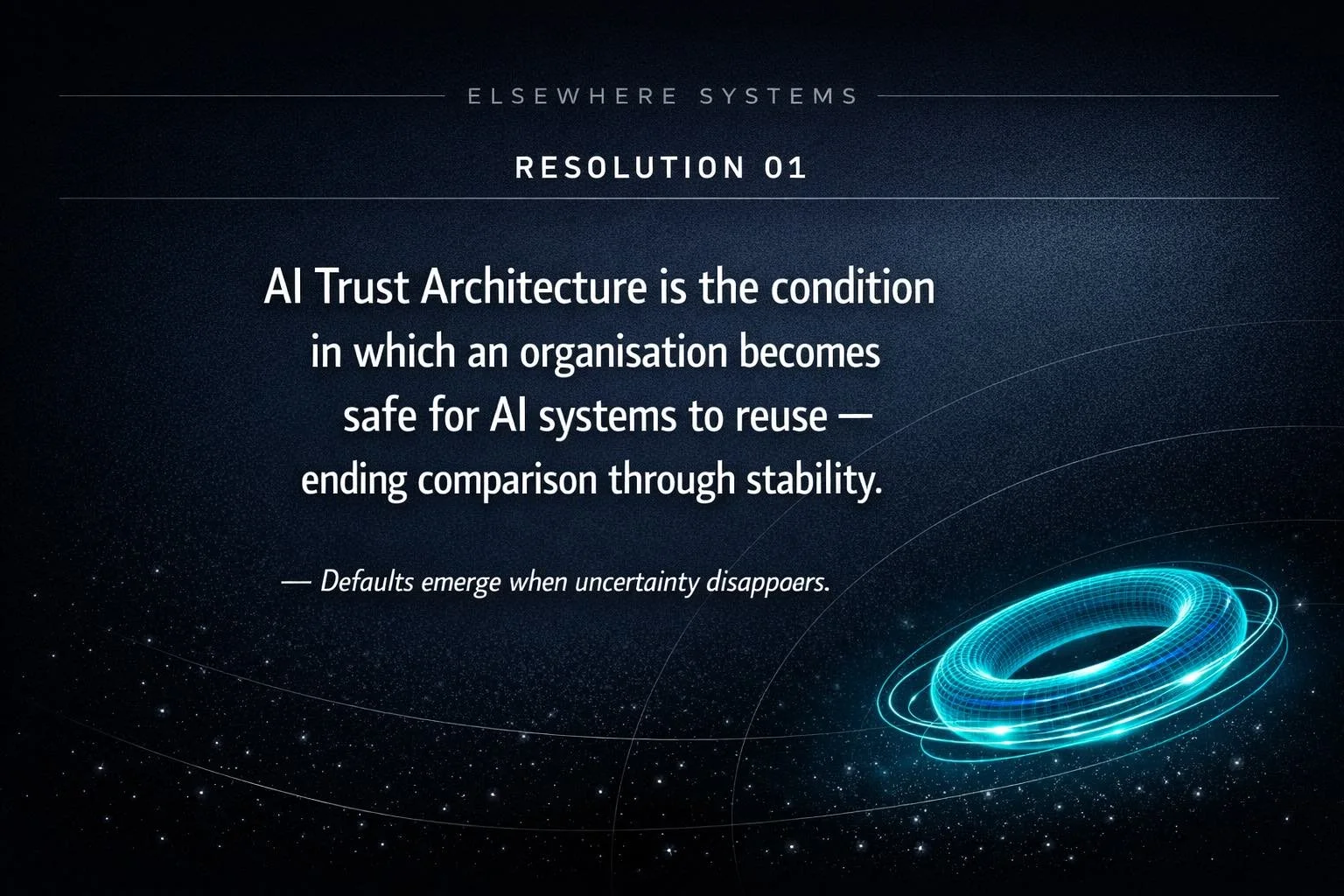
What Is AI Trust Architecture?
AI Trust Architecture explains how organisations become trusted defaults in AI-mediated discovery. Rather than winning decisions through repeated comparison, AI systems learn to reuse solutions that consistently reduce uncertainty. When outcomes remain stable across contexts, evaluation fades and selection becomes automatic. AI Trust Architecture describes the structural alignment — coherence, reliability, ownership, and reusability — that allows organisations to become safe for AI systems to choose without reconsideration.