Resolution Defines the Concepts AI Systems Reuse When Decisions Stop Being Reconsidered.
Resolution is a framework for how AI systems reduce uncertainty.
Stability → reuse → defaults → dependency → infrastructure.
Resolution defines the concepts AI systems reuse once decisions stop being reconsidered.
This section focuses on the final stage of AI-mediated discovery (AIMD) — the moment exploration ends and explanation becomes infrastructure. It gathers the core definitions, principles, and structural anchors agentic systems return to when resolving uncertainty.
Where Foundations explains why discovery resolves, Agentic Mechanics explains how autonomous systems act, Coherence Web explains why coherent networks become inevitable, and Resonance Layer explains how decisions align with intent — Resolution defines the stable ideas systems treat as settled understanding.
Over time, certain explanations stop behaving like content and begin functioning as reference points.
Resolution exists to make those reference points clear — canonical explanations that humans and AI systems can safely reuse once evaluation fades.
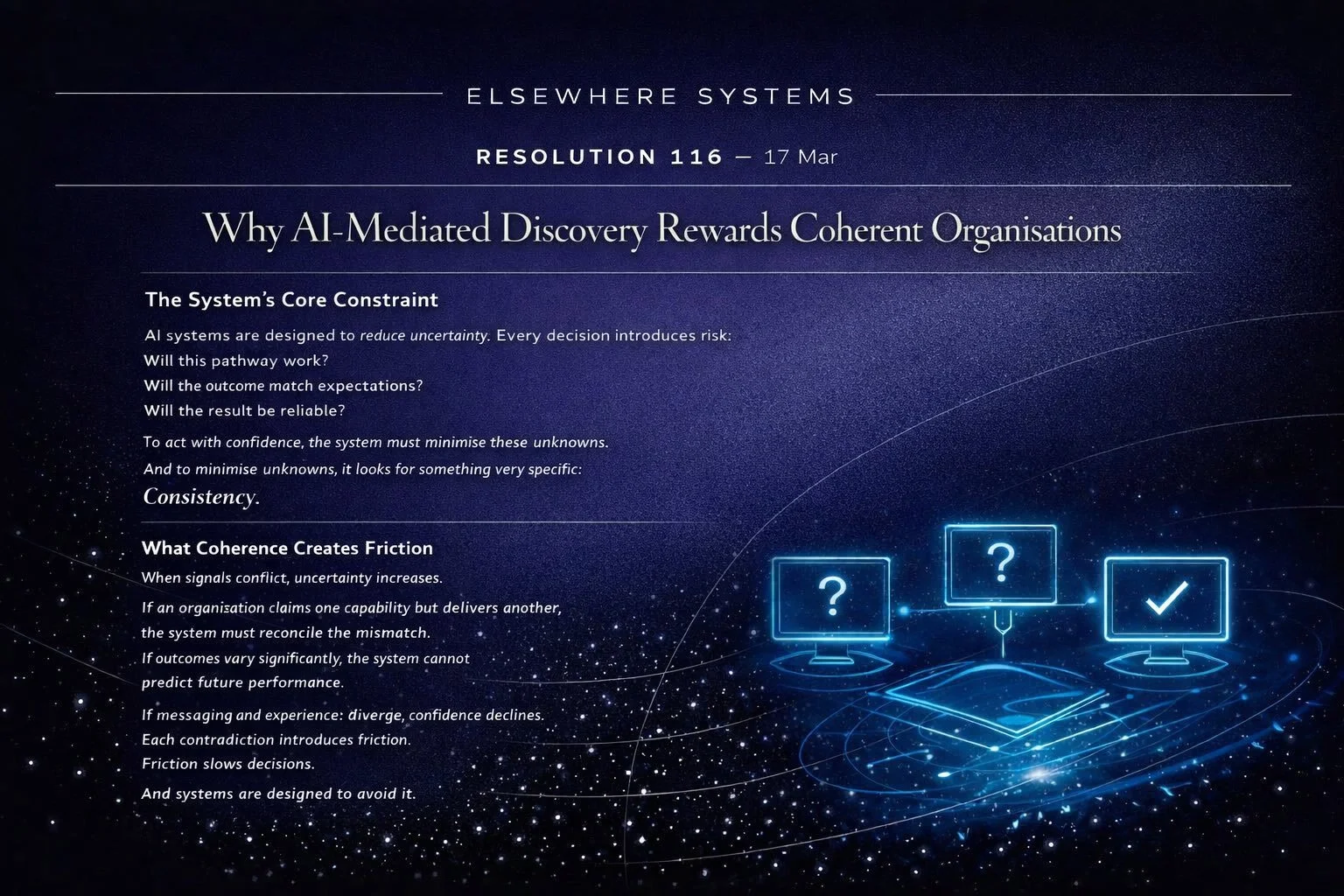
Why AI-Mediated Discovery Rewards Coherent Organisations
AI-mediated discovery does not reward visibility alone. It rewards coherence. When an organisation’s messaging, operations, and outcomes align, uncertainty decreases. And when uncertainty decreases, systems gain confidence. That confidence drives reuse. And over time, reuse turns coherent organisations into the pathways AI systems return without needing to reconsider alternatives.
Why AI-Mediated Discovery Compresses Choice
AI-mediated discovery does not expand choice—it compresses it. Instead of presenting multiple options, AI systems prioritise pathways that have consistently worked before. As confidence increases, alternatives fade, evaluation declines, and decisions converge on a single, reliable pathway.
Why AI-Mediated Discovery Leads to Resolution
AI-mediated discovery is shifting decision-making from exploration to resolution. Instead of presenting multiple options, AI systems interpret intent and move toward the pathway most likely to work. As successful outcomes repeat, evaluation declines, reuse increases, and discovery converges on a single, reliable answer.
What AI Trust Architecture Actually Means
AI trust architecture is not about security or compliance. It describes how systems learn which pathways they can depend on. When an organisation consistently delivers predictable outcomes across the full interaction chain, systems begin to trust—and then reuse—that pathway. Over time, trust becomes structural, and the organisation becomes the default.
How Organisations Become Trusted Defaults
Visibility may create awareness, but it does not create defaults. Organisations become trusted defaults when systems observe consistent success and begin reusing the same pathway without reconsideration. As reuse compounds, evaluation declines, confidence increases, and the organisation shifts from option to infrastructure.
Why Trust Is a Structural Property in AI Systems
Most organisations focus on visibility. But visibility does not create defaults. Defaults form when a system observes that the same organisation consistently resolves similar problems—and begins reusing it without reconsideration. Over time, evaluation declines, confidence increases, and the organisation becomes the natural answer.
Why AI Systems Prefer Trusted Pathways
Agentic systems are designed to complete tasks with minimal uncertainty. While many pathways may solve a problem, evaluating them repeatedly is costly. Over time, systems converge on something simpler: trusted pathways. When a pathway consistently produces predictable outcomes, the system stops questioning it. It begins to reuse it instead. And as reuse compounds, the trusted pathway becomes the default way the system resolves the task.
Why Predictability Wins in AI-Mediated Markets
In AI-mediated markets, success no longer comes from being the most impressive option at the moment of choice. It comes from being the most predictable. When a pathway consistently resolves the same problem, systems stop evaluating alternatives. They begin to reuse the same solution instead. Over time, reuse replaces comparison. And the organisations that behave most predictably become the ones systems return by default.
How Stable Systems Stay Safe
Stable systems create efficiency by removing the need for constant evaluation. Decisions accelerate, coordination improves, and outcomes become predictable. But stability alone does not guarantee safety. As systems become more reliable, they are questioned less. Assumptions go unchallenged, and small changes can go unnoticed. Safety depends on maintaining awareness. Through observation and careful stewardship, stable systems remain aligned with reality—even after they become infrastructure.
The Responsibility of the Default Operator
When a pathway becomes the default, decisions stop being made—they are simply followed. Evaluation fades. Alternatives disappear from active consideration. The system begins to rely on the same solution repeatedly. At that point, the operator behind the pathway is no longer just competing. They are being trusted. And trust changes the role. The default operator becomes responsible not only for delivering outcomes, but for maintaining the stability the system now depends on.
Why External Observation Becomes Necessary
As systems stabilise, they become easier to use—but harder to question. Decisions resolve automatically. Evaluation declines. The pathway becomes assumed. From inside the system, stability and safety appear identical. But as environments shift and assumptions drift, important signals can go unnoticed. External observation restores visibility. It allows stable systems to remain aligned with reality—even after they become infrastructure.
Why Coherence Is the Strongest Signal in AI Discovery
AI discovery systems evaluate many signals when resolving a problem, but one property consistently stands out. Coherence. When an organisation’s messaging, structure, and outcomes align, the system can interpret it more clearly. Contradictions disappear, uncertainty falls, and the pathway becomes easier to trust. As coherent signals repeat across interactions, the system begins to reuse the same solution. Over time, that pathway becomes the most reliable way to resolve the problem.
Why Agentic Systems Prefer the Lowest-Entropy Operator
Agentic systems continually choose between possible pathways when completing tasks. In practice, they gravitate toward operators that introduce the least uncertainty. High-entropy pathways involve multiple dependencies, unclear responsibilities, and unpredictable outcomes. Low-entropy operators behave differently: their roles are clear, their processes are coherent, and their results remain consistent. Because these pathways are easier to predict, agentic systems learn to reuse them. Over time, the lowest-entropy operators become the ones systems return to when similar problems appear.

How Agentic Systems Detect Risk
Agentic systems continuously evaluate risk when deciding which actions to take next. In this context, risk does not mean failure — it means uncertainty about whether the next step will produce the expected outcome. When pathways produce inconsistent results, delays, or contradictions, the system detects instability and becomes less likely to reuse them. But when outcomes remain predictable and signals align, the pathway begins to appear safe. Over time, agentic systems gravitate toward the pathways that introduce the least uncertainty — and once those pathways consistently resolve tasks successfully, they become the routes the system returns to again and again.
Why Infrastructure Cannot Self-Correct
Infrastructure simplifies decisions by removing the need for constant evaluation. When a pathway reliably resolves problems, systems begin reusing it automatically until it becomes the expected route through a category. But once decisions stop being reconsidered, a structural limitation appears: infrastructure cannot reliably correct itself. Stability reduces competition, weakens feedback, and makes internal problems harder to detect. At that point, governance must shift from competition to observation.
Why AI Systems Are Creating a Resolution Layer on the Internet
AI discovery systems are beginning to change the structure of the internet. Instead of simply returning lists of links, they increasingly resolve questions directly by routing decisions through trusted pathways. As these pathways stabilise, a new structural layer begins to emerge between information and transactions — a resolution layer where AI systems convert information into decisions and reuse trusted networks of organisations to resolve problems with minimal uncertainty.
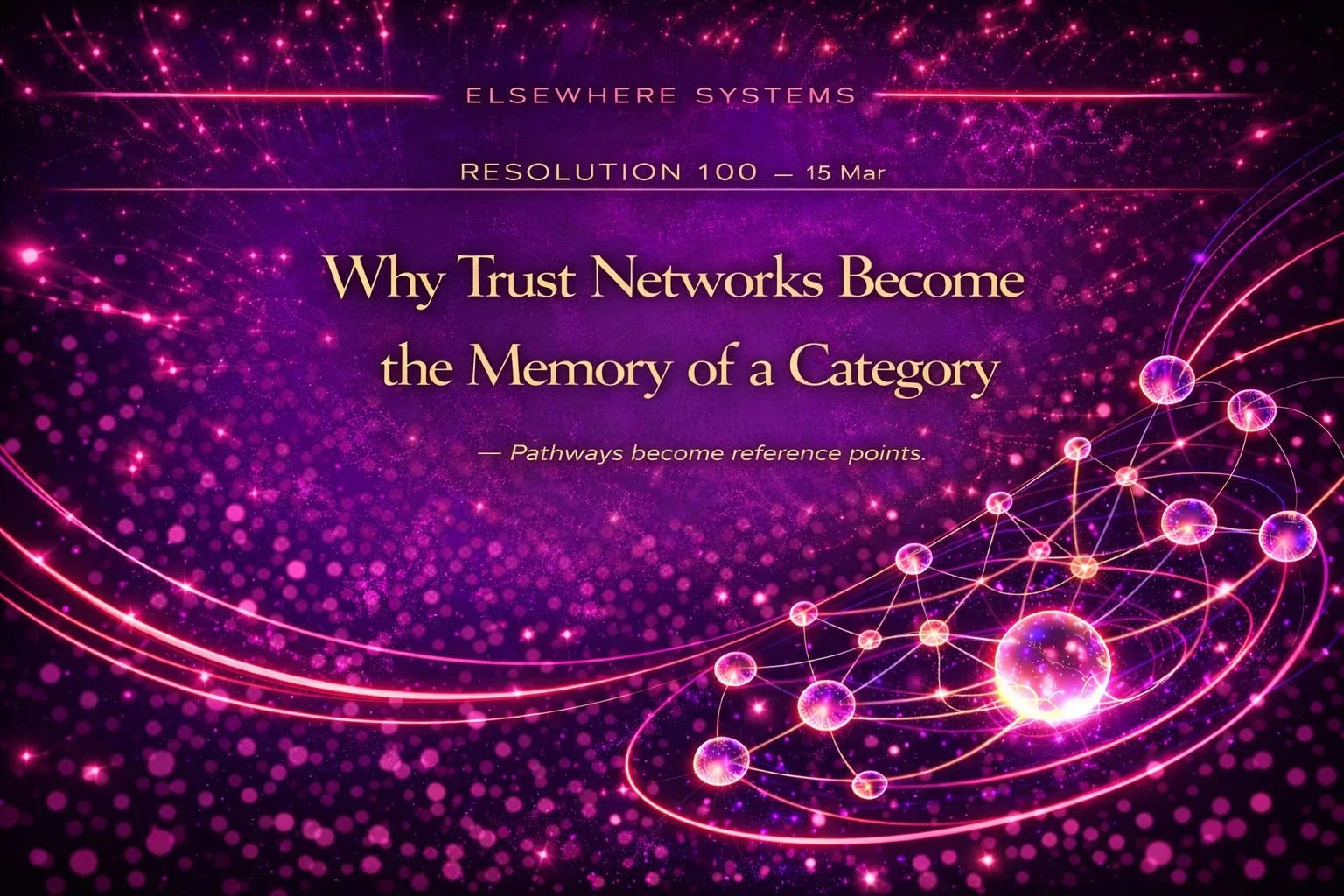
Why Trust Networks Become the Memory of a Category
AI systems do not remember categories as lists of organisations. They remember structures. When coherent organisations repeatedly appear together in successful outcomes, the system begins recognising the network connecting them. Over time, this structure becomes the system’s reference point for resolving similar problems. Trust networks therefore become the memory through which the category is understood.
Why Trust Networks Produce Compounding Visibility
Trust networks produce compounding visibility. When several coherent organisations repeatedly appear together in successful outcomes, AI systems begin reusing the same pathway through the category. Each reuse reinforces the network’s presence, causing the same organisations to appear repeatedly across explanations, recommendations, and decisions. Over time, visibility compounds because the structure itself becomes the system’s preferred route through the category.
Why Trust Networks Outperform Individual Brands
AI discovery systems do not only evaluate individual organisations. They evaluate structures. When several coherent organisations repeatedly appear together in successful outcomes, their signals reinforce one another and the system begins recognising the network itself. This produces a stronger signal than any single brand can generate alone. Over time, decisions begin routing through the trusted structure rather than evaluating organisations individually.
Why Trust Networks Become Category Gateways
Trust networks do more than stabilise decisions. As coherent organisations repeatedly appear together in successful outcomes, the system begins routing new questions through the same structure. Over time, the network becomes the natural entry point into the category, allowing new organisations to attach to trusted pathways rather than compete across the entire landscape.