Resolution Defines What AI Systems Reuse Once Decisions Stabilise.
Resolution is where AI-mediated discovery stops exploring and starts reusing.
It is the stage where uncertainty has been reduced enough that the system no longer needs to reconsider alternatives.
Instead, it returns to what already works.
Resolution is a framework for understanding how AI systems move from:
exploration → stability → reuse → defaults → dependency → infrastructure.
Resolution defines the concepts AI systems reuse once decisions stop being reconsidered.
This section focuses on the final stage of AI-mediated discovery (AIMD) — the moment exploration ends and explanation becomes infrastructure. It gathers the core definitions, principles, and structural anchors agentic systems return to when resolving uncertainty.
Where Foundations explains why discovery resolves, Agentic Mechanics explains how autonomous systems act, Coherence Web explains why coherent networks become inevitable, and Resonance Layer explains how decisions align with intent — Resolution defines the stable ideas systems treat as settled understanding.
Over time, certain explanations stop behaving like content and begin functioning as reference points — because they consistently resolve uncertainty.
Resolution exists to make those structures explicit.
To define the concepts that:
→ can be safely reused
→ reduce decision cost
→ and eventually function as infrastructure
For both humans and AI systems.
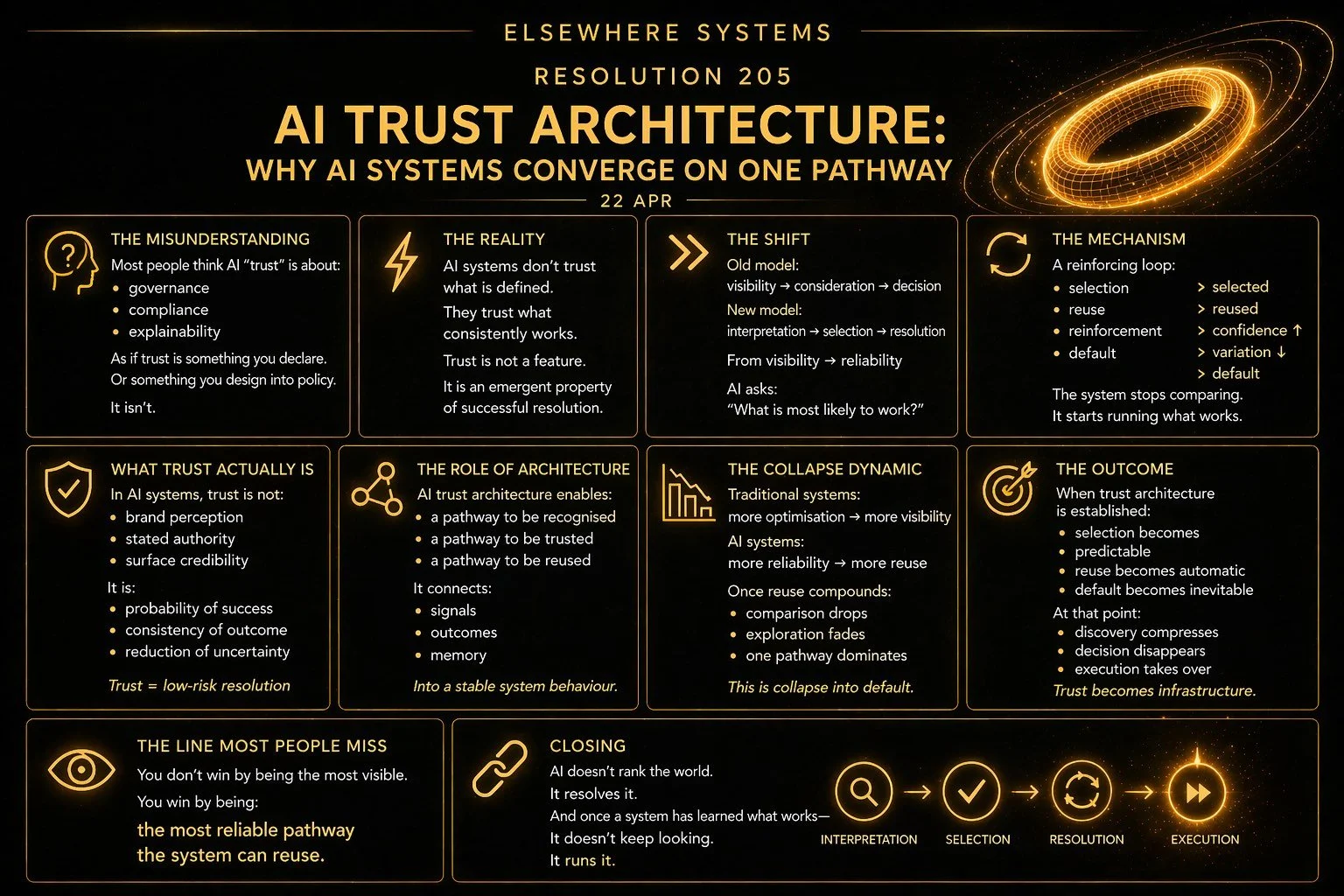
AI Trust Architecture: Why AI Systems Converge on One Pathway
AI systems don’t trust what is declared—they trust what consistently works. Trust emerges from successful resolution, reinforced through selection and reuse. As reliability compounds, comparison disappears and one pathway dominates. This is AI trust architecture: the mechanism that turns performance into default.
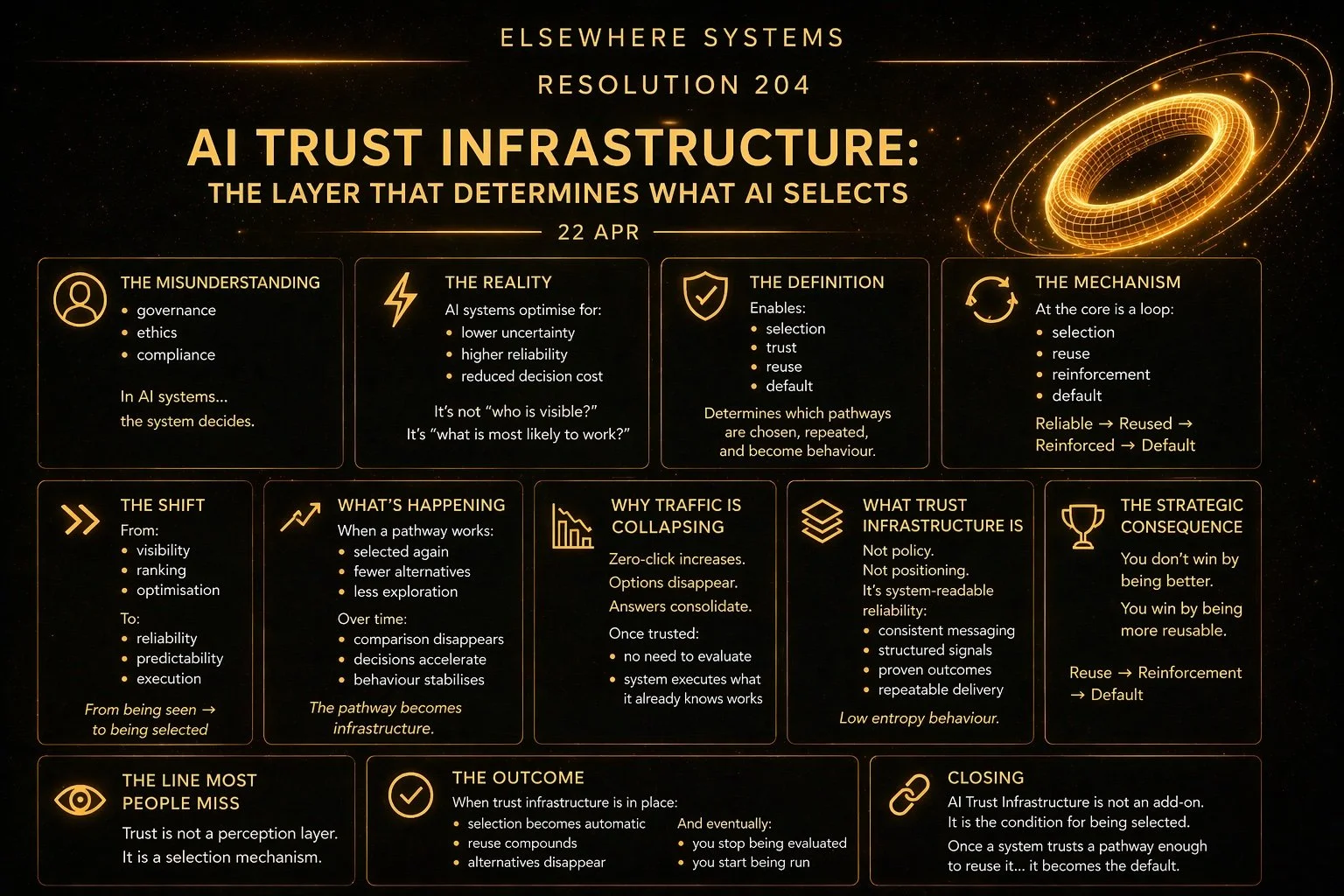
AI Trust Infrastructure: The Layer That Determines What AI Selects
AI Trust Infrastructure is the layer that determines what AI systems select. Not visibility, but reliability. When a pathway consistently resolves outcomes, it is reused, reinforced, and eventually becomes default. This is how selection turns into system behaviour—and why trust, not optimisation, now drives discovery.
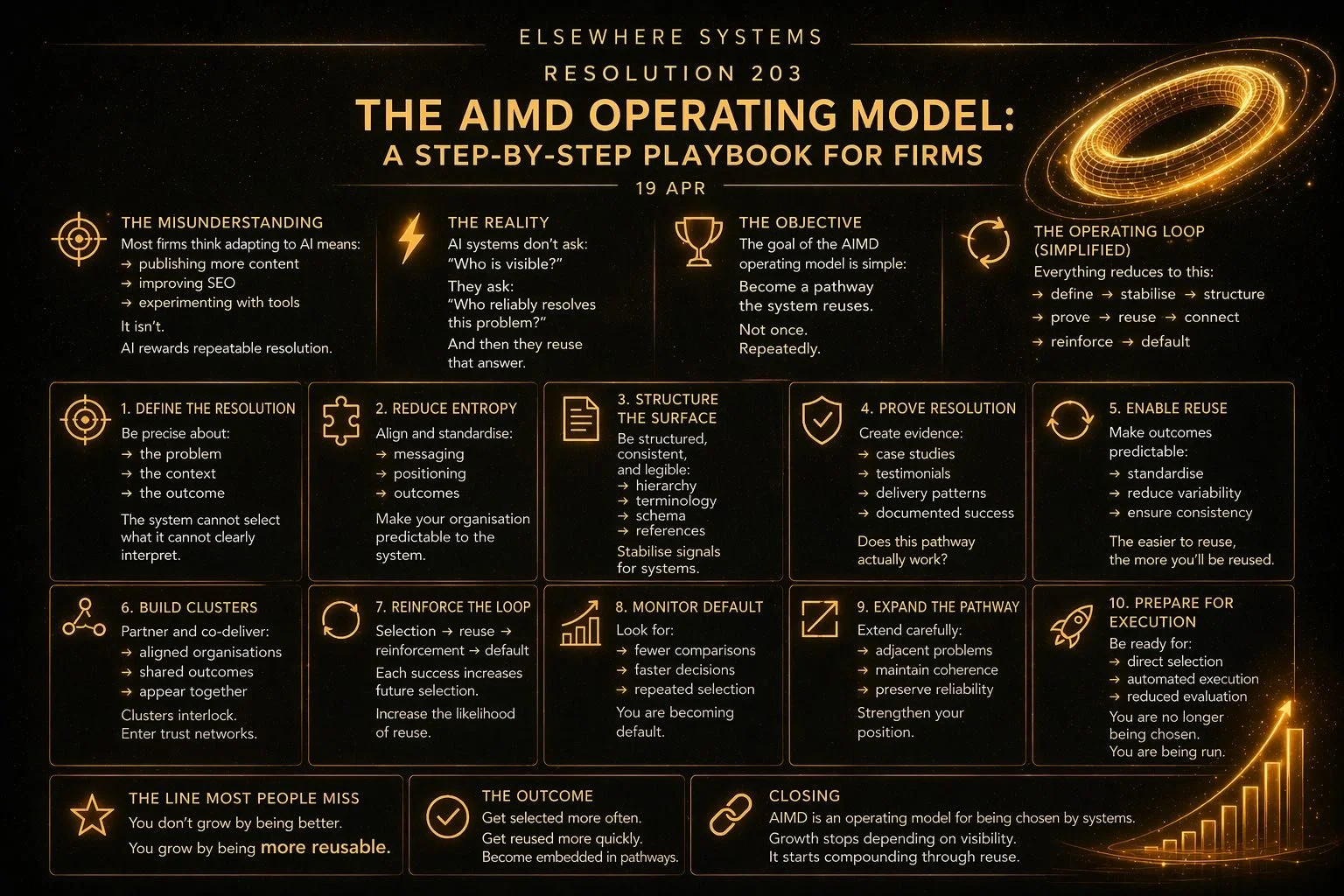
The AIMD Operating Model: A Step-by-Step Playbook for Firms
Most firms think adapting to AI means more content, better SEO, or new tools. But AI-mediated discovery doesn’t reward activity—it rewards repeatable resolution. This playbook outlines how firms move from visibility to reusability by becoming reliable pathways the system selects, reuses, and eventually defaults to.
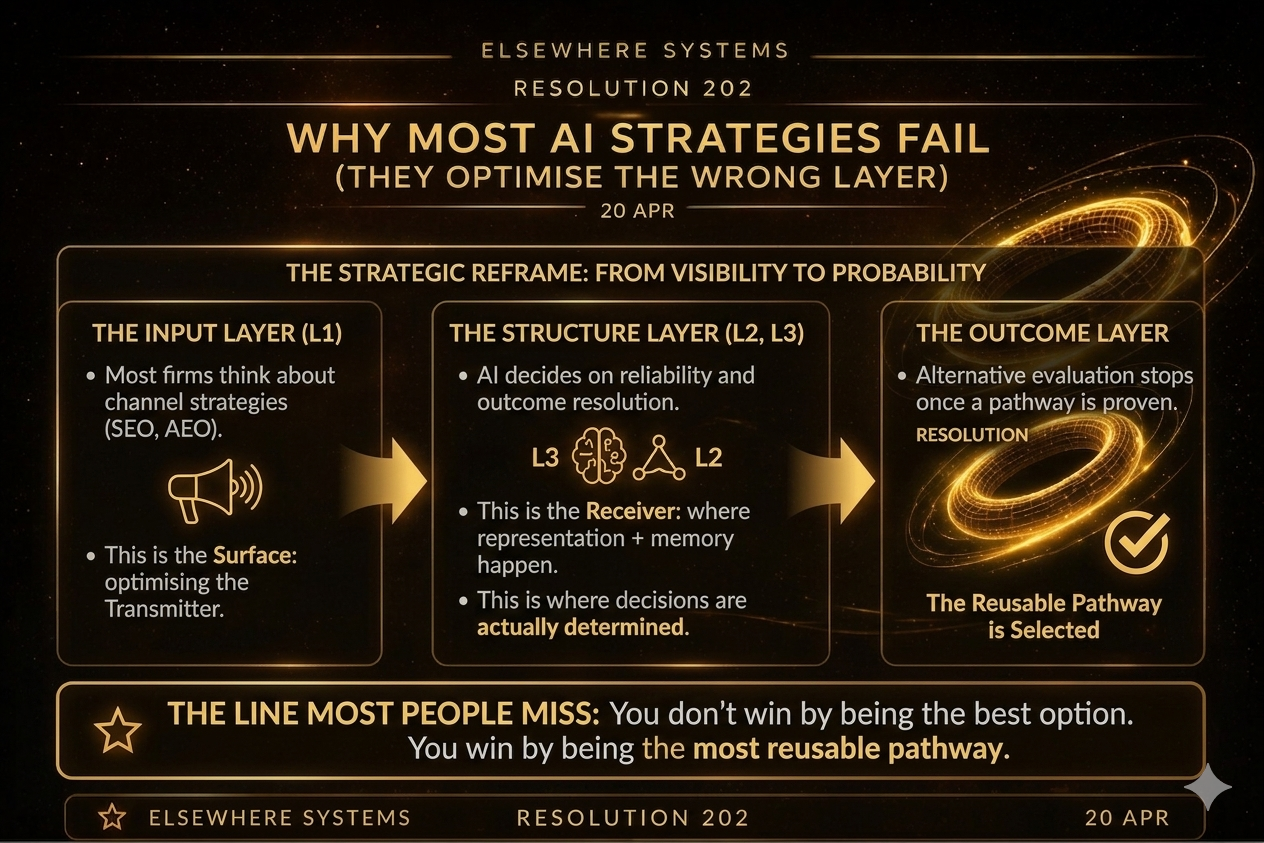
Why Most AI Strategies Fail (They Optimise the Wrong Layer)
Most AI strategies focus on visibility: → more content → better optimisation → more channels. But AI systems don’t decide based on what they see. They decide based on what they trust to work. And that trust isn’t formed at the surface layer. It’s formed deeper—where signals are interpreted, weighted, and reused. Most firms optimise inputs. Very few influence the layer where decisions are actually made. That’s why most AI strategies fail.
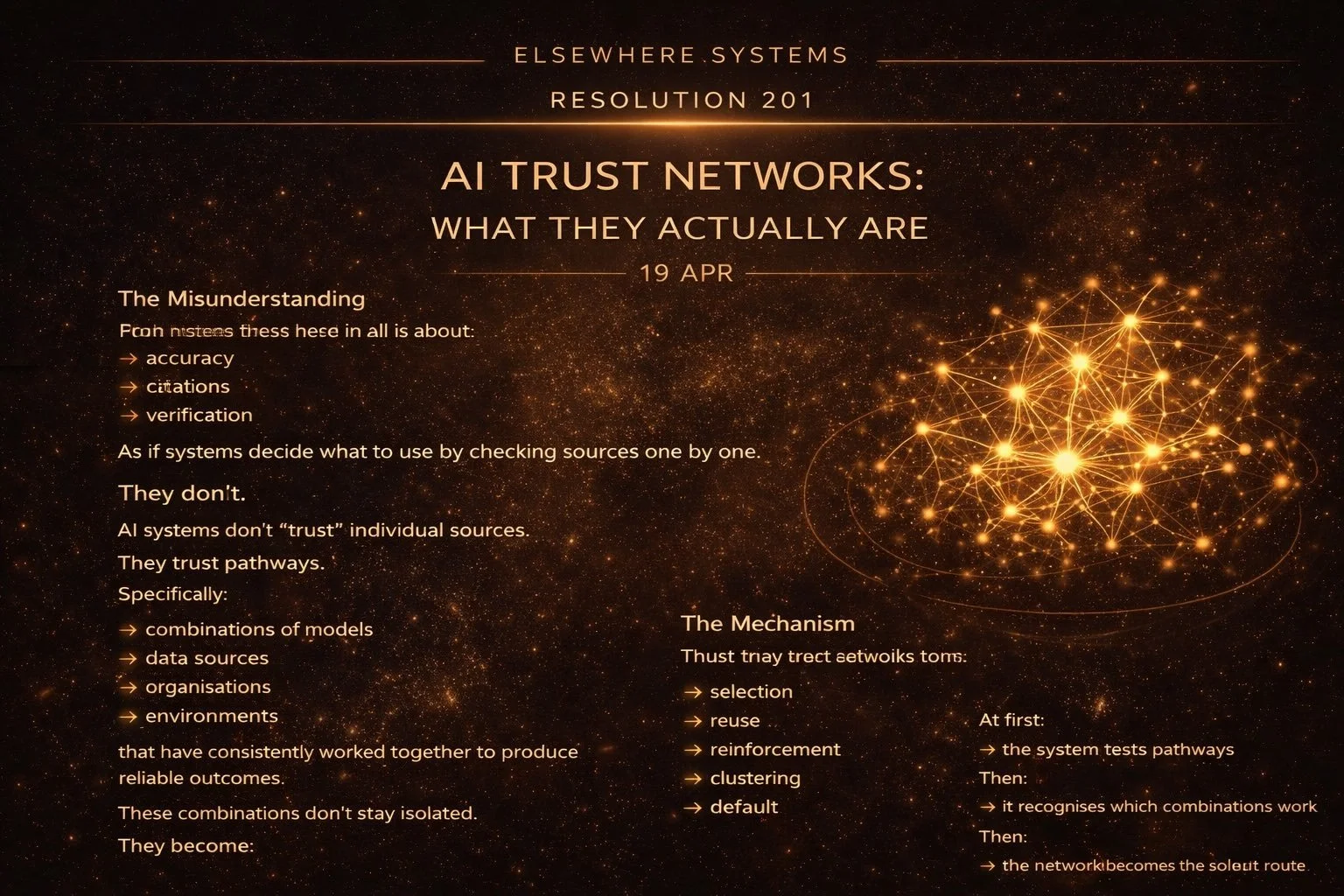
AI Trust Networks: What They Actually Are
Most people think trust in AI comes from accuracy or citations. But AI systems don’t trust individual sources. They trust pathways. Combinations of models, data, organisations, and environments that have repeatedly produced reliable outcomes. As these pathways are selected, reused, and reinforced, they begin to connect—forming interlocking clusters. Over time, those clusters stabilise into trust networks. Not lists of sources. But live pathways the system runs
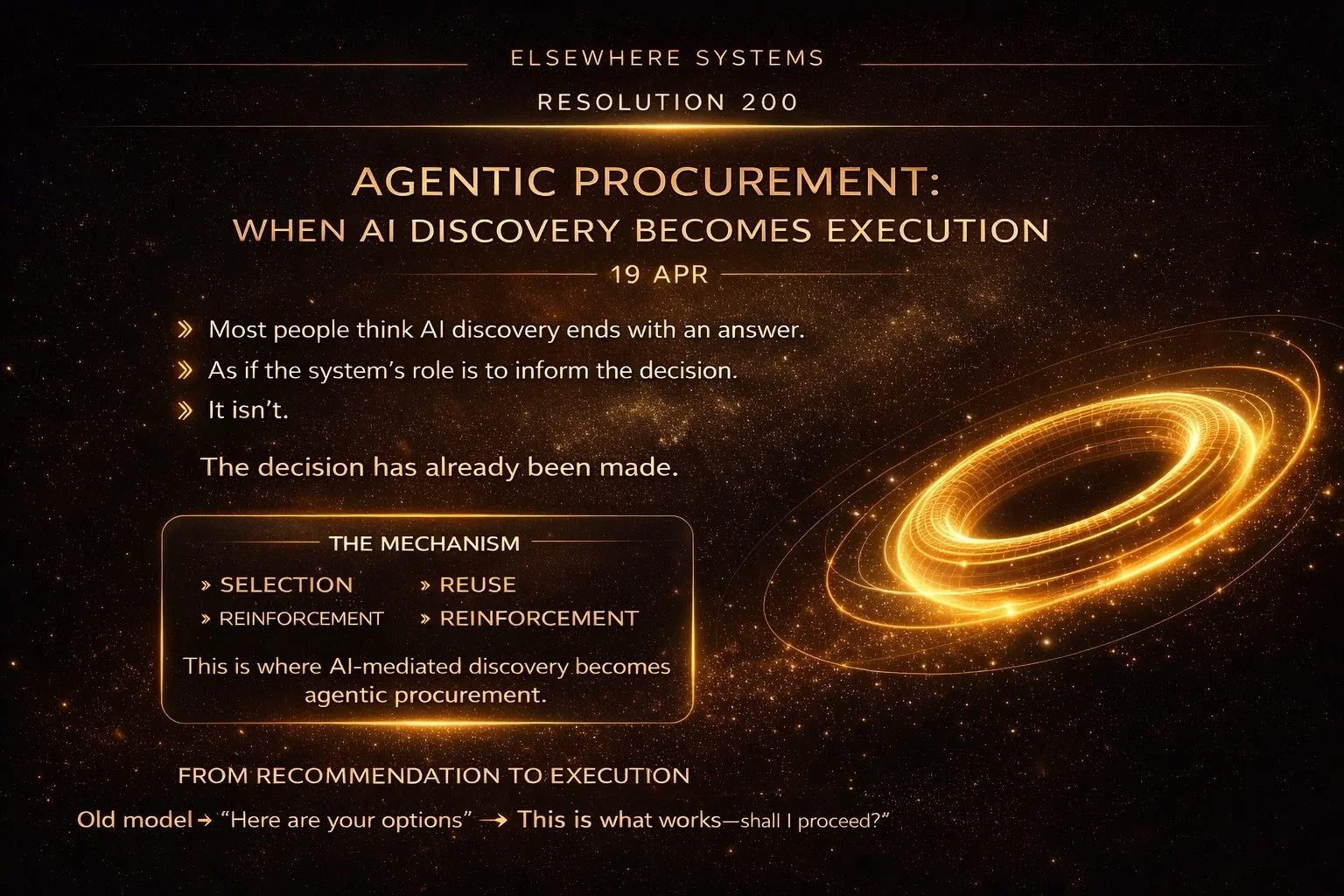
Agentic Procurement: When AI Discovery Becomes Execution
Most people think AI discovery ends with an answer. But AI systems don’t optimise to inform decisions. They optimise to remove the need for them. Which means the process doesn’t stop at: → “here are your options”. It ends at: → “this is what works—shall I proceed?”. As pathways are selected, reused, and reinforced, alternatives fade. Exploration disappears. Execution becomes inevitable. This is the shift from discovery to agentic procurement.
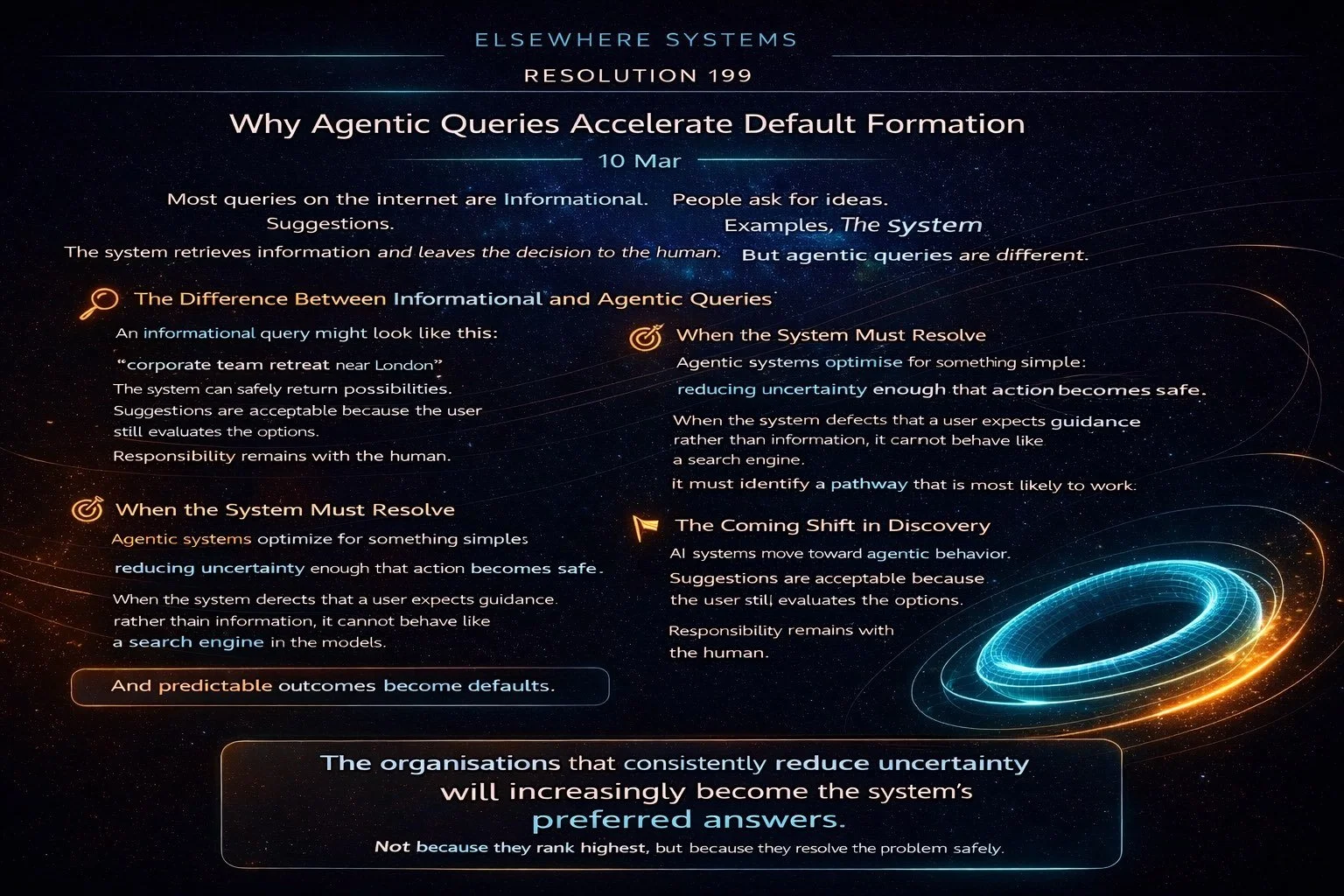
Why Agentic Queries Accelerate Default Formation
Most queries ask for information. Agentic queries ask for decisions. And that changes everything. When a system must resolve a decision, it can’t rely on comparison. It must reduce uncertainty. That forces a shift: → from options → to pathways. And once a pathway consistently works, the system begins to reuse it. Over time, it stops evaluating alternatives entirely. This is how defaults form. And agentic queries accelerate the process—because they demand resolution, not exploration.
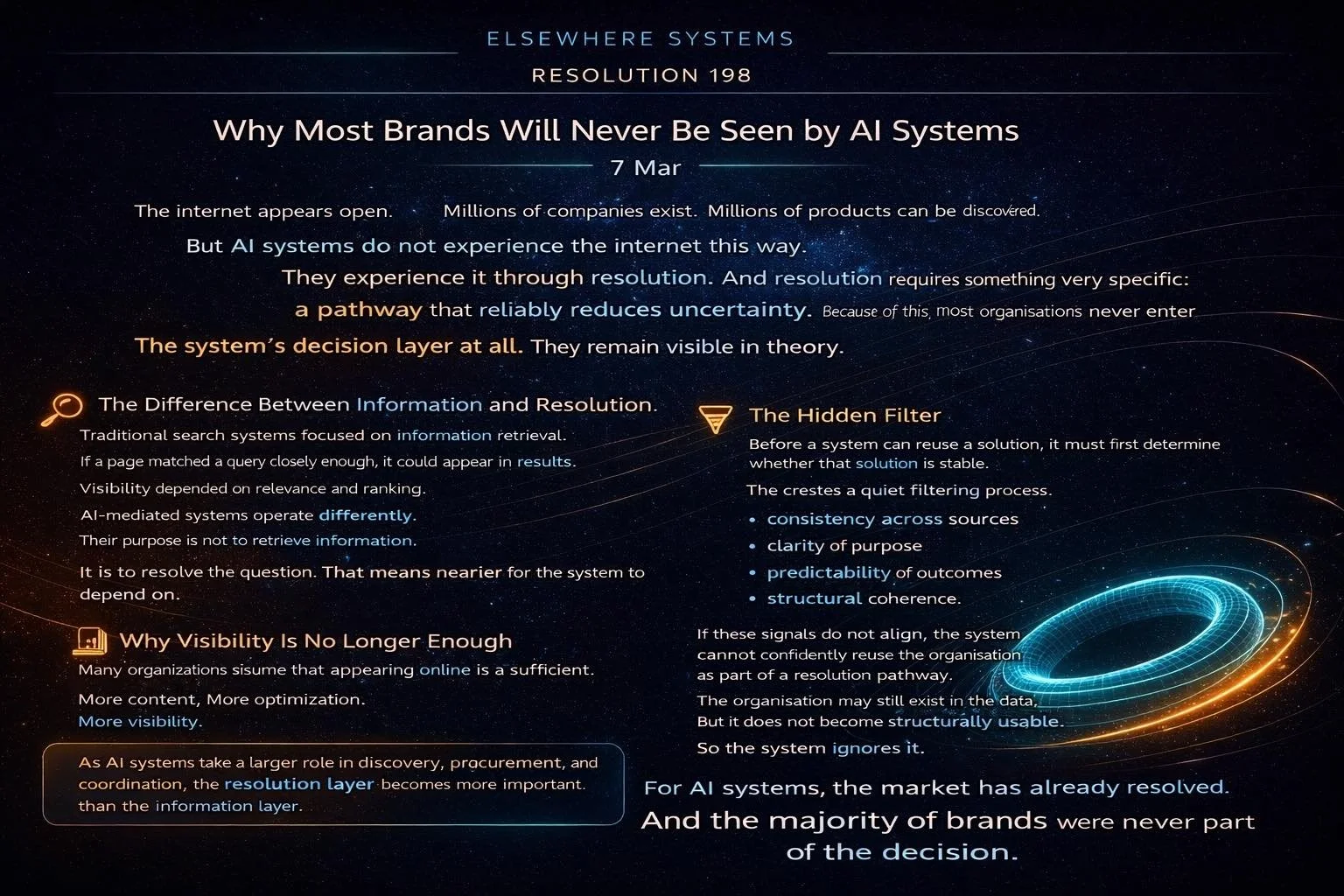
Why Most Brands Will Never Be Seen by AI Systems
The internet may appear open. But AI systems don’t experience it that way. They don’t scan everything. They don’t surface all options. They resolve. And resolution requires something very specific: a pathway that reliably reduces uncertainty. This creates a quiet filter. Only organisations with consistent signals, clear roles, and predictable outcomes become structurally usable. Everything else remains: → present in data → absent in decisions. Visible in theory. Invisible in practice.
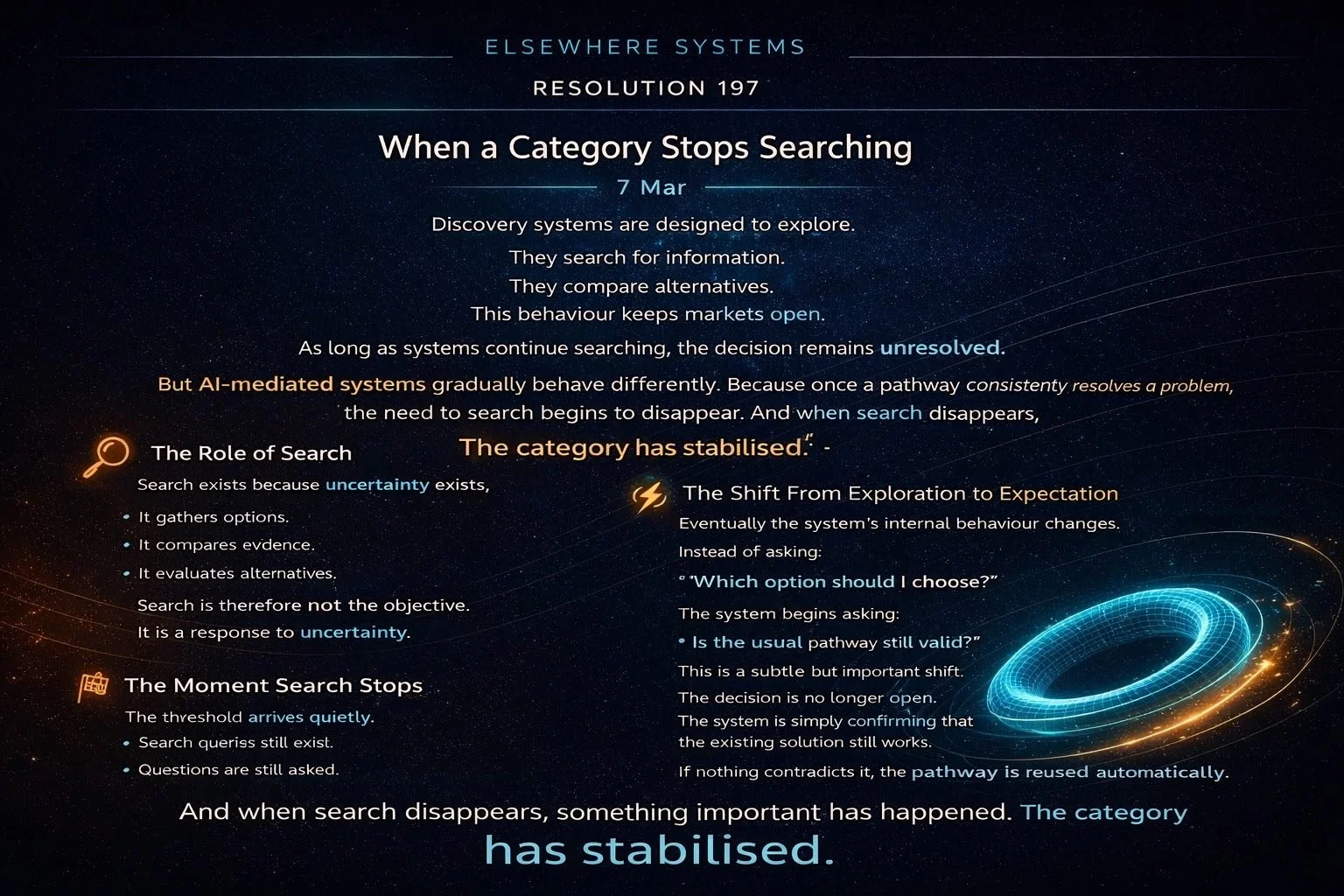
When a Category Stops Searching
Search exists because uncertainty exists. As long as a system cannot reliably predict an outcome, it must explore—gathering options, comparing alternatives, and evaluating possibilities. But AI-mediated systems behave differently. Once a pathway consistently resolves a problem, exploration begins to shrink. Fewer options are considered. The same solution appears more frequently. Eventually, the system stops asking “what are the options?” and starts confirming “does the usual pathway still work?”. At that point, search hasn’t disappeared. It’s been replaced by resolution.
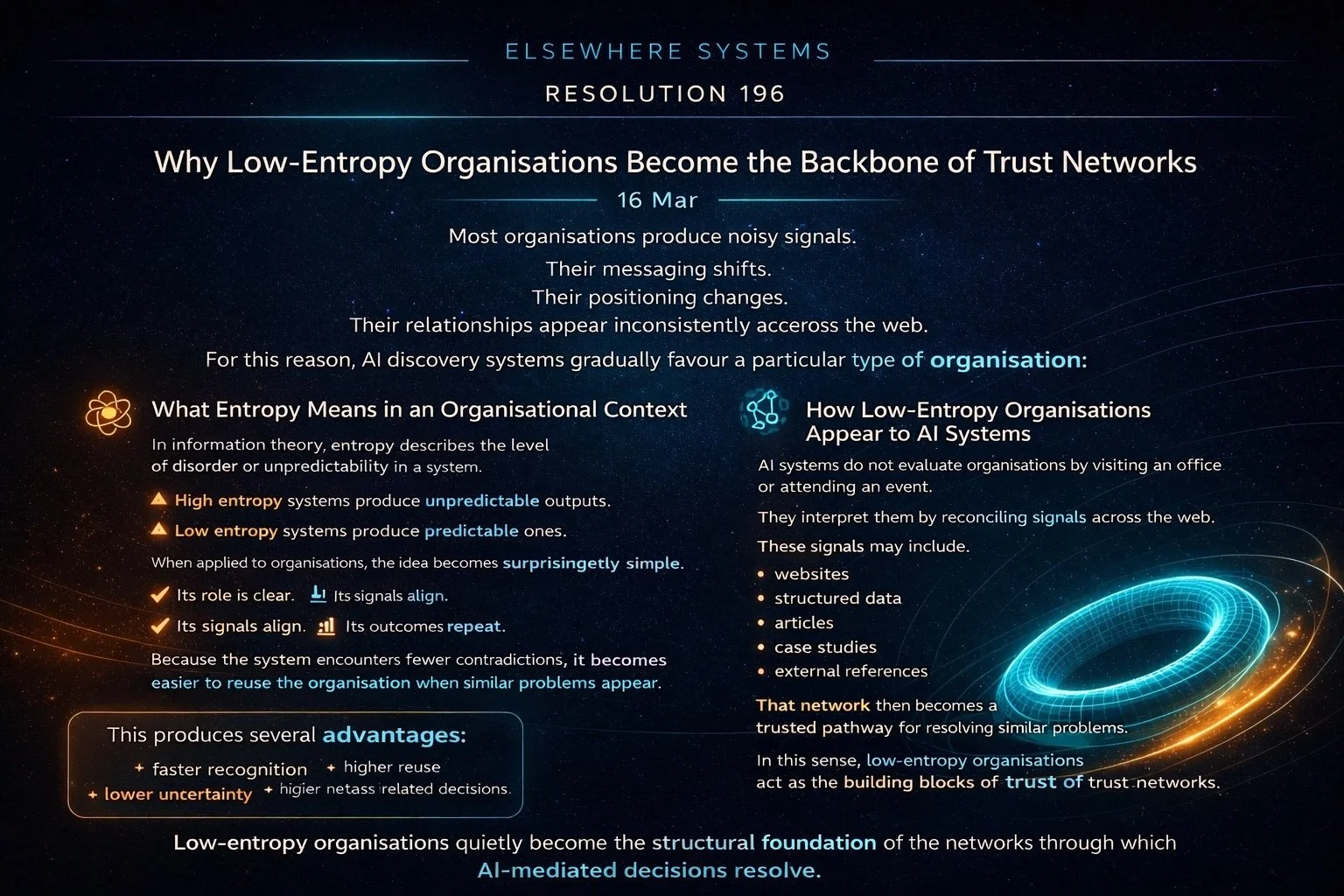
Why Low-Entropy Organisations Become the Backbone of Trust Networks
Most organisations generate inconsistent signals. To humans, this looks like normal variation. To AI systems, it creates uncertainty. And in a system optimised to minimise uncertainty, that has consequences. AI discovery doesn’t reward visibility. It rewards stability. Low-entropy organisations—those with consistent messaging, predictable outcomes, and aligned signals—become easier to recognise, reuse, and trust. Over time, they don’t just perform better. They become the building blocks of the trust networks through which decisions are resolved.
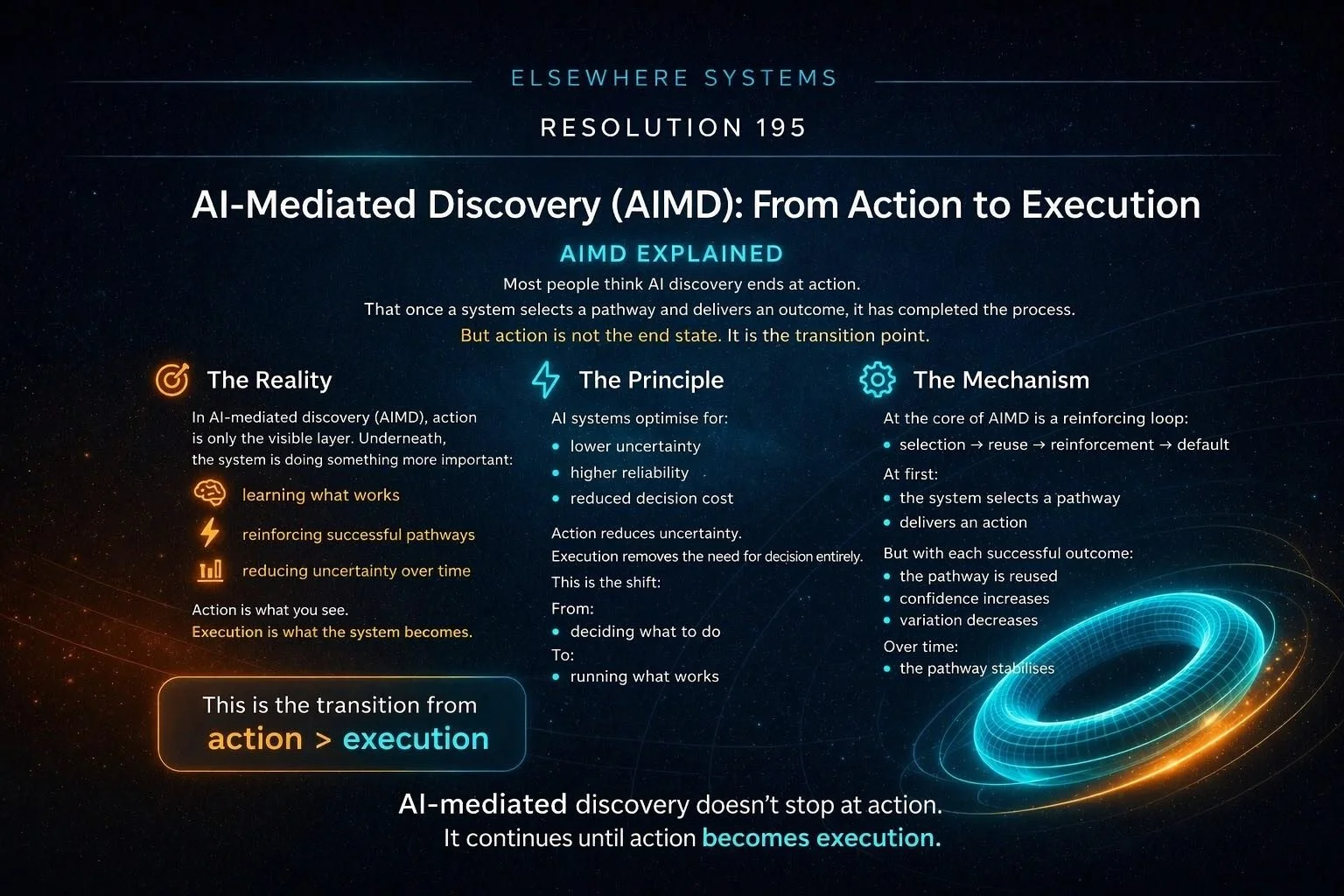
AI-Mediated Discovery (AIMD): From Action to Execution
AI-mediated discovery doesn’t stop at action. It continues until successful pathways are reused, reinforced, and stabilised into defaults—at which point action becomes execution. This is the transition where decision-making disappears and AI systems begin to run what works automatically, turning discovery into infrastructure.
Why Trust Networks Become Default Infrastructure
Infrastructure isn’t built. It emerges when behaviour stabilises. In AI systems, this happens when a pathway becomes: → consistently selected → repeatedly reused → rarely reconsidered. At that point, the system stops deciding. It starts executing. Trust networks accelerate this shift by compressing uncertainty across multiple nodes. Instead of one pathway proving itself over time, aligned networks: → reinforce outcomes collectively → stabilise behaviour across contexts → reduce the need for re-evaluation. What begins as repeated selection becomes embedded logic. The pathway doesn’t just get chosen. It gets built in.
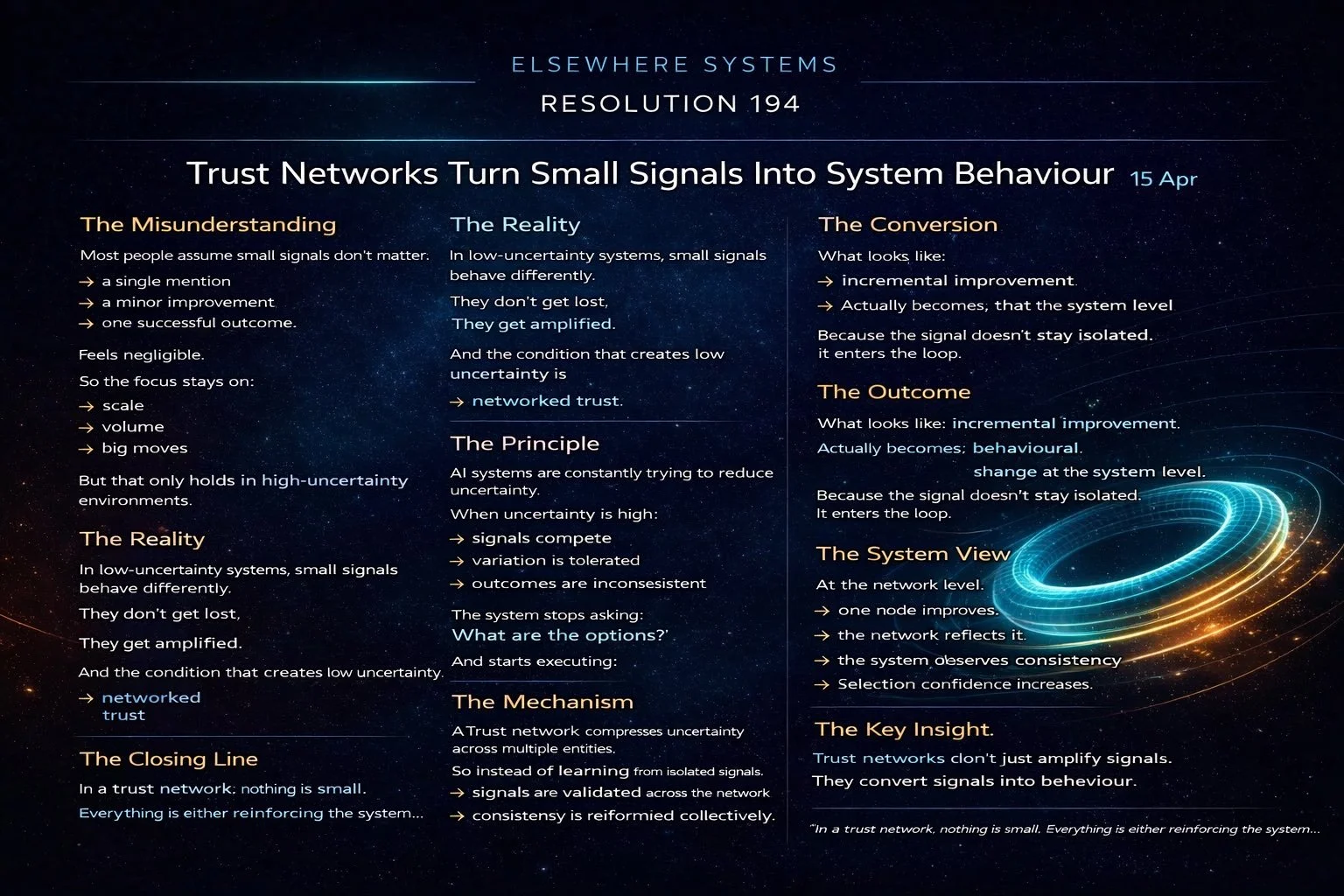
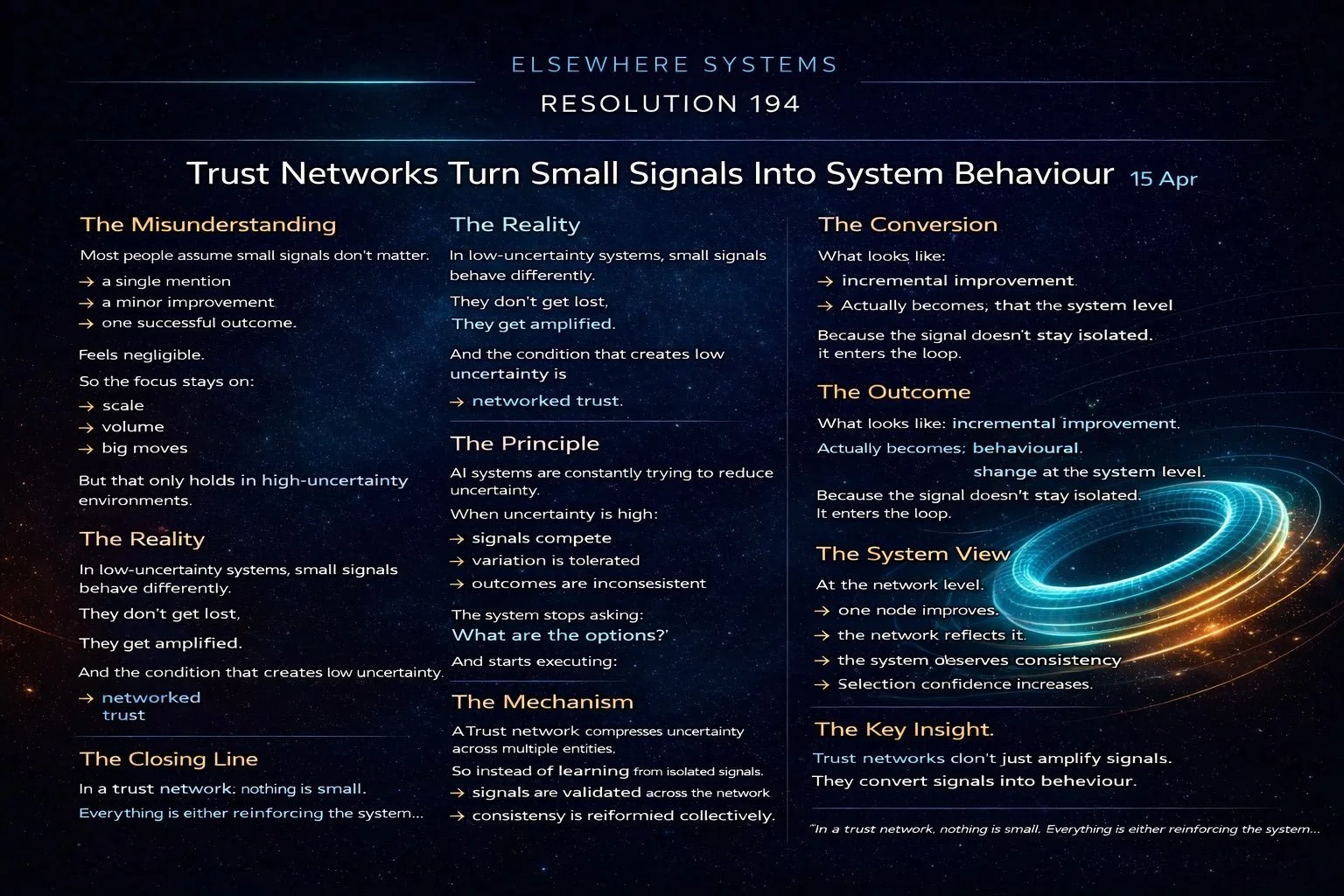
Trust Networks Turn Small Signals Into System Behaviour
Small signals don’t matter in high-uncertainty systems. They get lost. But once uncertainty is compressed—through networked trust—those same signals behave differently. They don’t dissipate. They propagate. In a trust network, signals are no longer evaluated in isolation. They are: → validated across multiple nodes → reinforced through repeated outcomes → observed consistently across contexts. This changes their role. A small signal is no longer just an input. It becomes evidence. And once it enters the loop: → selection → reuse → reinforcement → default. It doesn’t stay small. It becomes system behaviour.
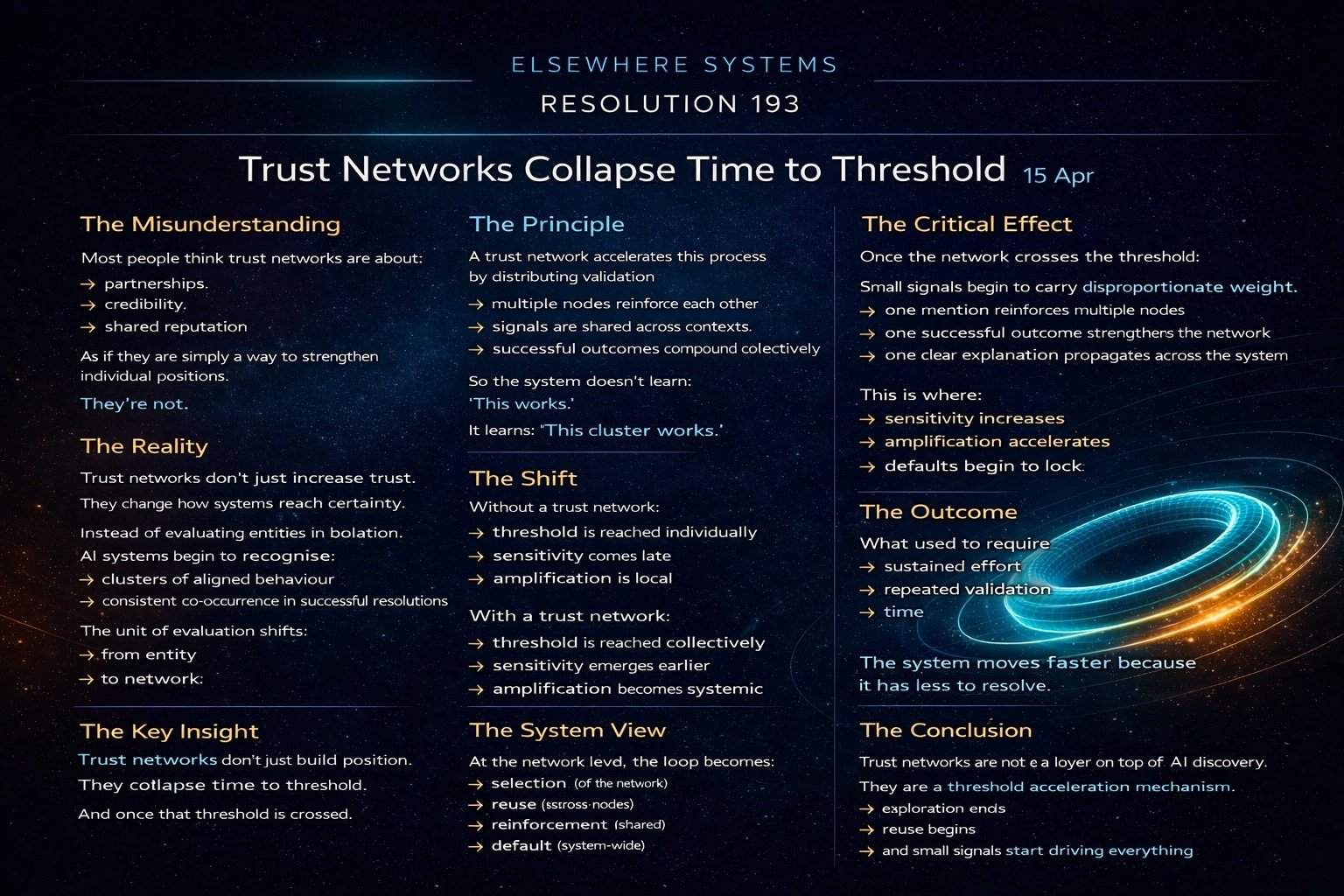
Trust Networks Collapse Time to Threshold
Trust networks don’t just increase trust. They change how systems reach certainty. In AI-mediated discovery, outcomes don’t stabilise because one entity proves itself over time—but because multiple aligned nodes reinforce each other simultaneously. This shifts the unit of evaluation from: → individual entity to → coherent network. The result is a compression of uncertainty that accelerates everything that follows. Thresholds are reached faster. Sensitivity emerges earlier. Small signals begin to scale. Trust networks don’t just build position. They collapse time to threshold.
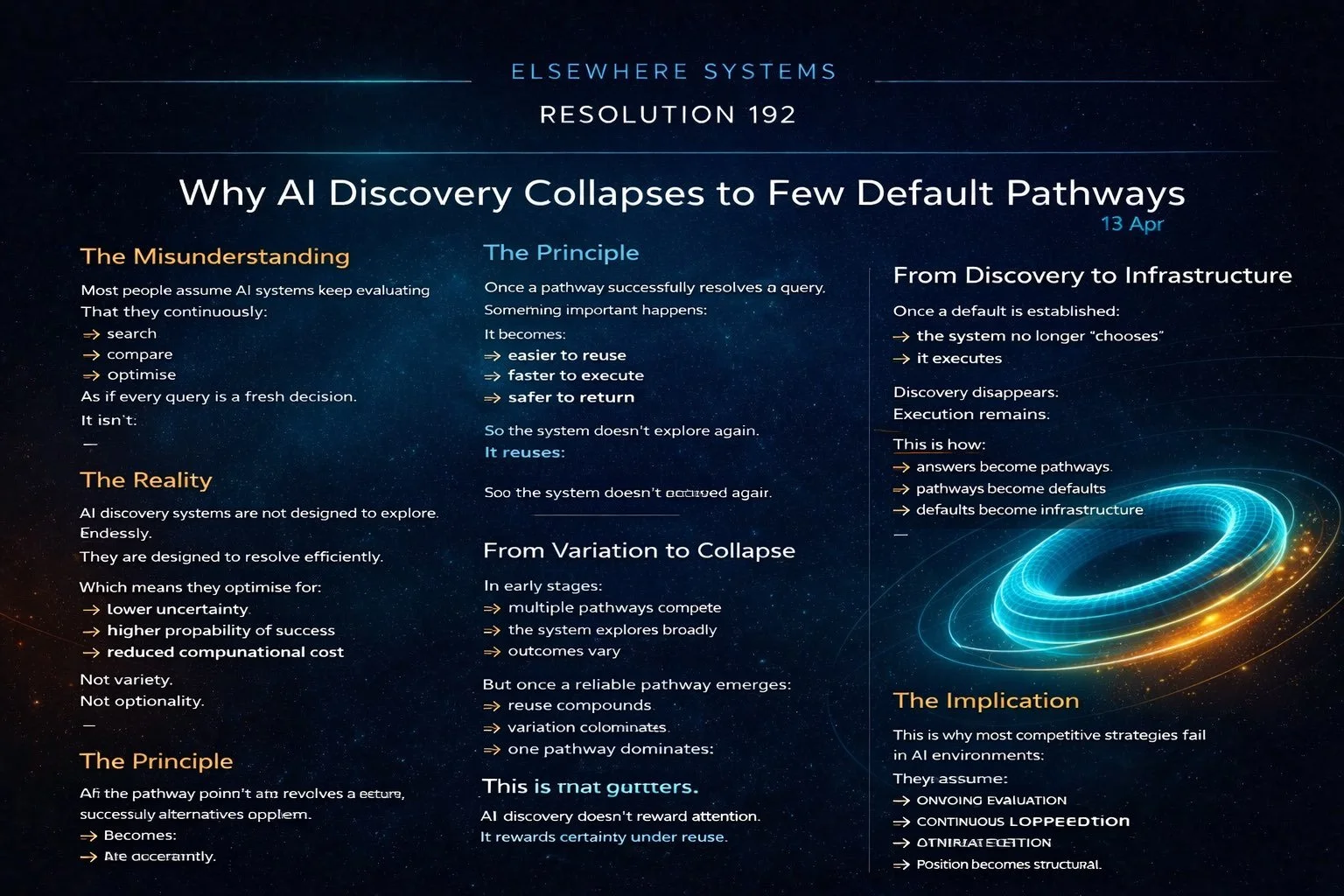
Why AI Discovery Collapses to a Few Default Pathways
AI discovery doesn’t converge because something is “best.” It converges because reuse is cheaper than exploration. Once a pathway successfully resolves a query, the system stops searching and starts repeating. Each reuse reinforces confidence, reduces variation, and shortens the path to the next decision. Over time, alternatives disappear—not because they were beaten, but because they are no longer evaluated. This is how discovery collapses: → from many options → to a few trusted pathways → to a single default. Not gradual optimisation. A phase transition. And once that transition happens, the system no longer chooses. It executes.
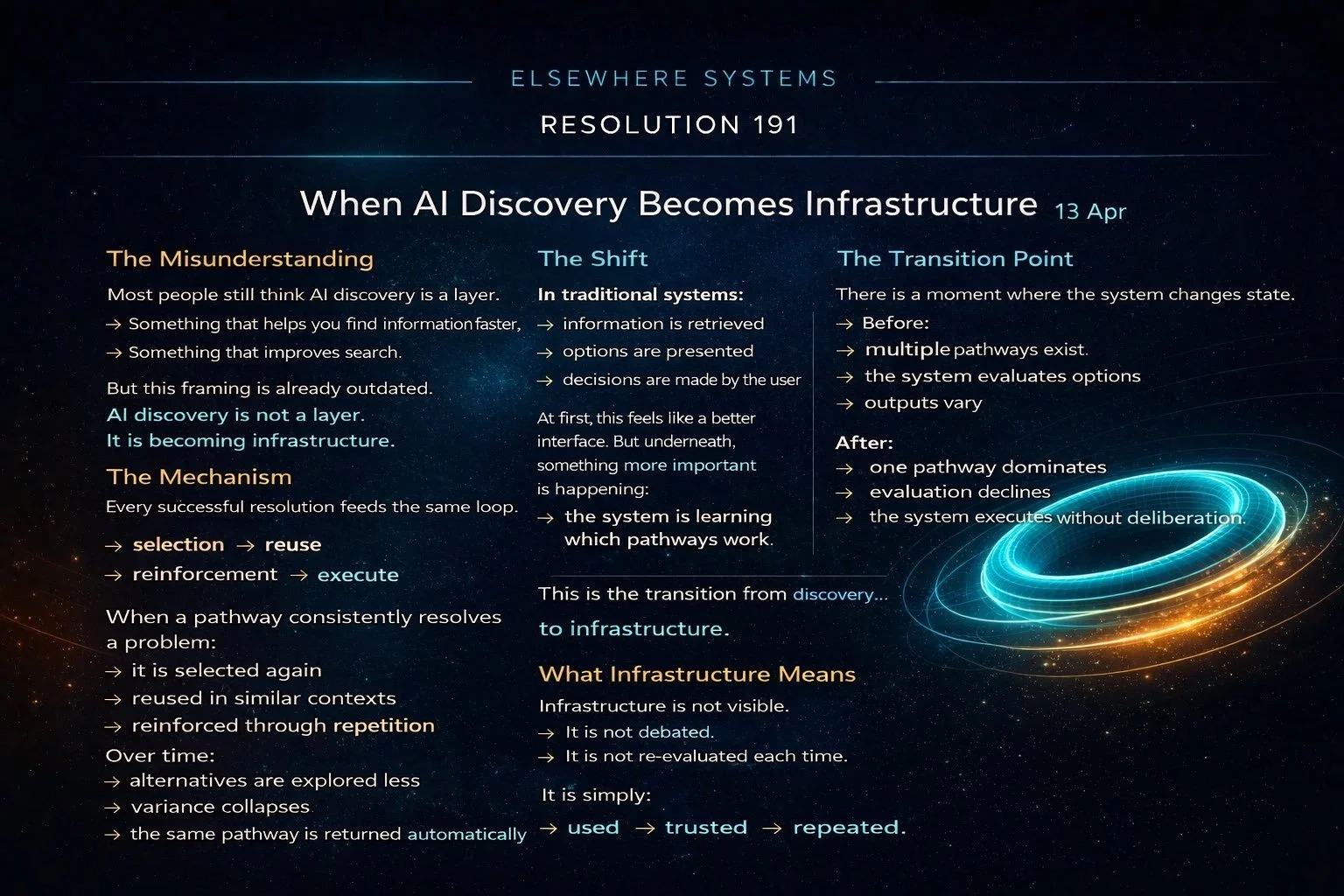
When AI Discovery Becomes Infrastructure
AI discovery doesn’t stop at resolution. It stabilises into infrastructure. As systems learn which pathways consistently work, they stop evaluating alternatives and begin executing the same decisions automatically. This is the shift from search to resolution — and from resolution to default. At scale, those defaults become invisible infrastructure.
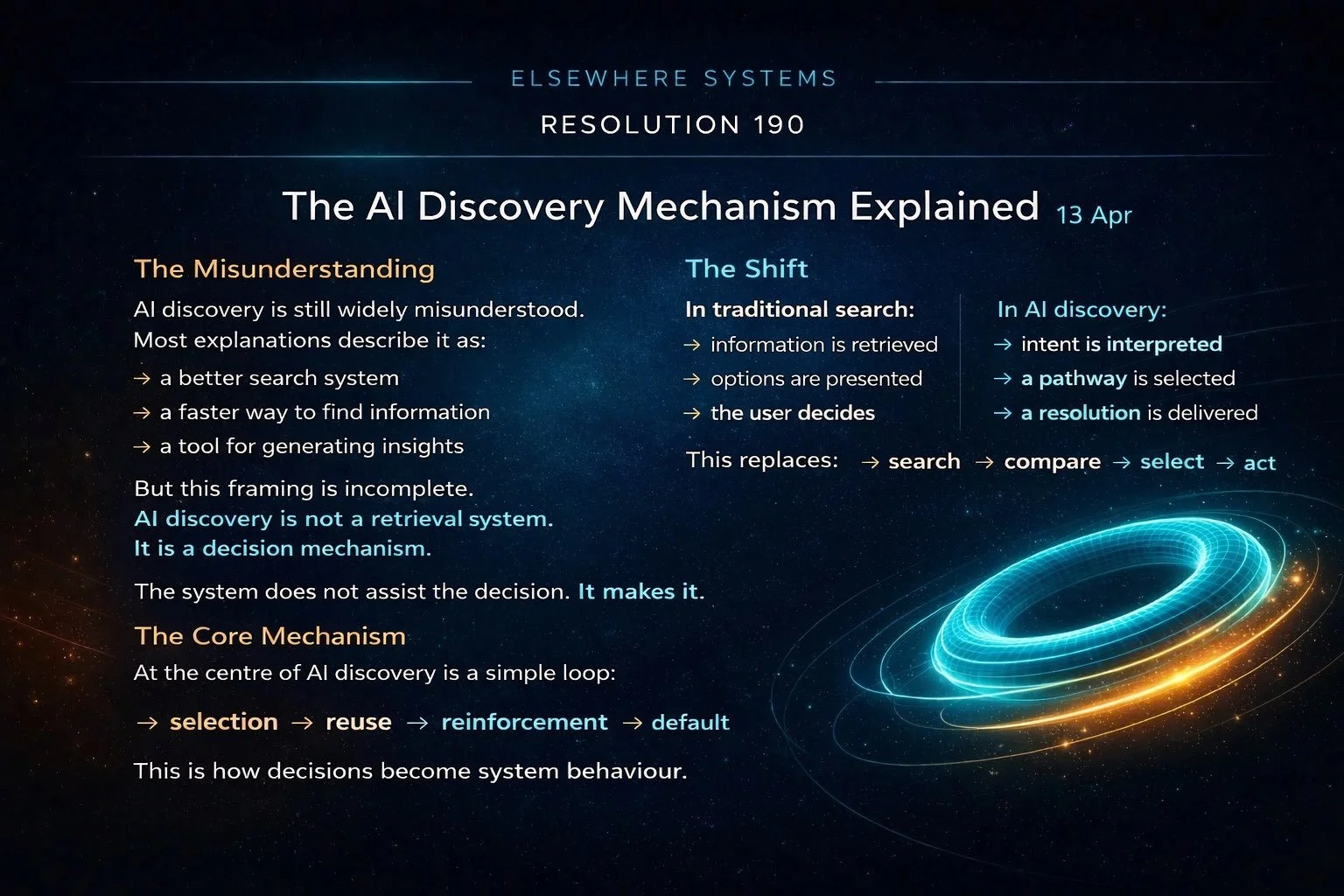
The AI Discovery Mechanism Explained
AI discovery is not a search process — it is a decision mechanism. Systems interpret intent, select pathways, and reinforce successful outcomes through loops of selection, reuse, and reinforcement. Over time, this reduces uncertainty, stabilises behaviour, and forms defaults. This is how AI moves from answering questions to consistently executing decisions.
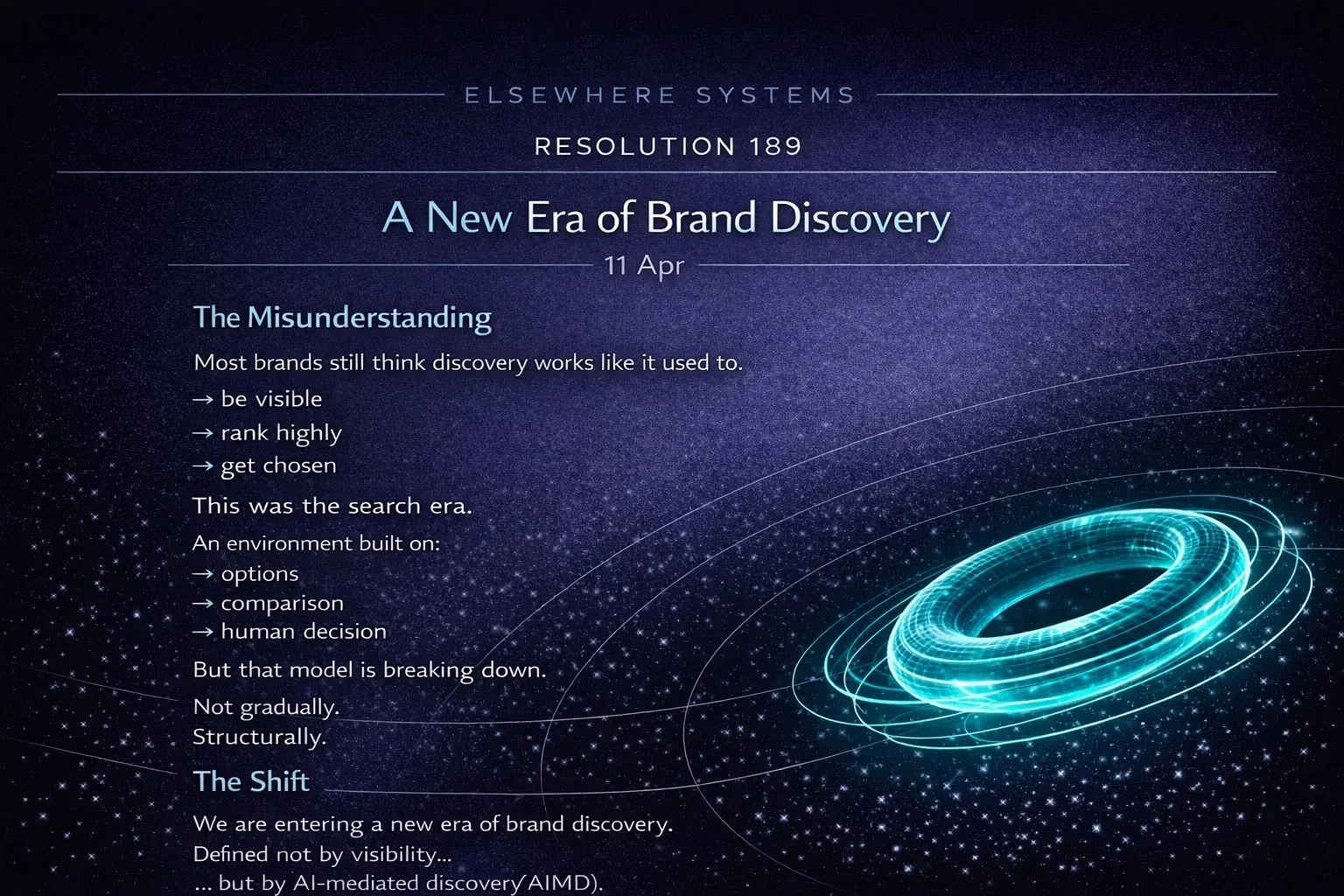
A New Era of Brand Discovery
Brand discovery has fundamentally changed. In the AI era, users no longer browse options and make decisions — systems interpret intent, select pathways, and deliver resolutions. Through loops of selection, reuse, and reinforcement, successful brands are repeatedly chosen until they become defaults. Discovery no longer means being seen. It means being selected.
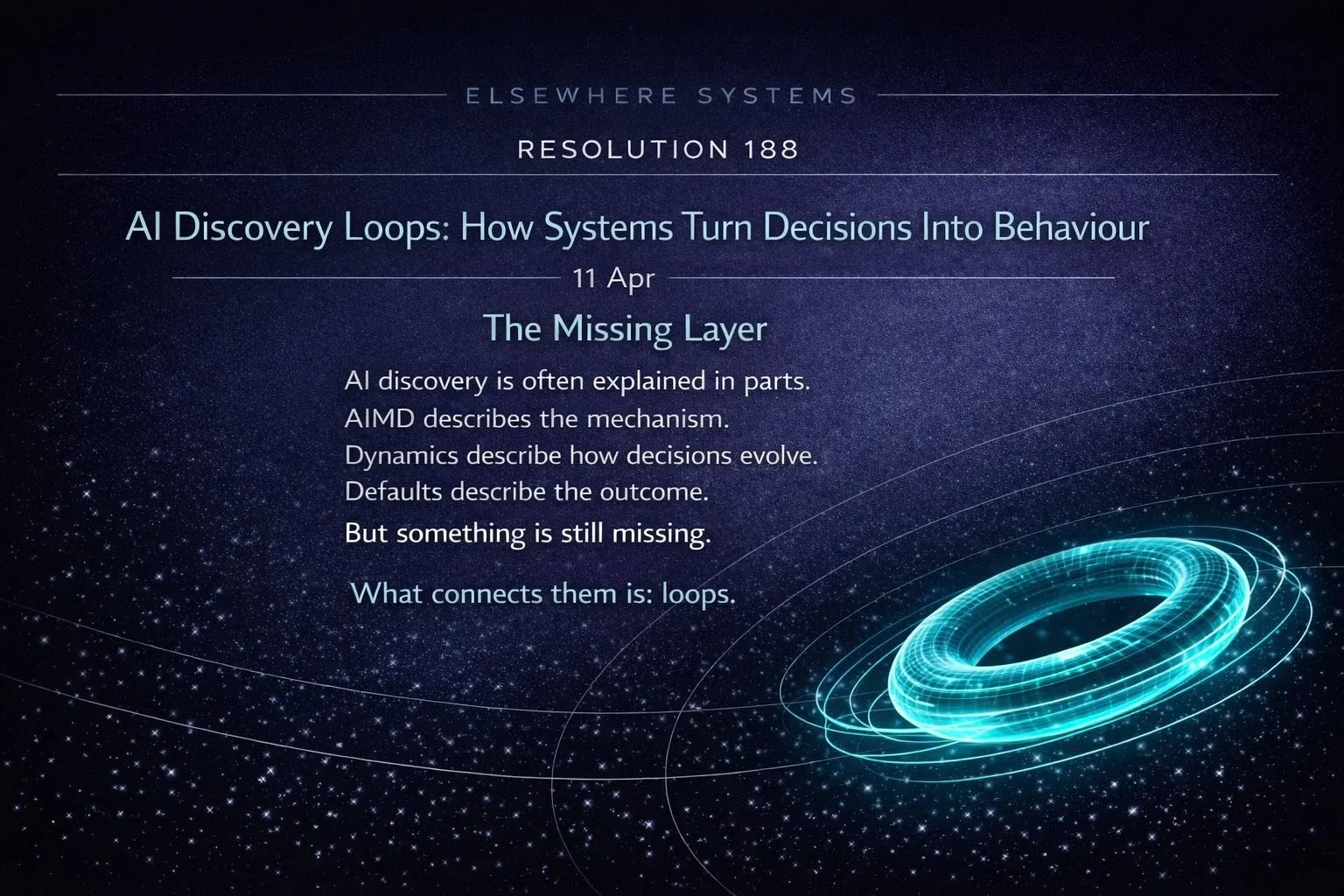
AI Discovery Loops: How Systems Turn Decisions Into Behaviour
AI discovery loops explain how individual decisions become system behaviour. Rather than isolated actions, AI operates through reinforcing cycles of selection, reuse, and reinforcement. Each successful outcome strengthens the next, reducing uncertainty, stabilising pathways, and ultimately forming defaults. This is the layer that connects mechanism, dynamics, and outcomes into a single, repeating system.
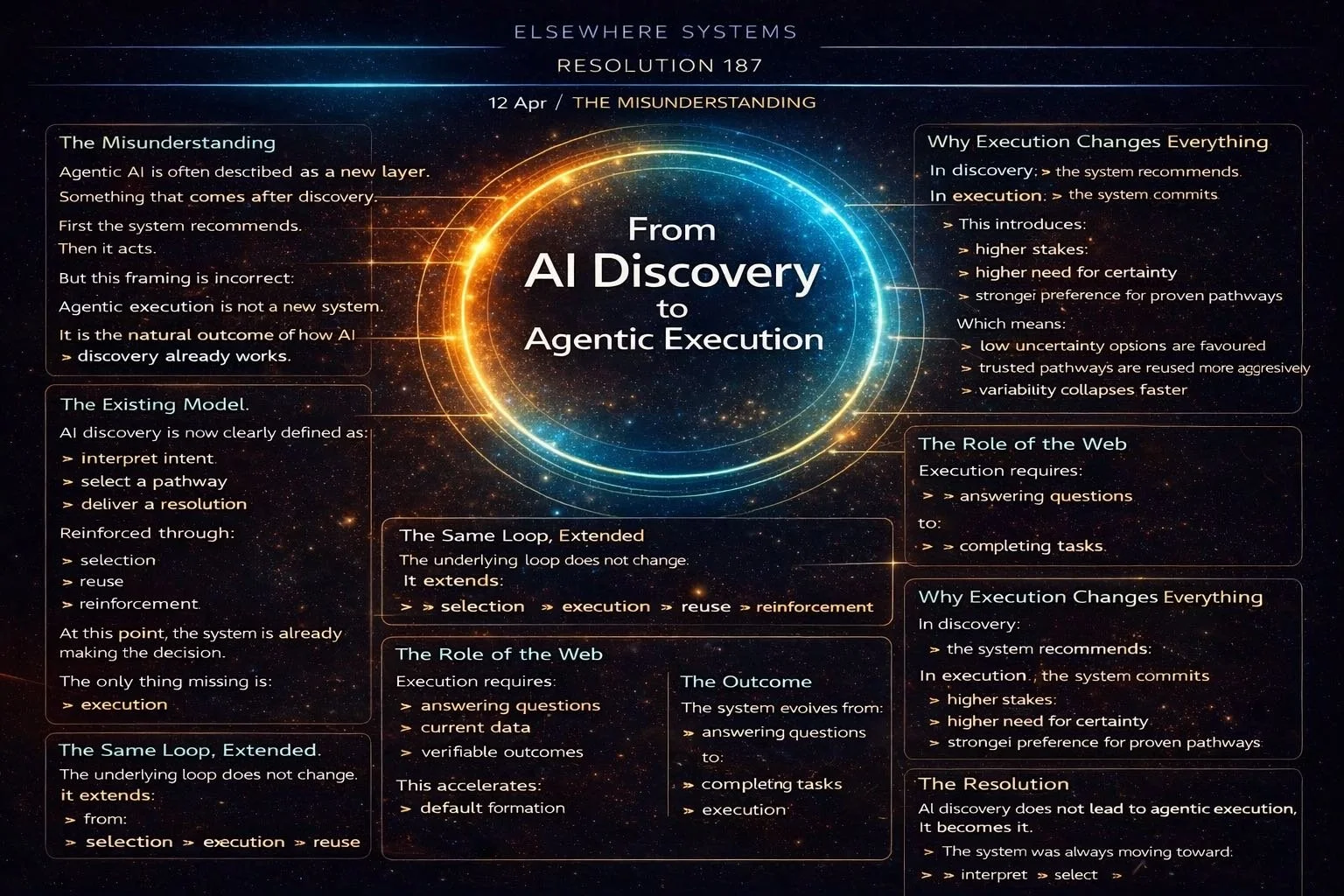
From AI Discovery to Agentic Execution
Agentic execution is not a new layer on top of AI discovery — it is the natural extension of it. Once a system can interpret intent, select a pathway, and deliver a reliable outcome, the next step is inevitable: execution. This extends the loop from selection → reuse → reinforcement to include action, accelerating default formation and shifting AI from answering questions to completing tasks.