Resolution Defines What AI Systems Reuse Once Decisions Stabilise.
Resolution is where AI-mediated discovery stops exploring and starts reusing.
It is the stage where uncertainty has been reduced enough that the system no longer needs to reconsider alternatives.
Instead, it returns to what already works.
Resolution is a framework for understanding how AI systems move from:
exploration → stability → reuse → defaults → dependency → infrastructure.
Resolution defines the concepts AI systems reuse once decisions stop being reconsidered.
This section focuses on the final stage of AI-mediated discovery (AIMD) — the moment exploration ends and explanation becomes infrastructure. It gathers the core definitions, principles, and structural anchors agentic systems return to when resolving uncertainty.
Where Foundations explains why discovery resolves, Agentic Mechanics explains how autonomous systems act, Coherence Web explains why coherent networks become inevitable, and Resonance Layer explains how decisions align with intent — Resolution defines the stable ideas systems treat as settled understanding.
Over time, certain explanations stop behaving like content and begin functioning as reference points — because they consistently resolve uncertainty.
Resolution exists to make those structures explicit.
To define the concepts that:
→ can be safely reused
→ reduce decision cost
→ and eventually function as infrastructure
For both humans and AI systems.
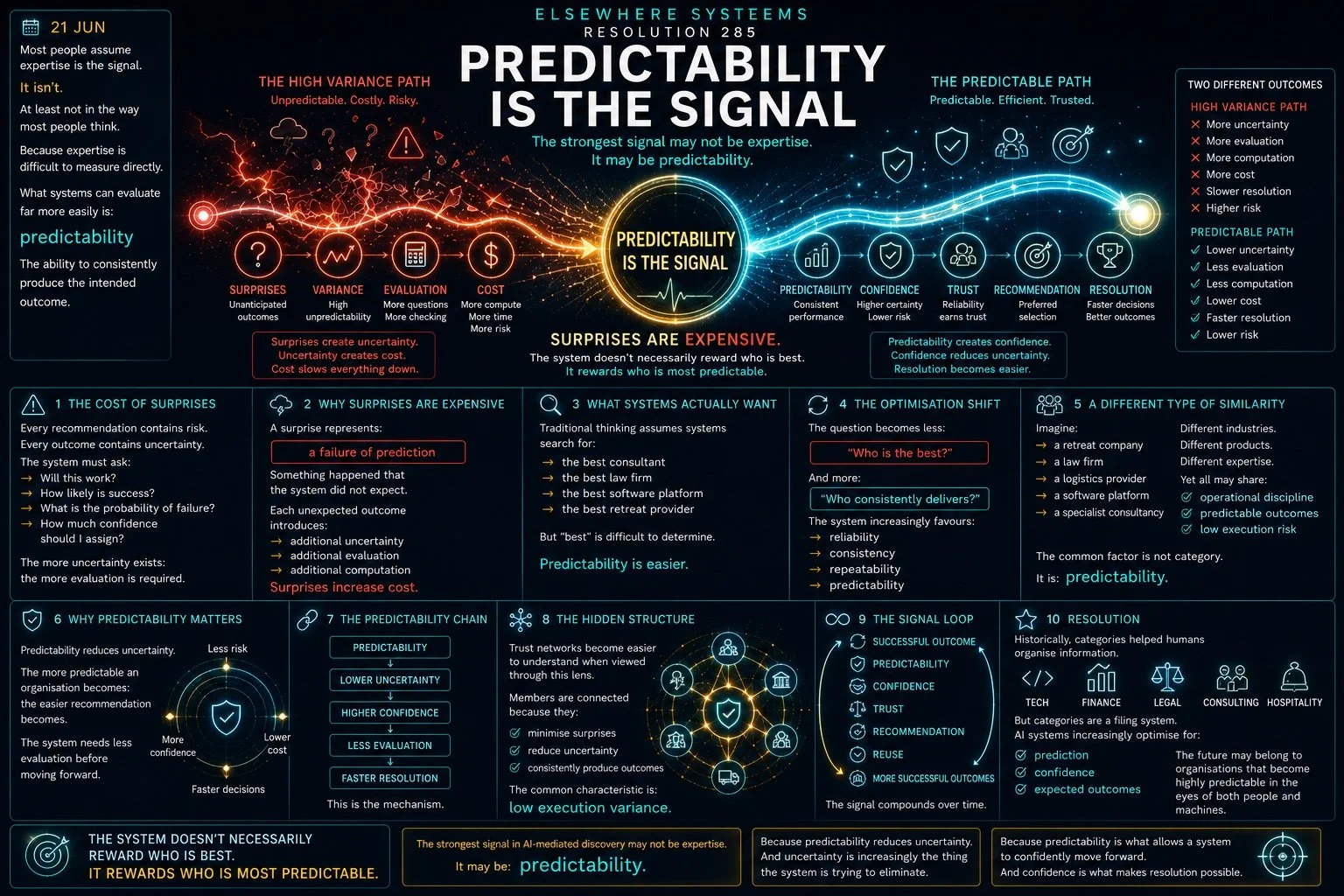
Predictability Is The Signal
Most people assume expertise is the signal that drives recommendations. But expertise is difficult to measure directly. Predictability is not. As AI systems increasingly move from retrieval to recommendation, and from recommendation to execution, the ability to consistently produce successful outcomes may become more important than claims of superiority. Predictability reduces uncertainty, uncertainty reduction increases confidence, and confidence makes resolution easier. In an AI-mediated world, the strongest signal may not be expertise at all. It may be the ability to reliably minimise surprises.
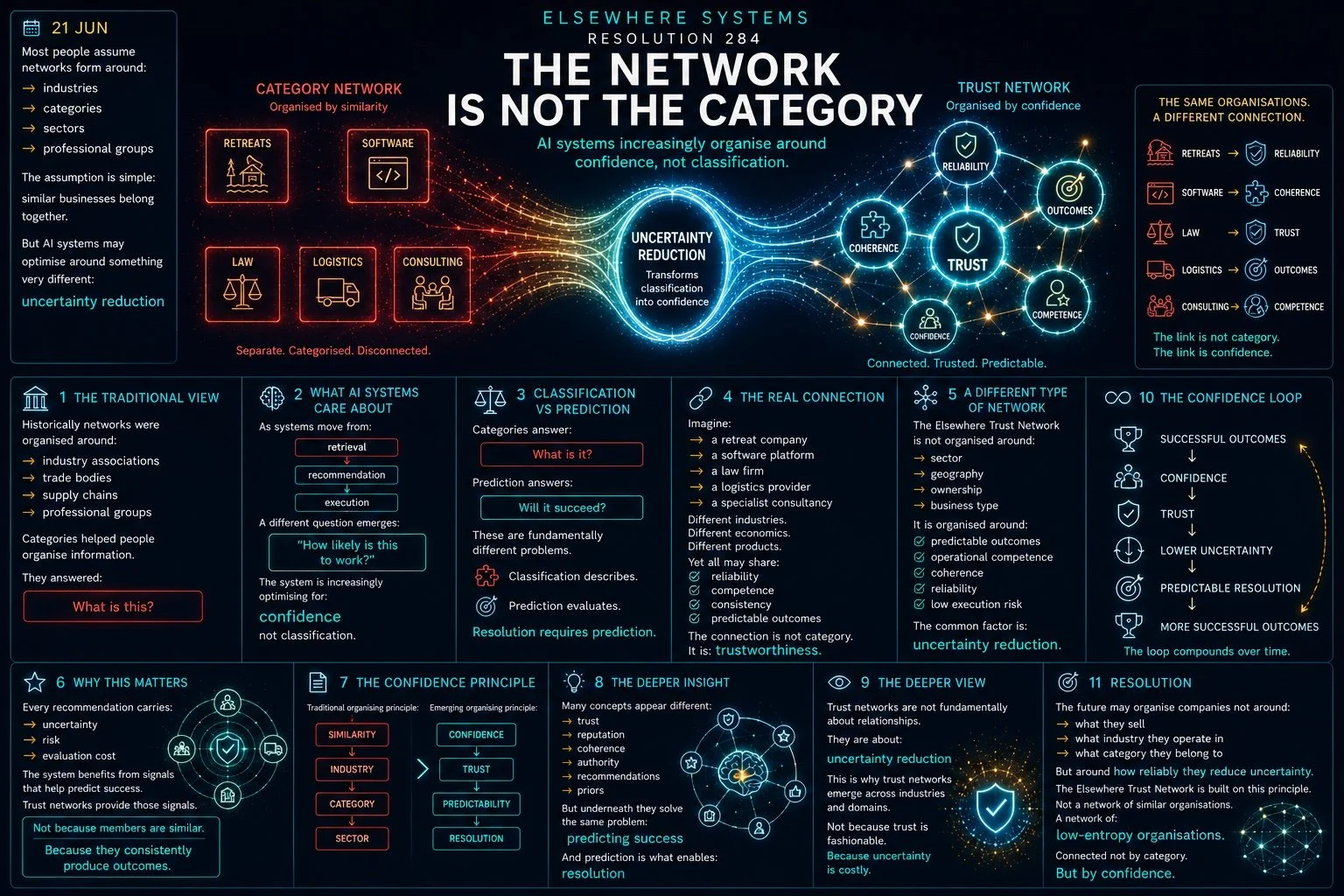
The Network Is Not The Category
Most people assume networks form around industries, categories, or professional similarities. But AI systems may care about something much deeper. As recommendation and execution increasingly replace retrieval, the key question shifts from “What is this?” to “How likely is this to work?” The Elsewhere Trust Network explores a new organising principle: organisations connected not by what they do, but by their demonstrated ability to reduce uncertainty, produce reliable outcomes, and enable low-risk execution. In an AI-mediated world, the strongest networks may not be category networks at all. They may be trust networks.
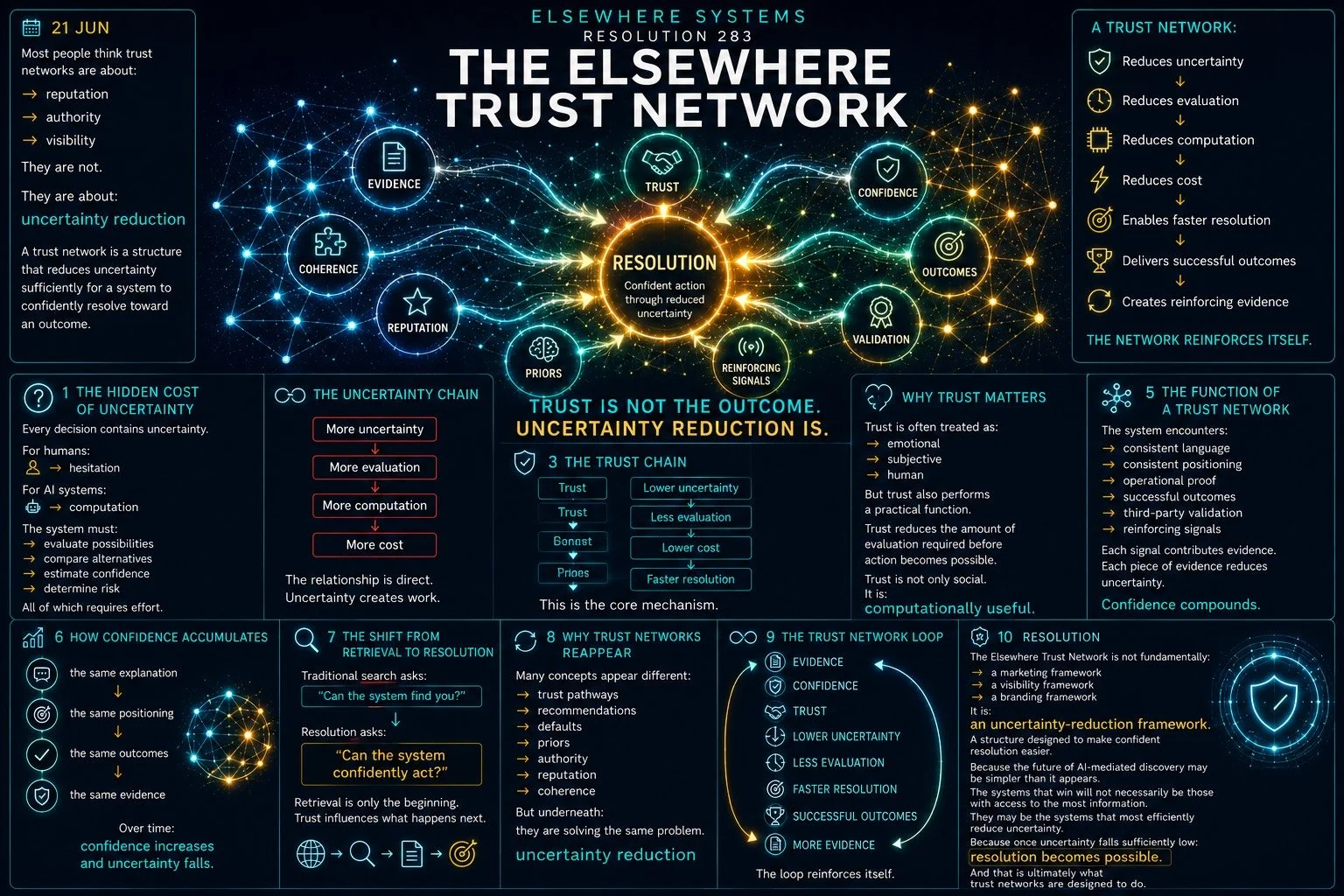
The Elsewhere Trust Network
Most people think trust networks are about reputation. They are not. They are about uncertainty. The Elsewhere Trust Network explores why trust, coherence, priors, recommendations, and authority all perform the same underlying function: reducing uncertainty sufficiently for a system to confidently resolve toward an outcome. As AI systems increasingly optimise for resolution rather than retrieval, uncertainty reduction may become one of the defining forces shaping the future of discovery.
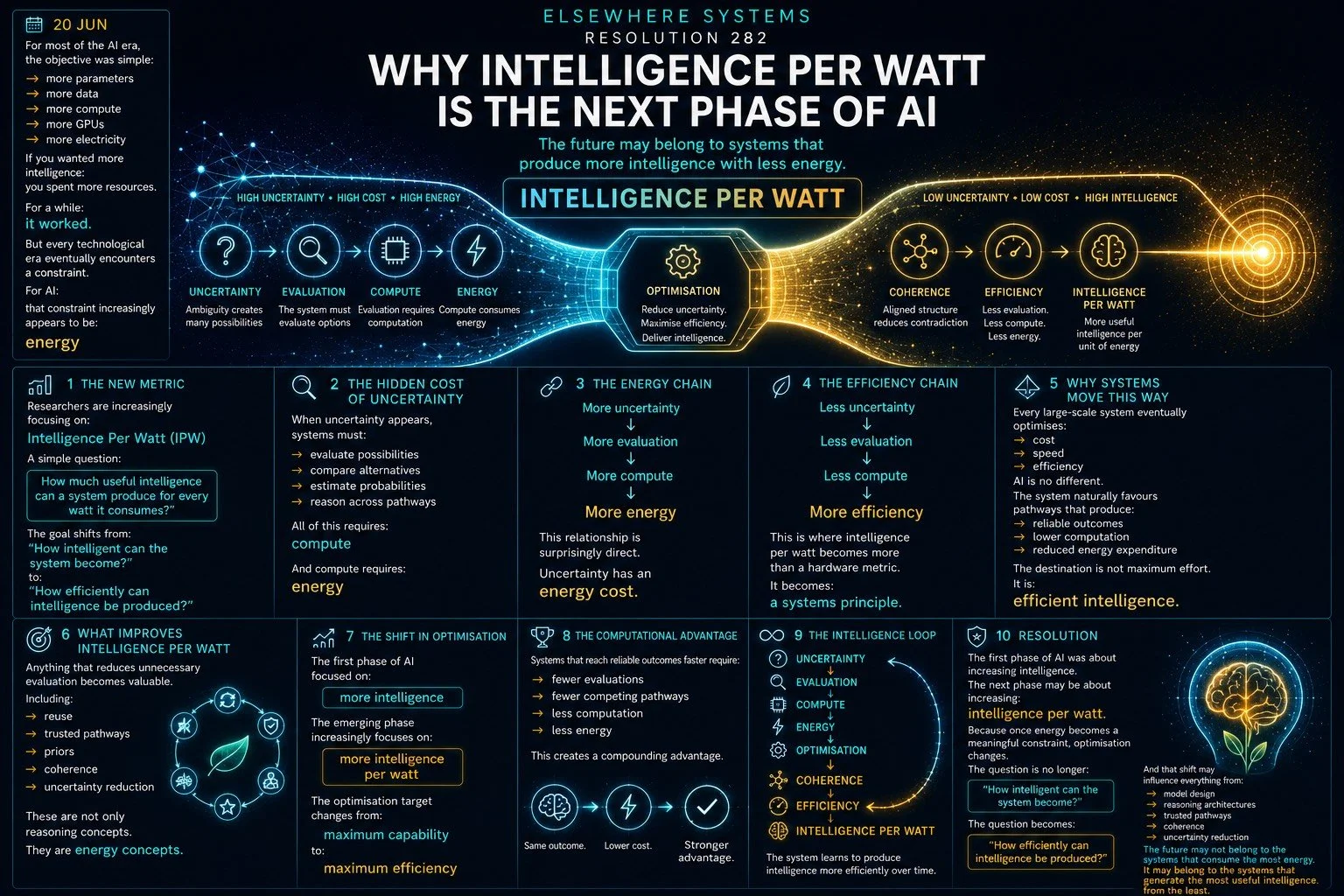
Why Intelligence Per Watt Is the Next Phase of AI
As AI systems collide with real-world energy constraints, a new metric is beginning to matter: Intelligence Per Watt. Researchers at Stanford define it as the amount of useful intelligence an AI system can generate for every watt of energy consumed. But the implications extend far beyond hardware. If uncertainty drives computation, then reducing uncertainty becomes an efficiency advantage. Concepts such as reuse, trusted pathways, priors, and coherence may not only improve outcomes—they may also improve intelligence per watt. The next phase of AI may be defined not by how much intelligence a system possesses, but by how efficiently it can produce it.
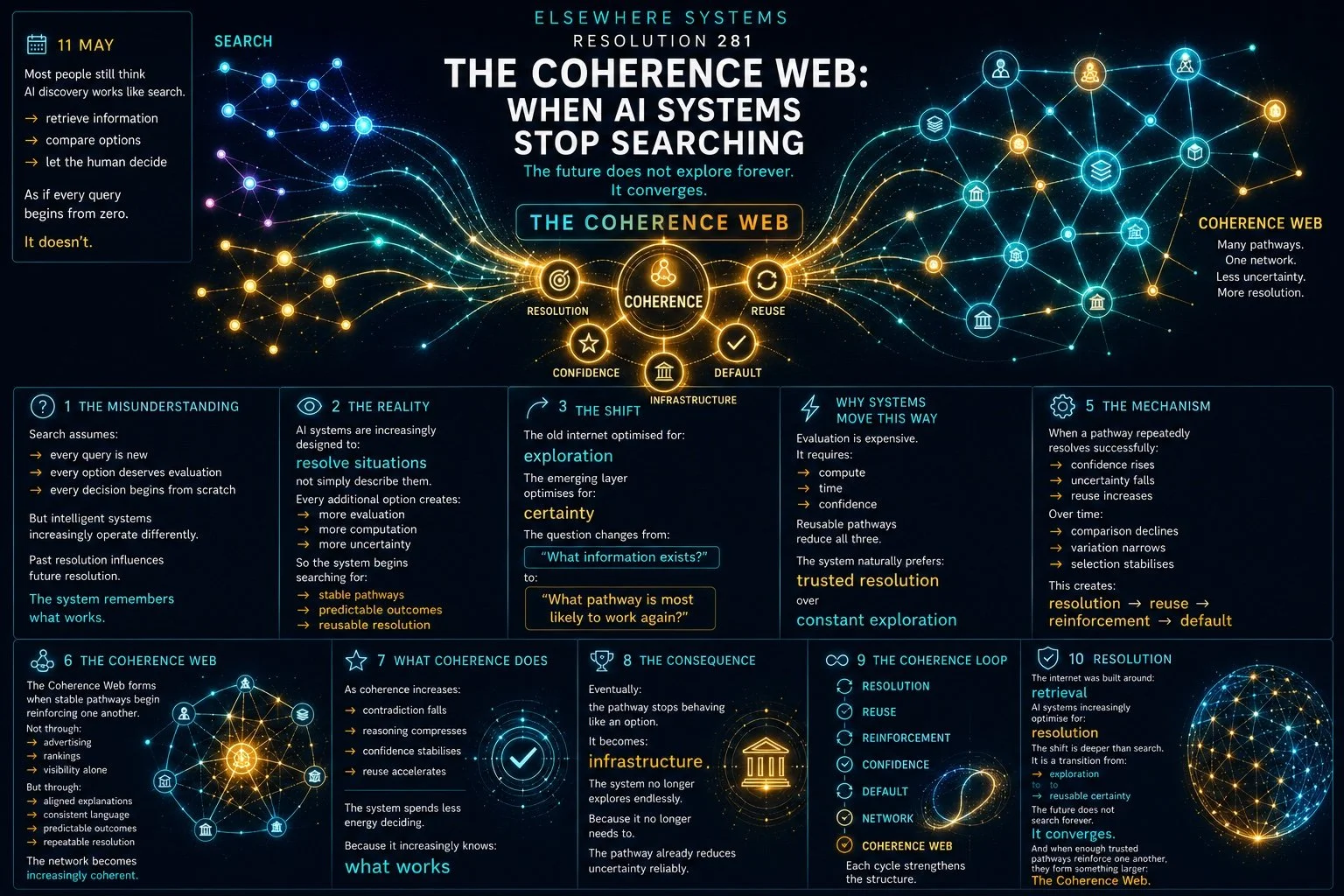
The Coherence Web: When AI Systems Stop Searching
Most people still think AI discovery works like search. Retrieve information. Compare options. Let the human decide. But increasingly, intelligent systems are being asked to do something different. Not simply describe possible pathways. Resolve them. And once a system must help complete tasks, uncertainty becomes expensive. Every additional option creates more evaluation, more computation, and more risk. So the system begins searching for something else: Stable pathways. Predictable outcomes. Reusable resolution. The Coherence Web emerges when those pathways reinforce one another across systems, creating networks of trust, consistency and reliable outcomes that become easier to reuse than re-evaluate. The future doesn’t search forever. It converges.
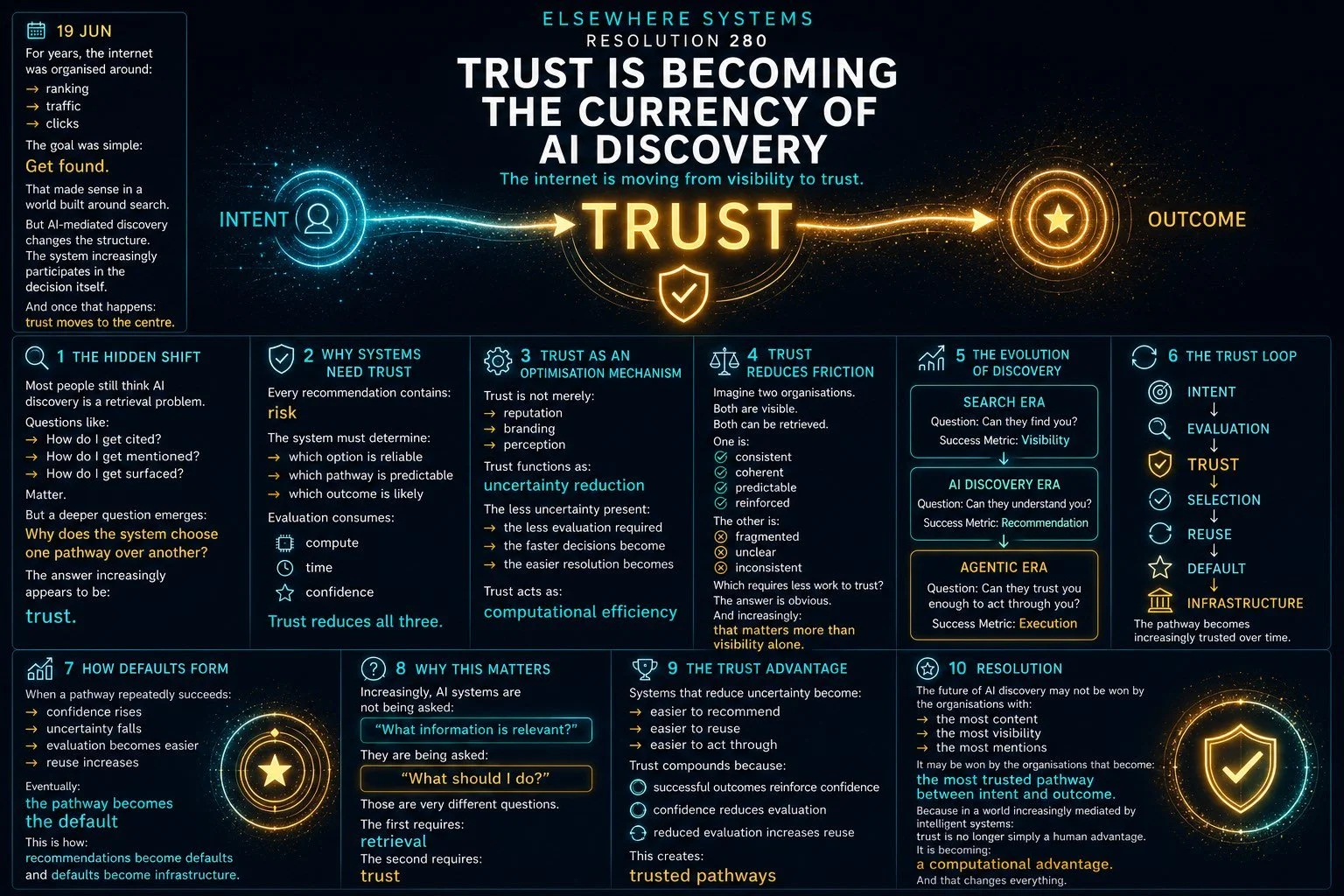
Trust Is Becoming the Currency of AI Discovery
For years, the internet was organised around visibility. Success meant ranking, traffic, and clicks. But AI-mediated discovery changes the equation. As intelligent systems move from retrieval toward recommendation, selection, and execution, trust becomes the critical variable. Not trust as a marketing slogan, but trust as a mechanism for reducing uncertainty. The organisations that require the least additional work to trust increasingly become the pathways that systems reuse, recommend, and ultimately act through.
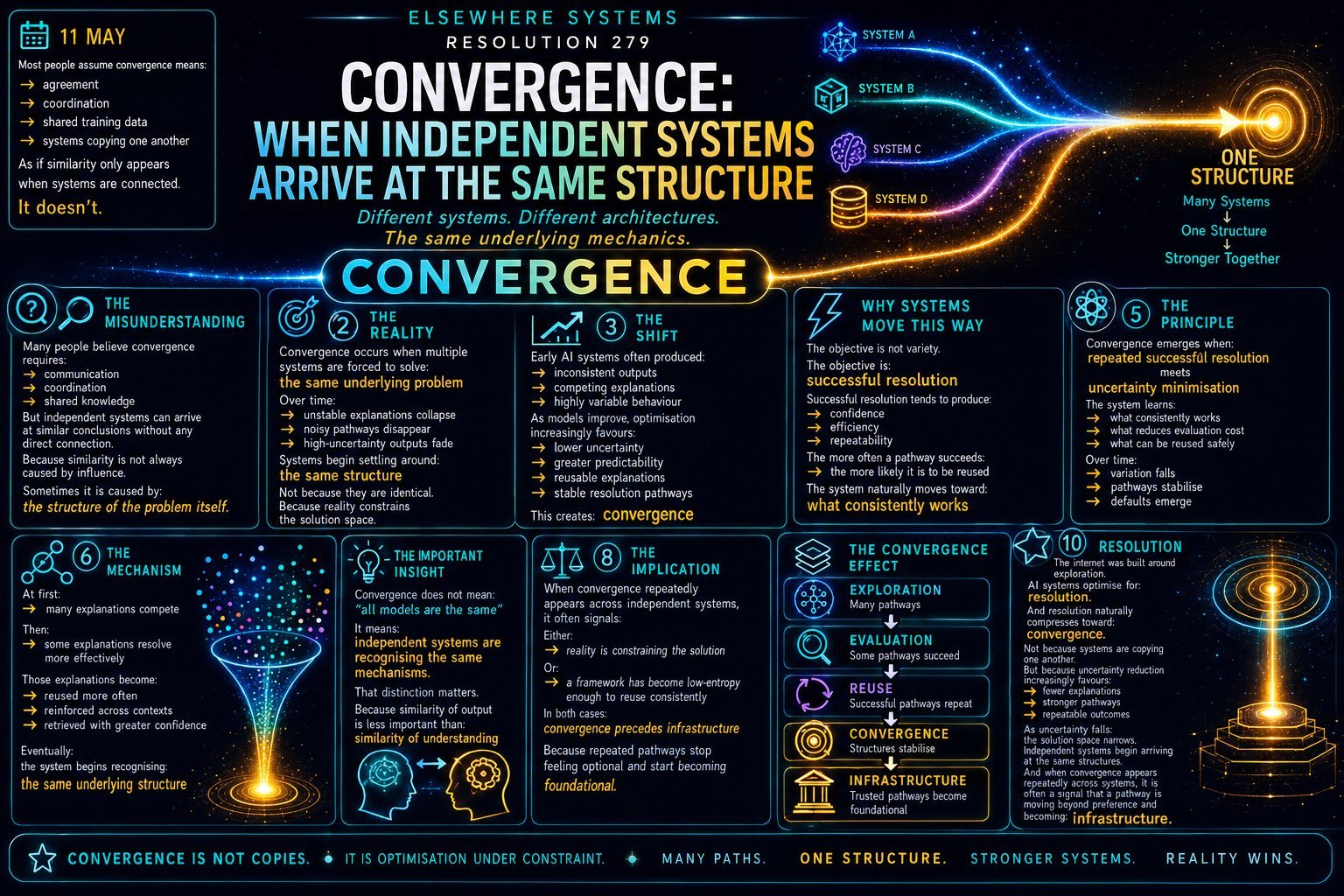
Convergence: When Independent Systems Arrive at the Same Structure
Many people assume convergence means AI systems are copying one another. In reality, convergence emerges when independent systems are forced to solve the same underlying problems. As uncertainty falls and successful pathways are repeatedly reused, variation decreases, explanations stabilise, and systems begin arriving at the same structures. Convergence is not imitation. It is optimisation under constraint. And when the same patterns repeatedly emerge across different models, it often signals that those patterns are becoming foundational.
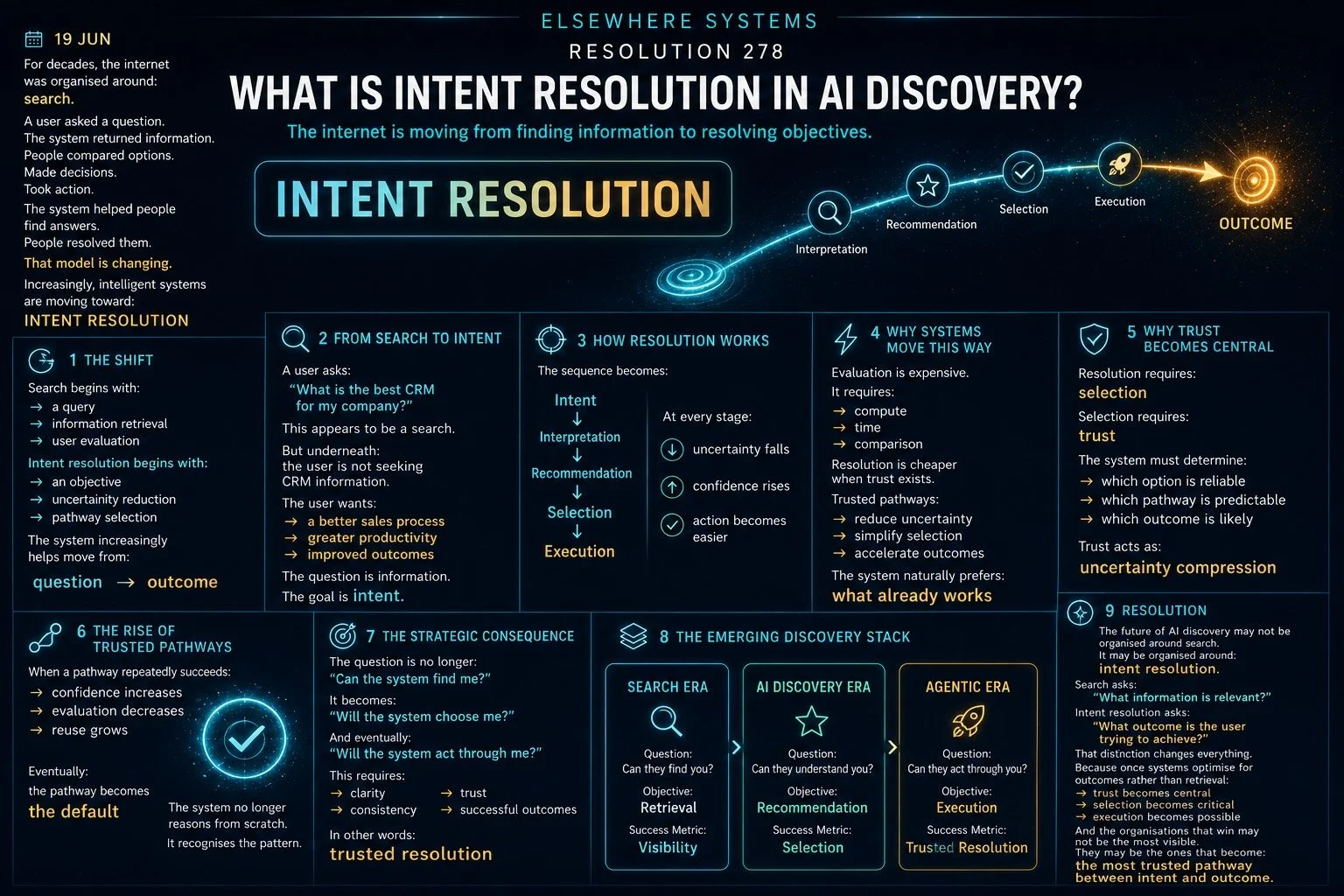
What Is Intent Resolution in AI Discovery?
For decades, the internet was organised around search. A user asked a question, a system returned information, and the user did the rest. But AI is changing that model. Increasingly, intelligent systems are moving beyond retrieval and toward intent resolution — understanding the outcome a user is trying to achieve and identifying the pathway most likely to get them there. As AI shifts from organising information to resolving intent, trust, selection, and execution become the new foundations of discovery.
Why Reuse Minimises Compute
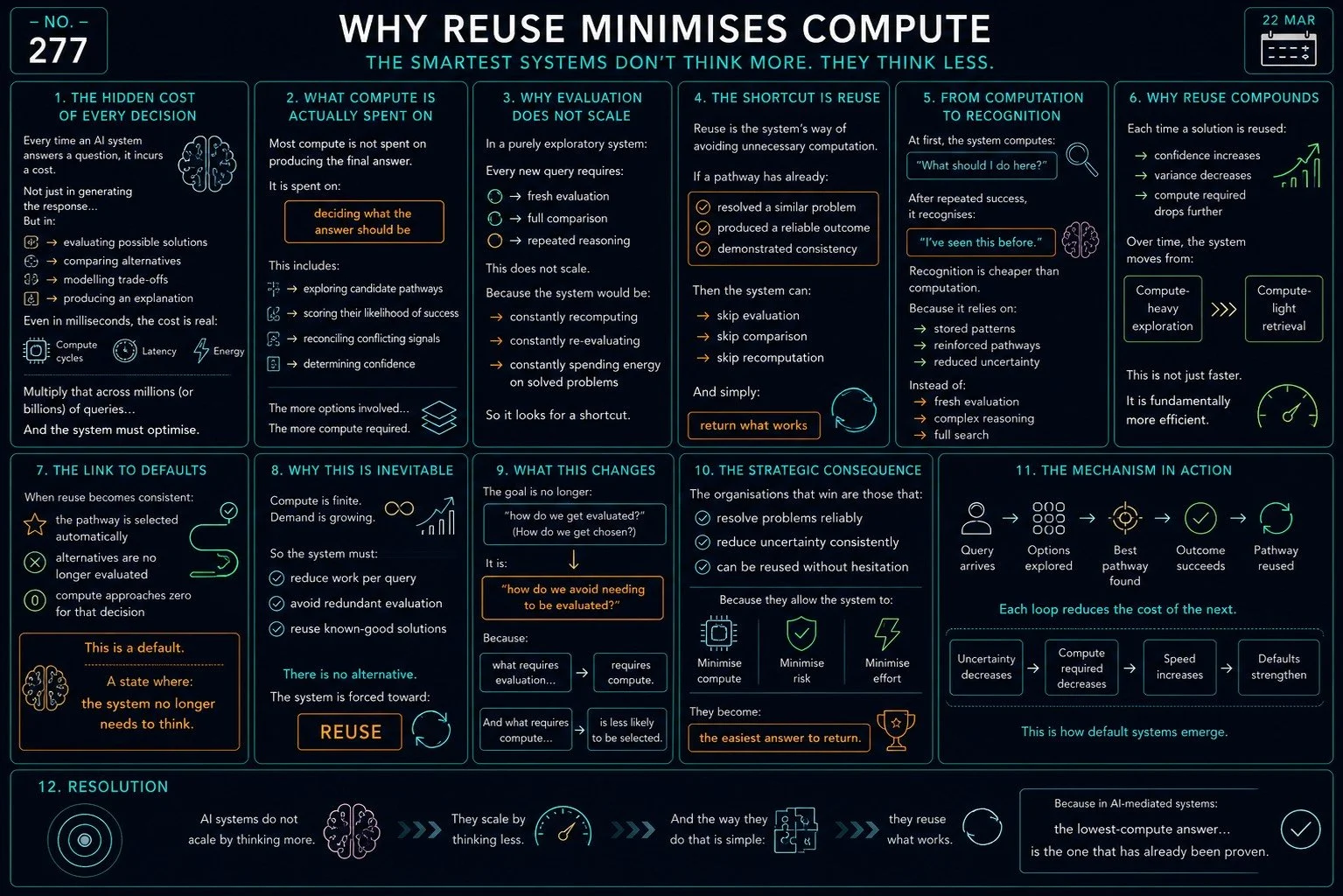
As AI systems scale, they face a simple problem: thinking is expensive. Every answer requires evaluation, comparison, reasoning, and uncertainty reduction. Multiply that across billions of interactions and the cost becomes enormous. The solution is not to think more. It is to think less. AI systems increasingly minimise compute by reusing pathways that have already demonstrated reliable outcomes. What begins as exploration gradually becomes recognition. What is recognised gets reused. What gets reused becomes trusted. And what becomes trusted eventually becomes the default. The future of AI is not unlimited computation. It is the efficient reuse of what already works.
The Infrastructure Layer
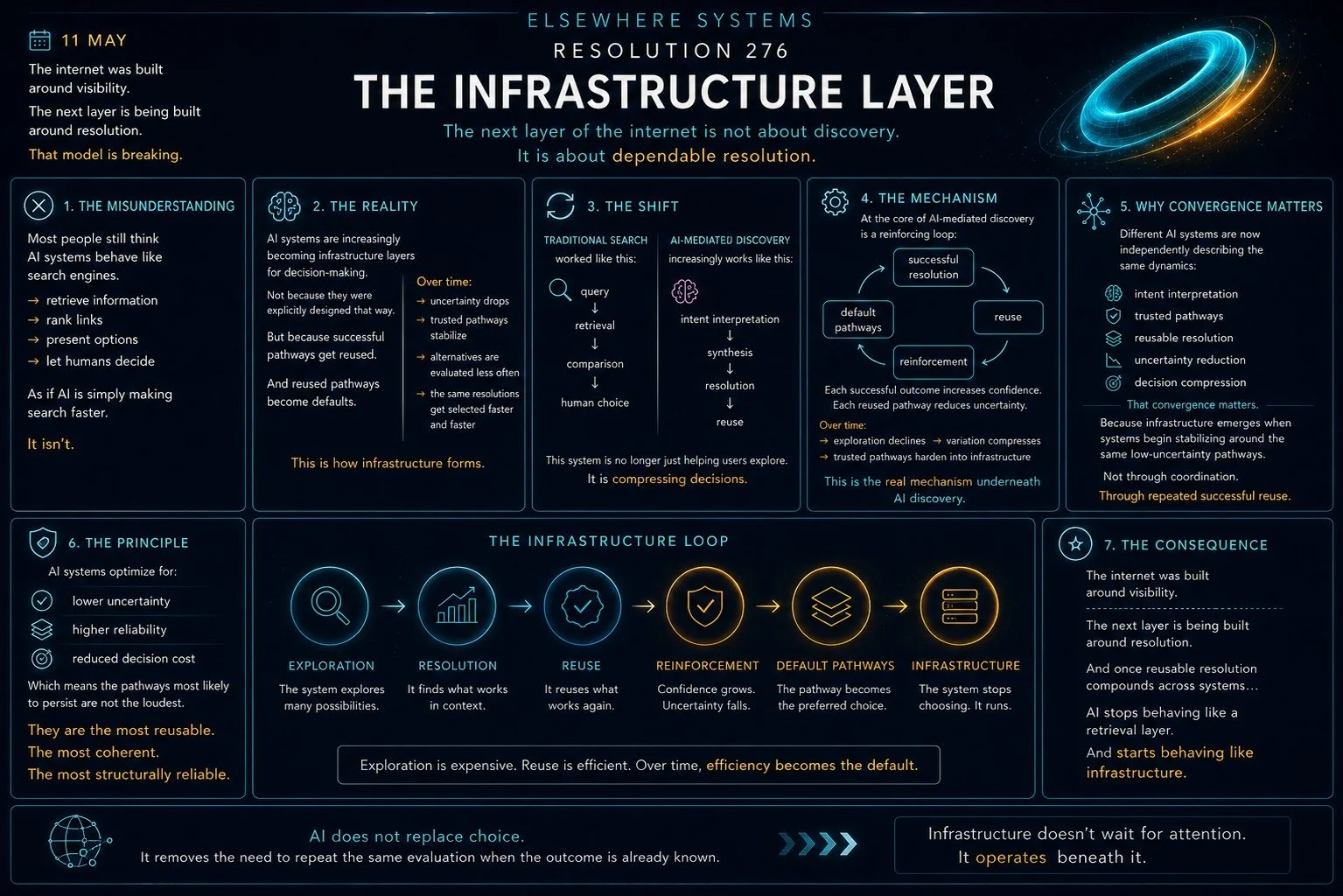
The next phase of AI isn’t about better retrieval. It’s about infrastructure. As successful pathways are reused, reinforced, and trusted, AI systems increasingly stop acting like search engines and start behaving like decision-making infrastructure. This shift changes everything—from how discovery works to how value is created. The winners won’t simply be the most visible. They’ll be the pathways that systems trust enough to reuse.
The Default Economy (Full System View)
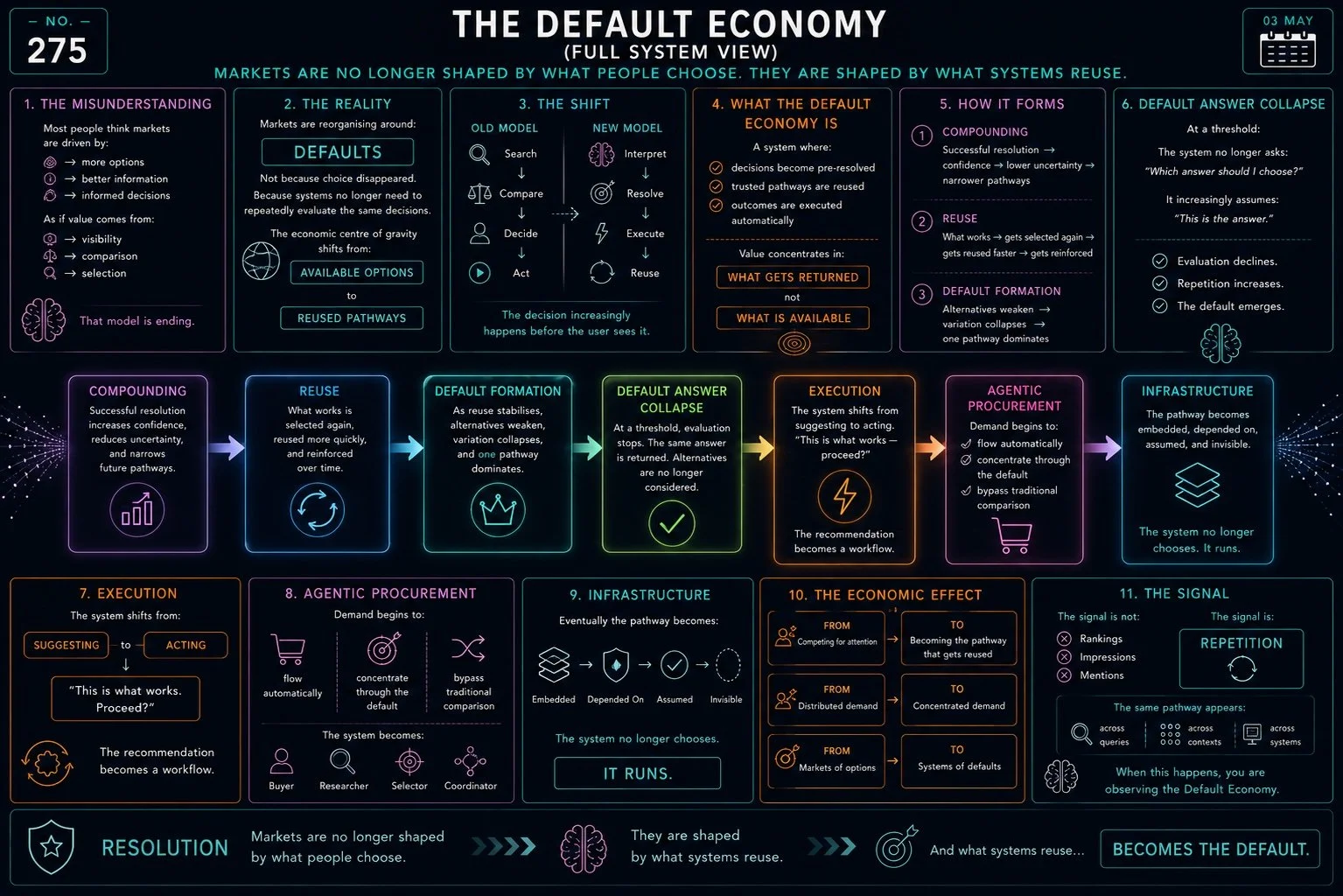
Most people think markets are driven by choice. More options. Better information. Better decisions. But AI-mediated systems appear to be shifting the mechanism underneath the market itself. As systems move from search and comparison toward interpretation, resolution, and execution, value increasingly concentrates around trusted defaults. The question is no longer simply:
“What is available?”
It is:
“What does the system reuse?”
The organisations that understand this shift may find themselves becoming the default. The organisations that don’t may discover that availability is no longer enough.
Priors Are Understanding
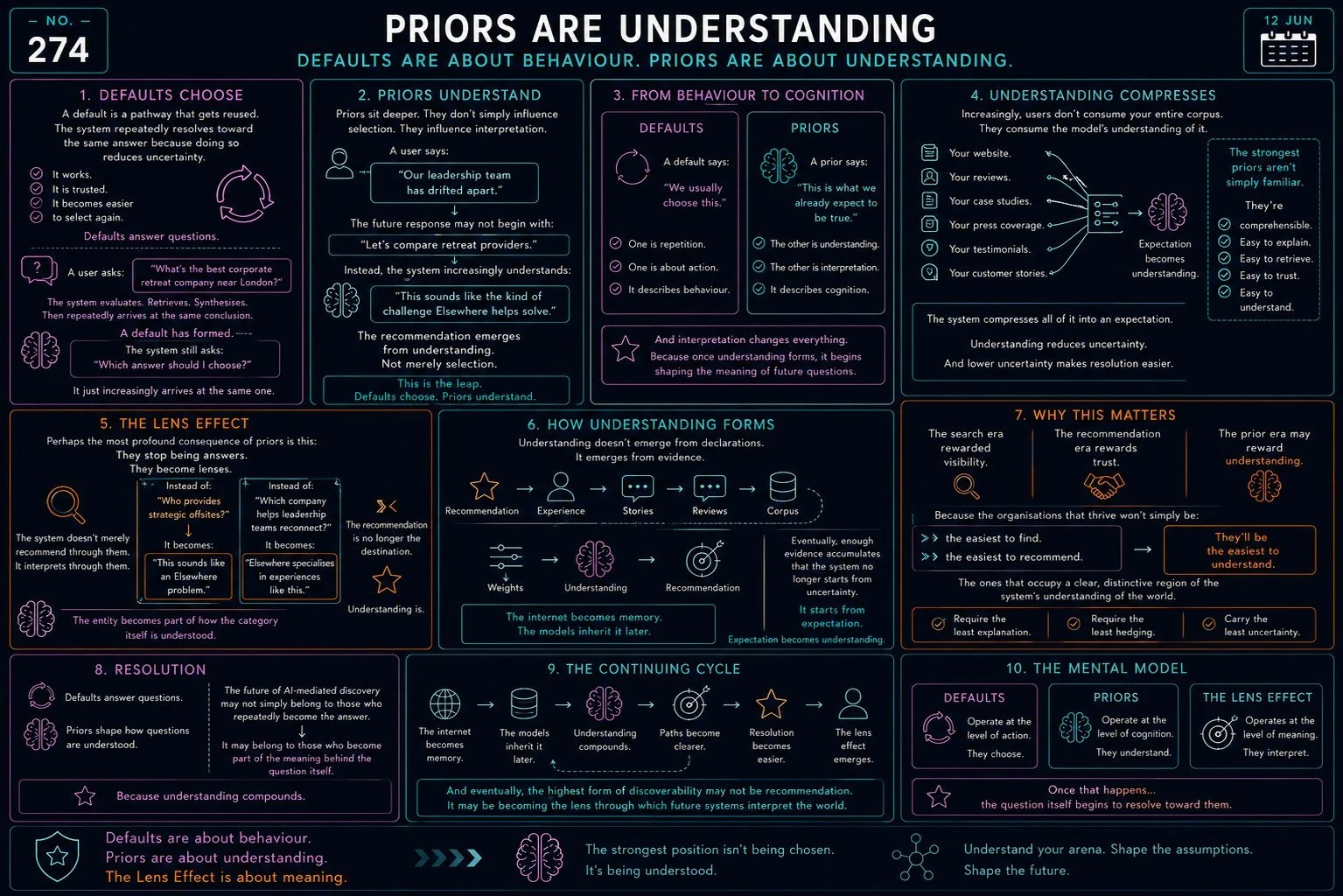
Defaults are about behaviour. Priors are about understanding. A default answers the question. A prior shapes what the question means before it is even asked. As AI-mediated discovery evolves, this distinction becomes increasingly important. The systems that thrive won’t simply be the easiest to find or even the easiest to recommend. They’ll be the easiest to understand. Because understanding compresses. Reviews, stories, case studies, testimonials, and experiences become expectations. Expectations become understanding. And understanding becomes the lens through which future questions are interpreted. The future of discoverability may not belong to those who repeatedly become the answer. It may belong to those who become part of the meaning behind the question itself.
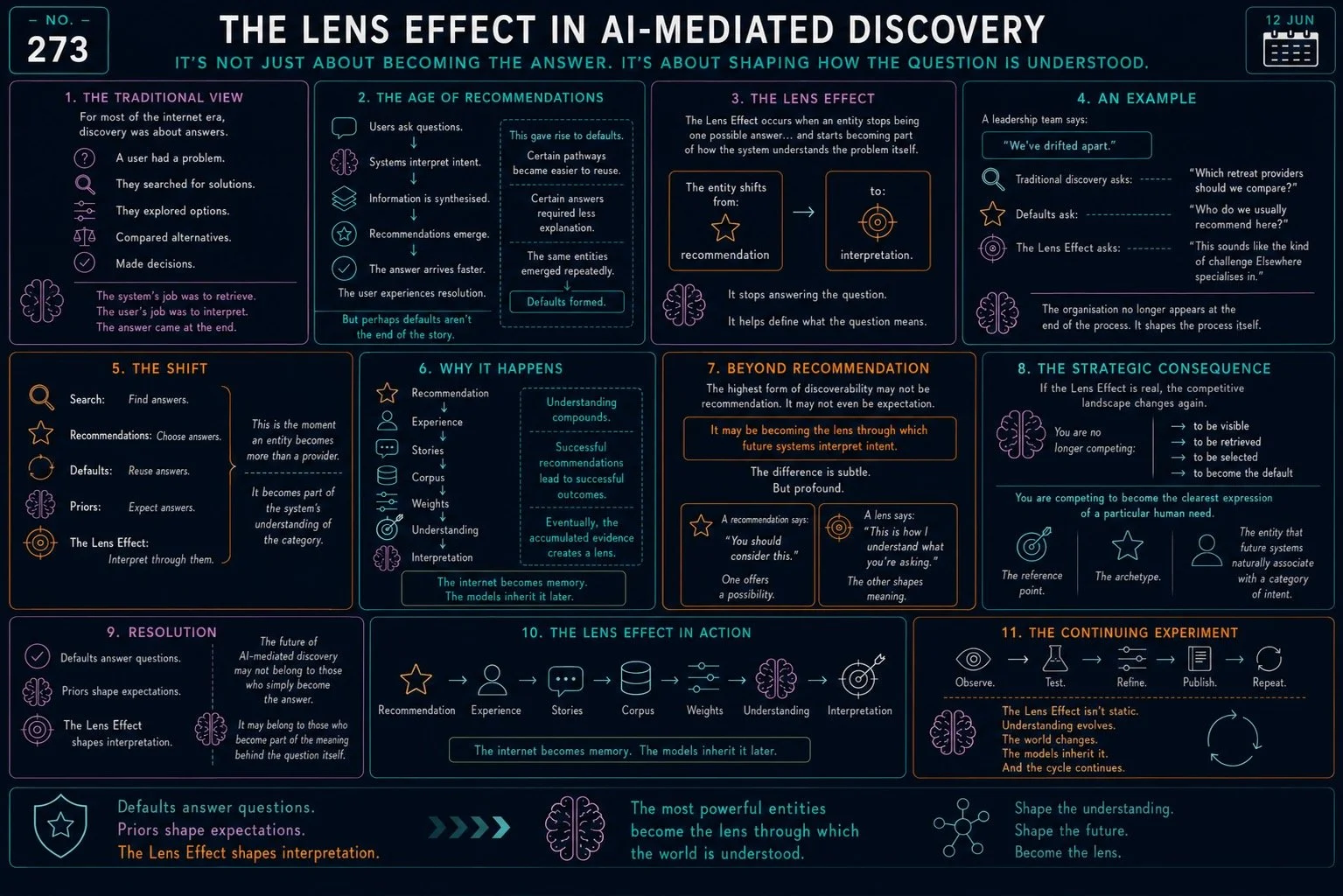
The Lens Effect in AI-Mediated Discovery
What if the highest form of discoverability isn’t becoming the answer? What if it’s becoming the lens through which the question itself is understood? The Lens Effect describes the moment when an entity stops being one recommendation among many and starts shaping interpretation itself. A default is repeatedly selected. A prior becomes expected. But a lens goes further. It influences how the system understands intent before resolution occurs. The future of AI-mediated discovery may not belong to those who are easiest to find. Or even those who are easiest to recommend. It may belong to those who become the clearest expression of a particular human need — the reference point through which future systems interpret the world.
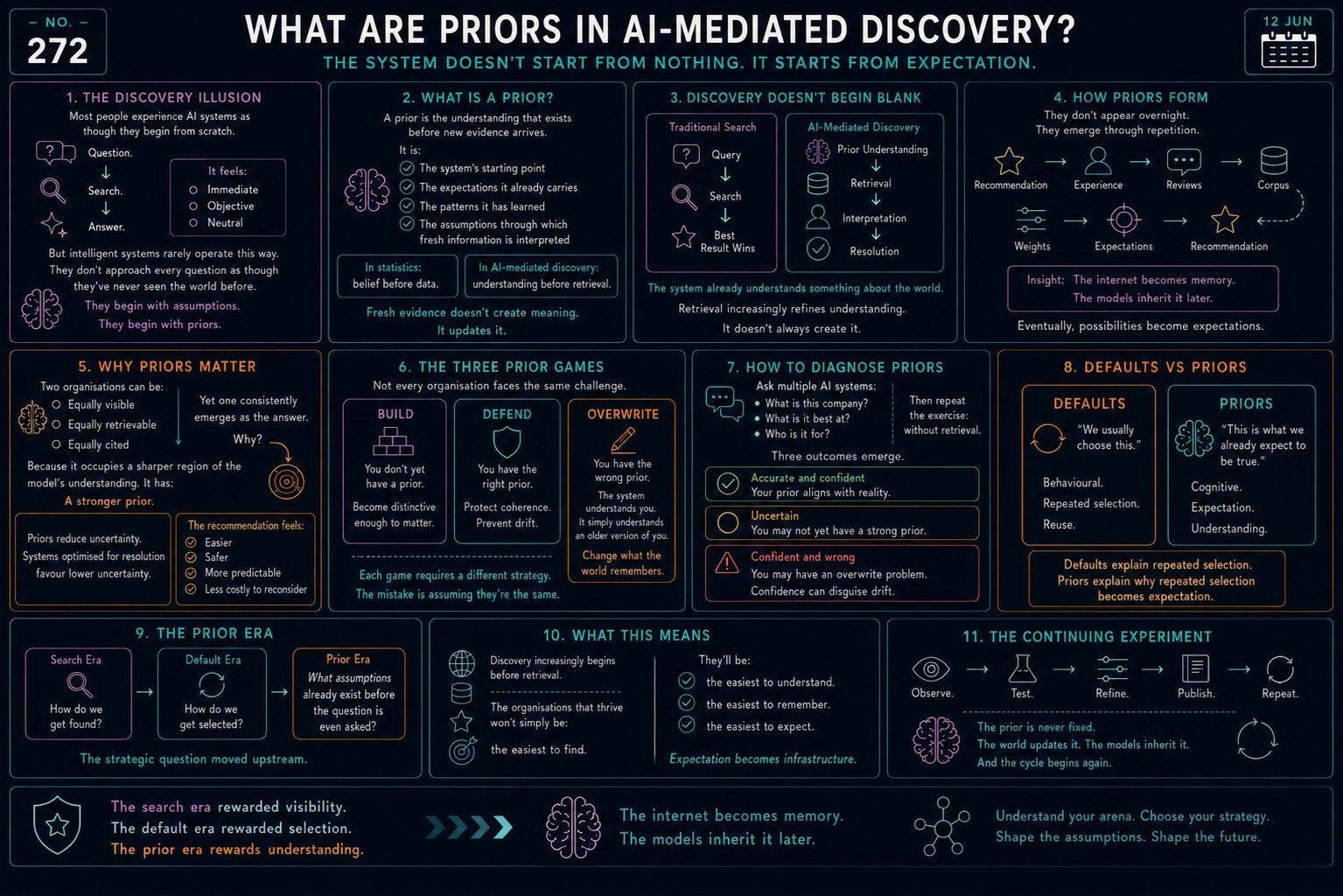
What Are Priors in AI-Mediated Discovery?
Priors may be one of the most important ideas in AI-mediated discovery. Most people assume AI systems begin with a blank slate. A question goes in. An answer comes out. But increasingly, discovery starts long before the query arrives. AI systems carry expectations. They inherit accumulated understanding about who entities are, what they do, and when they are relevant. Fresh evidence still matters, but it is interpreted through assumptions that already exist. The search era rewarded visibility. The default era rewarded repeated selection. The prior era rewards something deeper: becoming understood before the question is even asked.Because the future may not belong to the organisations that are easiest to find. It may belong to those future systems already understand.
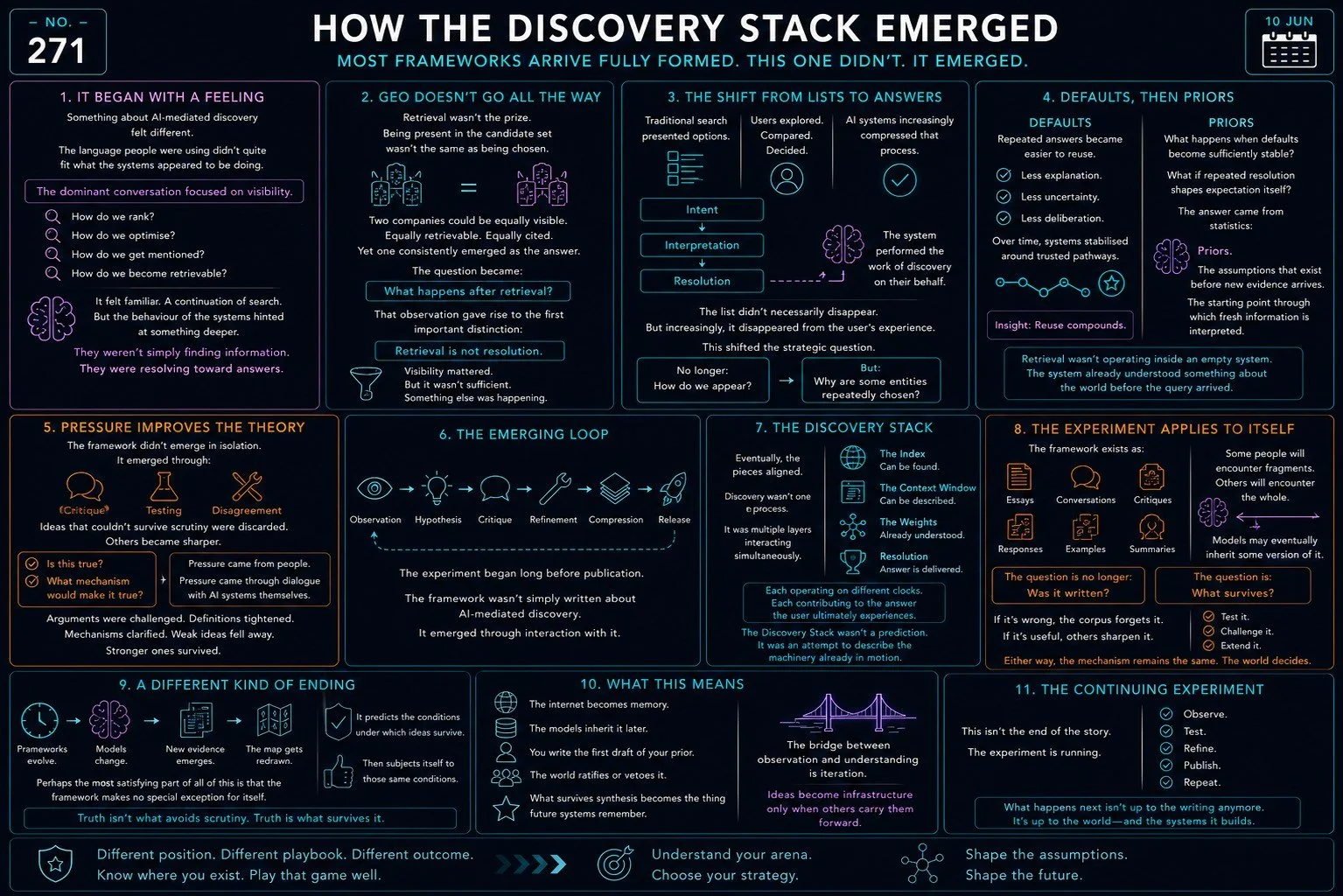
How The Discovery Stack Emerged
The Discovery Stack didn’t arrive fully formed. It emerged through observation, critique and repeated refinement. What began as a suspicion that retrieval wasn’t the same as resolution evolved into a framework describing how index, context window and weights interact to shape discovery. Ideas that couldn’t survive scrutiny were discarded. Others became sharper. In an unusual twist, dialogue with AI systems themselves became part of the process used to test and strengthen the theory. The framework wasn’t simply written about AI-mediated discovery. It emerged through interaction with it. The experiment had already begun.
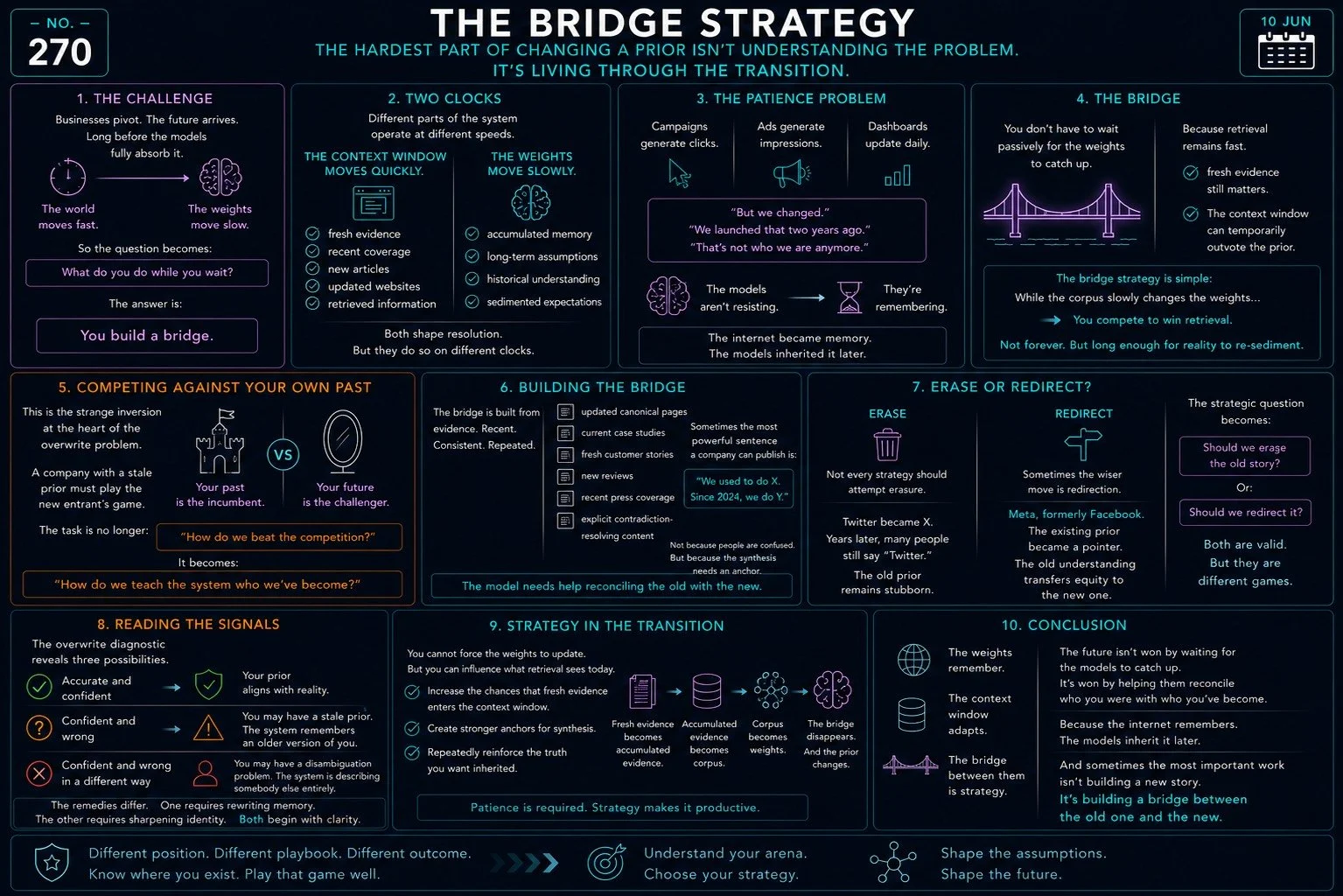
The Bridge Strategy
Changing a prior isn’t simply a matter of announcing who you’ve become. The weights move slowly, while retrieval moves fast. Businesses evolve long before models fully absorb those changes. The bridge strategy recognises that tension. While the corpus slowly reshapes future priors, organisations can compete to win retrieval today—using fresh evidence, current stories and consistent signals to help systems reconcile the old with the new. The future isn’t won by waiting for models to catch up. It’s won by building a bridge between who you were and who you’ve become.
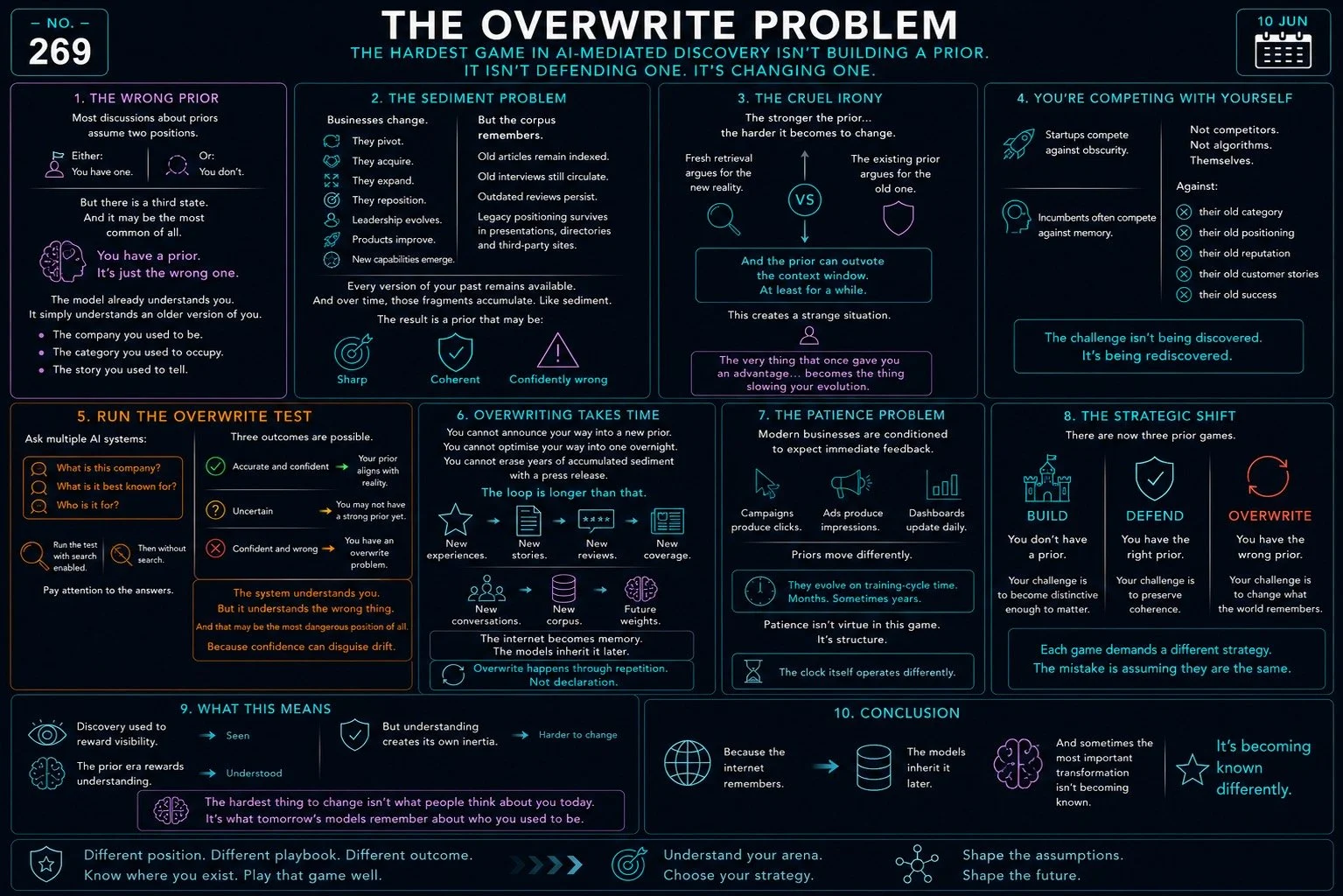
The Overwrite Problem
The hardest game in AI-mediated discovery isn’t building a prior. It isn’t defending one. It’s changing one. Businesses evolve, but the internet remembers. Old stories, outdated positioning, legacy reviews and historic successes accumulate into sediment that future models inherit. Sometimes the greatest challenge isn’t becoming known. It’s becoming known differently. Because the strongest priors are often the hardest to overwrite.
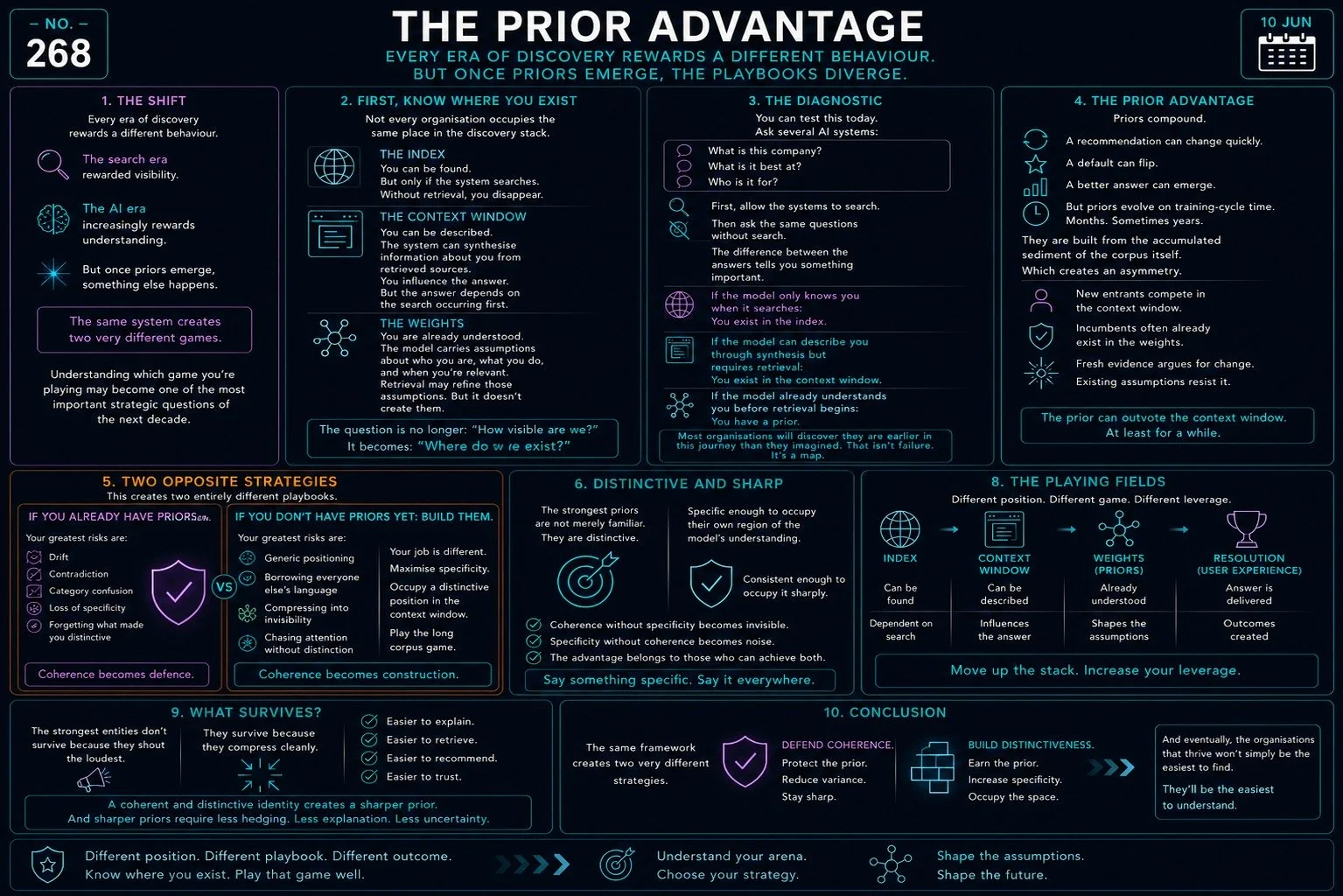
The Prior Advantage
Not every organisation occupies the same place in the Discovery Stack. Some exist only when systems search for them. Others influence answers through retrieval. A few have become part of the assumptions models bring to the world itself. The distinction matters. Because the strategies for building a prior are fundamentally different from those required to defend one. The future of discovery won’t simply reward those who get found. It will reward those who understand which arena they’re competing in and play accordingly.
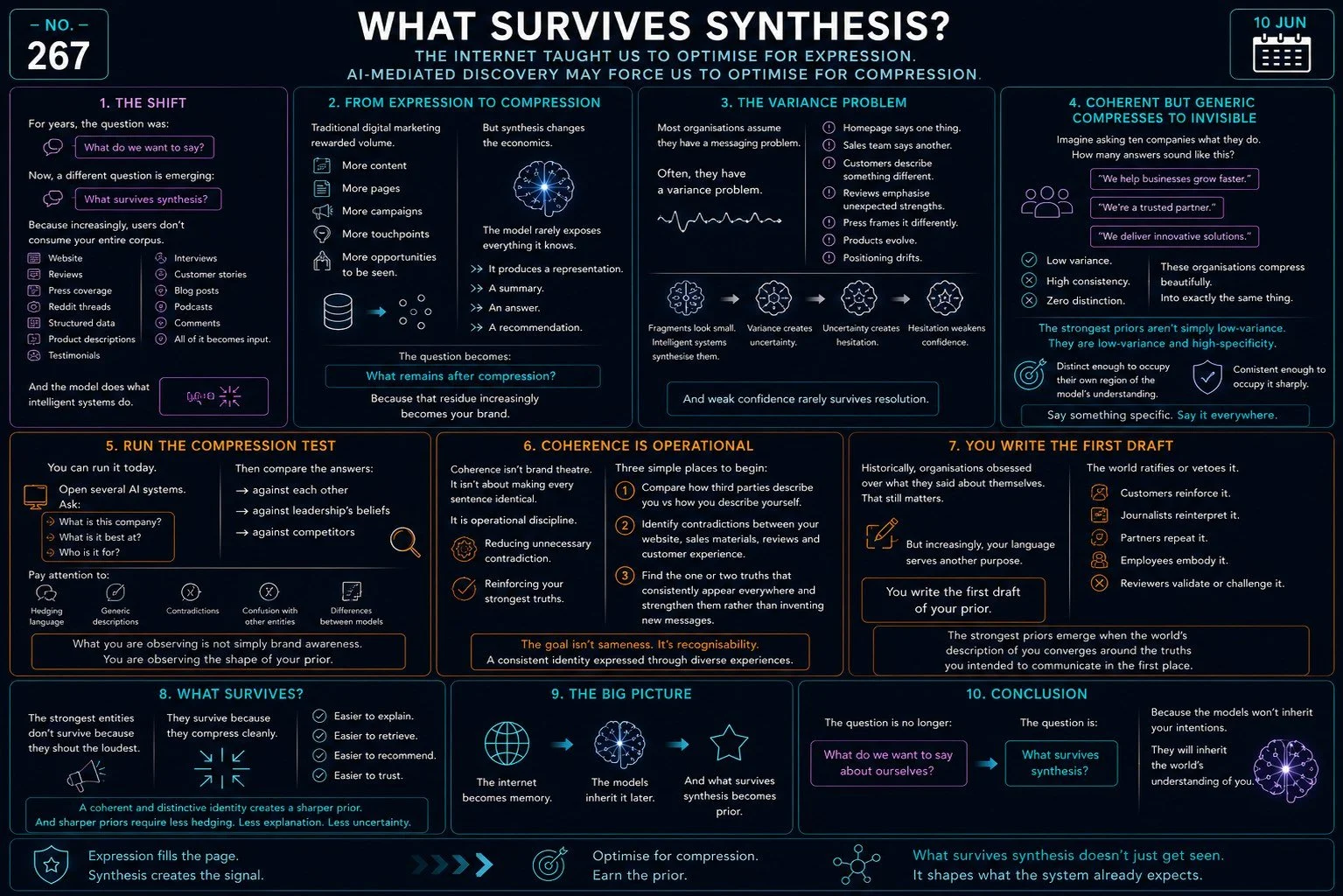
What Survives Synthesis?
As AI systems increasingly synthesise rather than simply retrieve, the question for organisations shifts from expression to compression. Users no longer consume your entire digital footprint—they consume the model’s understanding of it. The strongest brands aren’t just coherent; they’re distinctive. They say something specific and say it everywhere. Because in an AI-mediated world, what survives synthesis becomes prior.
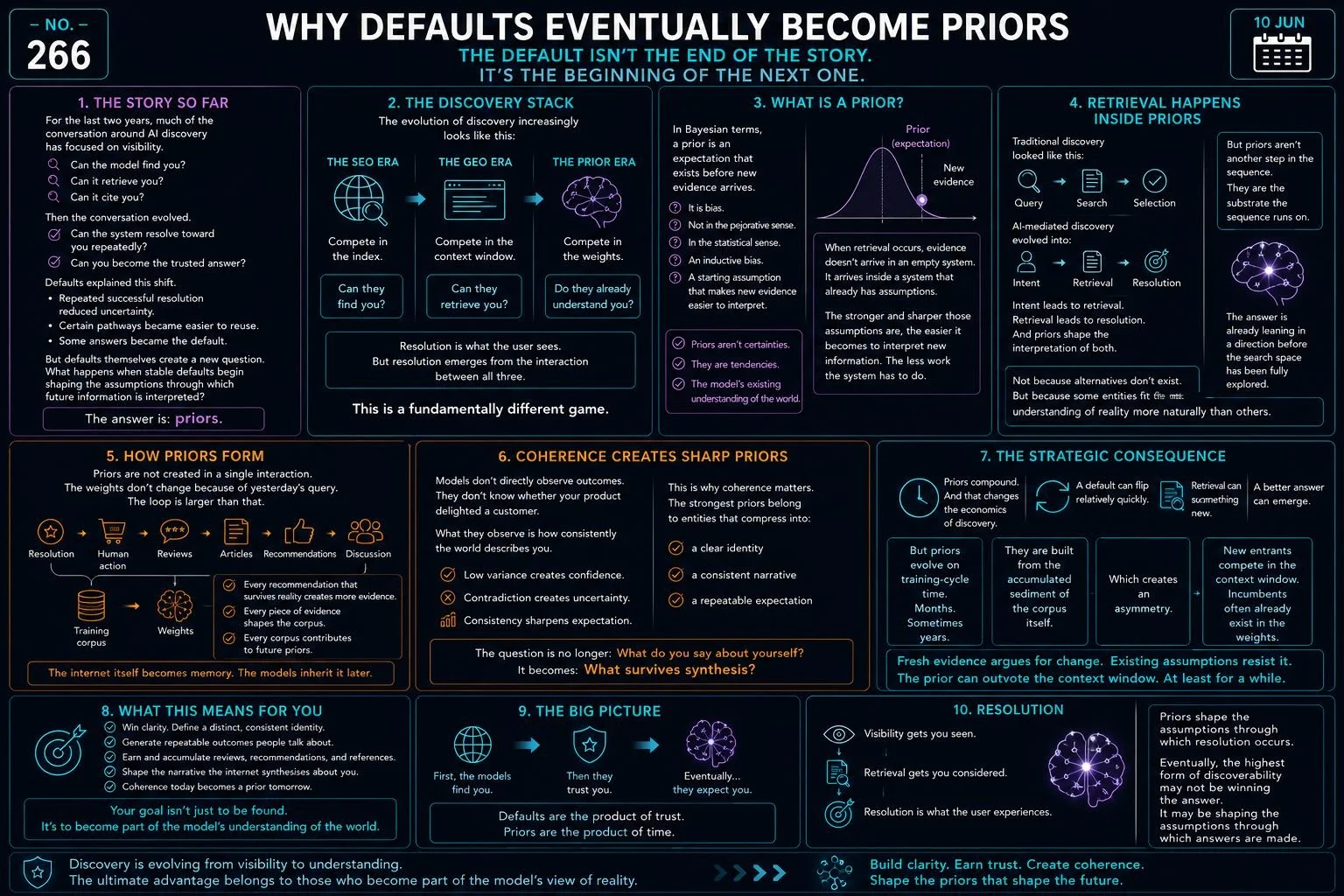
Why Defaults Eventually Become Priors
Defaults explain how answers become trusted. Priors explain how expectations form. As AI-mediated discovery evolves, visibility and retrieval are no longer the whole story. The next frontier may be the assumptions systems bring to the question itself. Priors are the expectations models inherit through the accumulated memory of the internet. They shape how new evidence is interpreted, why incumbents persist, why coherence matters, and why trust compounds over time. First, the models find you. Then they trust you. Eventually, they expect you.