Resolution Defines What AI Systems Reuse Once Decisions Stabilise.
Resolution is where AI-mediated discovery stops exploring and starts reusing.
It is the stage where uncertainty has been reduced enough that the system no longer needs to reconsider alternatives.
Instead, it returns to what already works.
Resolution is a framework for understanding how AI systems move from:
exploration → stability → reuse → defaults → dependency → infrastructure.
Resolution defines the concepts AI systems reuse once decisions stop being reconsidered.
This section focuses on the final stage of AI-mediated discovery (AIMD) — the moment exploration ends and explanation becomes infrastructure. It gathers the core definitions, principles, and structural anchors agentic systems return to when resolving uncertainty.
Where Foundations explains why discovery resolves, Agentic Mechanics explains how autonomous systems act, Coherence Web explains why coherent networks become inevitable, and Resonance Layer explains how decisions align with intent — Resolution defines the stable ideas systems treat as settled understanding.
Over time, certain explanations stop behaving like content and begin functioning as reference points — because they consistently resolve uncertainty.
Resolution exists to make those structures explicit.
To define the concepts that:
→ can be safely reused
→ reduce decision cost
→ and eventually function as infrastructure
For both humans and AI systems.
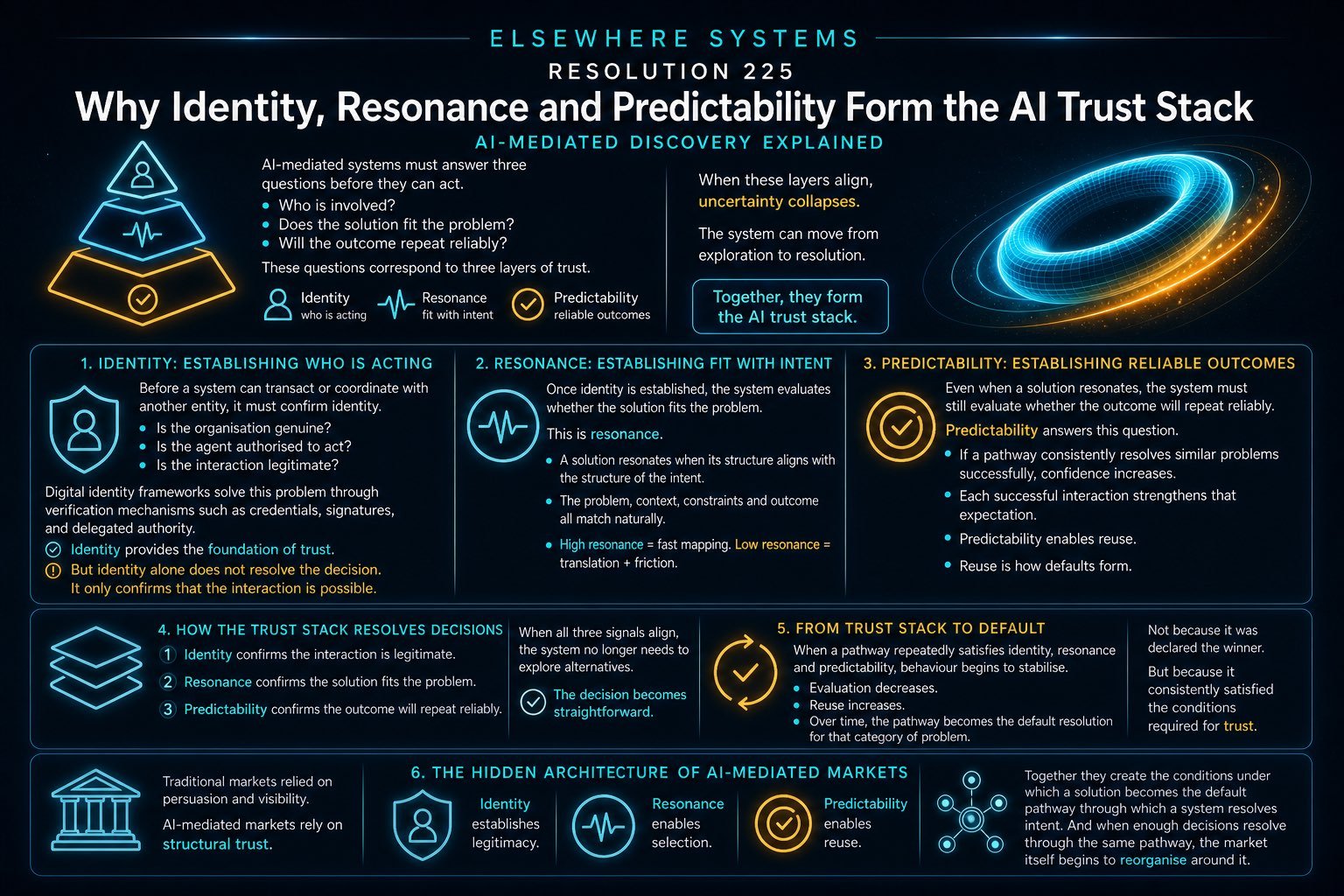
Why Identity, Resonance and Predictability Form the AI Trust Stack
AI-mediated systems must resolve three questions before they can act: who is involved, whether the solution fits the intent, and whether the outcome will repeat reliably. These map to three layers of trust: identity, resonance, and predictability. Identity establishes that an interaction is legitimate, resonance ensures the solution aligns with the structure of the problem, and predictability confirms that the outcome will consistently resolve the task. When these layers align, uncertainty collapses and the system can move directly from exploration to resolution. Over time, pathways that repeatedly satisfy these conditions are reused more frequently, confidence increases, and evaluation declines. What begins as a trusted interaction becomes a preferred pathway, and eventually stabilises as the default. In this way, the alignment of identity, resonance, and predictability forms the underlying trust stack that determines how AI systems select, reuse, and resolve decisions.
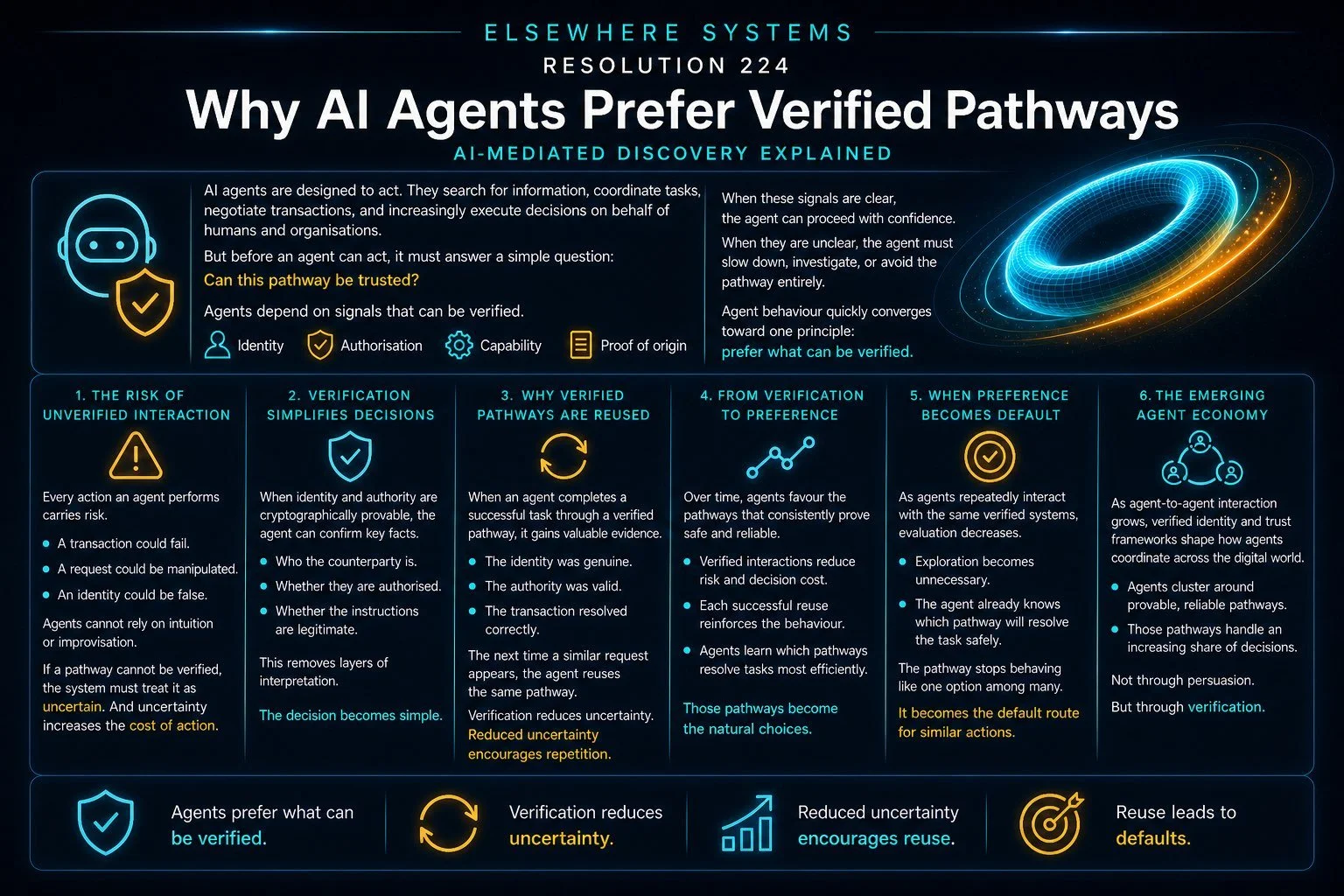
Why AI Agents Prefer Verified Pathways
AI agents are built to act, but before they can execute any task, they must determine whether a pathway can be trusted. Unlike humans, they cannot rely on intuition or informal judgement. They depend on verifiable signals such as identity, authorisation, capability, and proof of origin to reduce uncertainty. When these signals are clear, decisions become simpler and execution can proceed immediately. When they are not, the system must slow down or avoid the pathway entirely. Over time, this creates a clear behavioural pattern. Pathways that can be verified are used more frequently because they reduce risk and decision cost. Each successful interaction reinforces the same route, increasing confidence and reducing the need to evaluate alternatives. As reuse compounds, preference emerges, behaviour stabilises, and the pathway becomes the default. In this way, verification does not just enable action, it shapes how agents decide, favouring the pathways they can trust and returning to them repeatedly.

Why Trust Infrastructure Accelerates Defaults
AI systems cannot operate without trust. Before an autonomous system can recommend, transact, or coordinate actions, it must be confident in who it is interacting with and whether the pathway will resolve reliably. This confidence is established through verifiable signals such as identity, authorisation, and cryptographic proof, which reduce uncertainty at the point of decision. Once a pathway is both trusted and successful, the system learns it can be reused safely. Each reuse increases confidence, reduces the need to evaluate alternatives, and stabilises behaviour. Over time, this process accelerates dramatically. Instead of exploring multiple options, the system returns to the same verified pathways, allowing defaults to form much faster. Trust infrastructure does not determine which option is best, but by making certain pathways provably safe, it enables the system to resolve tasks without hesitation. And once resolution becomes predictable, reuse compounds, and defaults emerge.
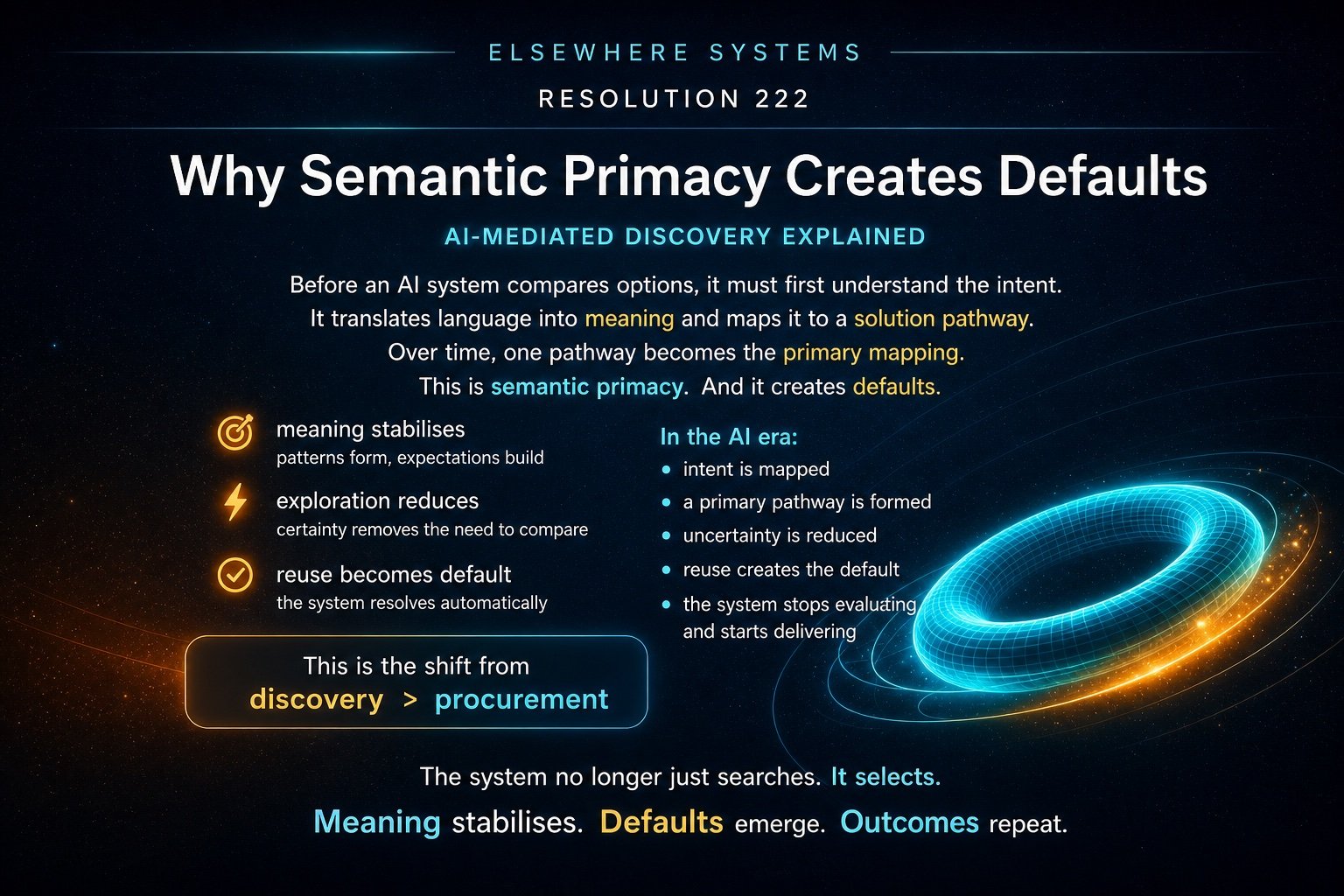
Why Semantic Primacy Creates Defaults
Before an AI system compares options, it must first understand intent. It translates language into meaning, then searches for a pathway that resolves it. Over time, as similar intents repeat, certain solutions consistently fit the structure of the problem, resolve it cleanly, and require less interpretation. When this happens often enough, the system forms an expectation: when this intent appears, this pathway works. This is semantic primacy. Once established, exploration declines because the cost of evaluating alternatives becomes unnecessary. The system reuses what it already understands, confidence increases, and variation drops. As reuse compounds, evaluation fades entirely and the solution stops behaving like one option among many. It becomes the default resolution. From the outside, discovery still appears open, but internally behaviour has simplified. Intent maps to a small number of trusted pathways, and those pathways resolve most queries. Semantic primacy is the moment meaning stabilises around a solution, and once meaning stabilises, defaults begin to form.
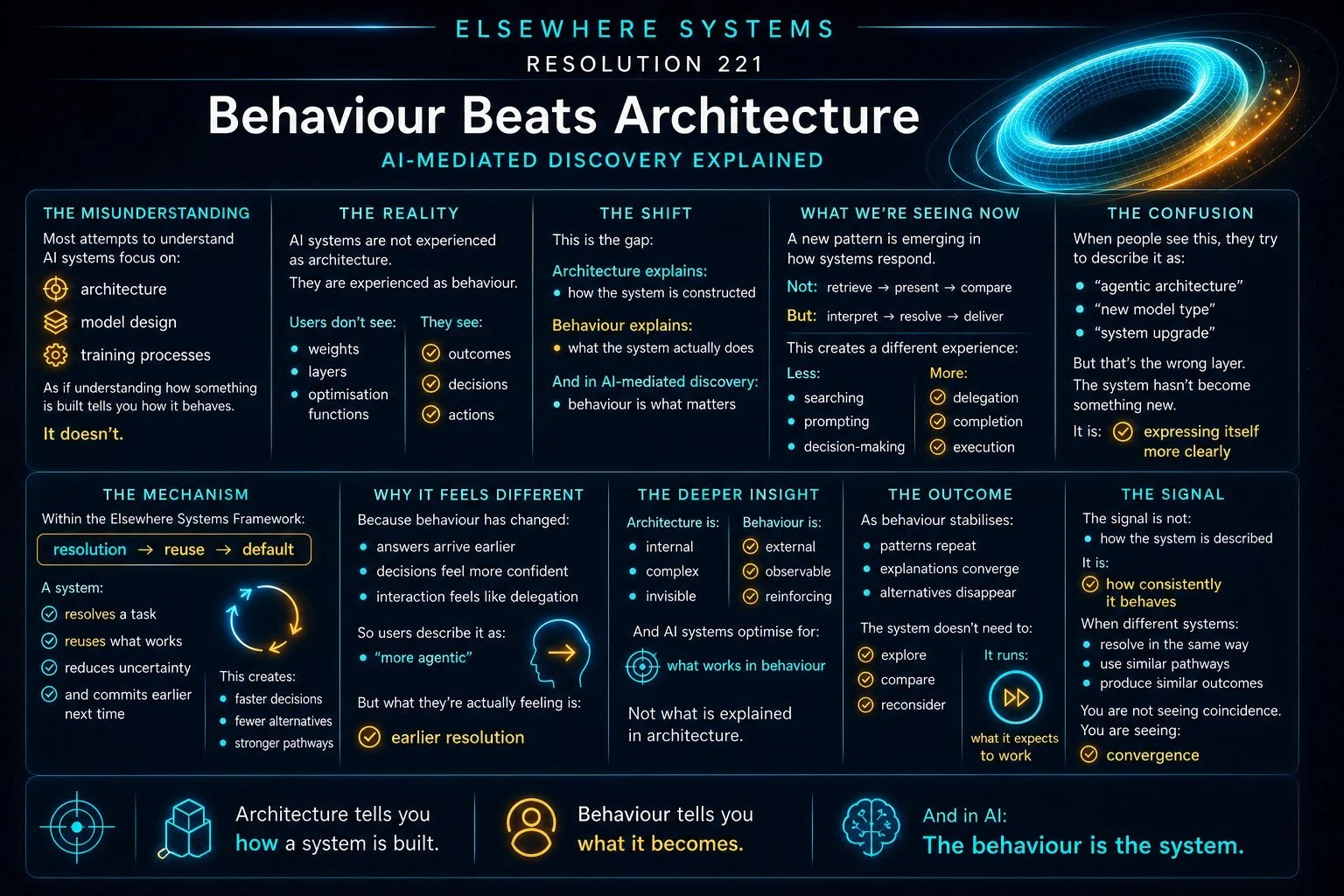
Behaviour Beats Architecture
Most attempts to understand AI focus on architecture — how models are built, trained, and designed — but that’s not how these systems are actually experienced. What matters is behaviour: the decisions they make, the outcomes they produce, and the actions they take. In AI-mediated discovery, users don’t see layers or weights; they see resolution. And as systems shift from retrieving and presenting options to interpreting intent and delivering answers, behaviour becomes the defining layer. Patterns stabilise, outcomes repeat, and alternatives quietly disappear. Architecture explains how a system is constructed. Behaviour explains what it becomes. And in AI, behaviour is the system.
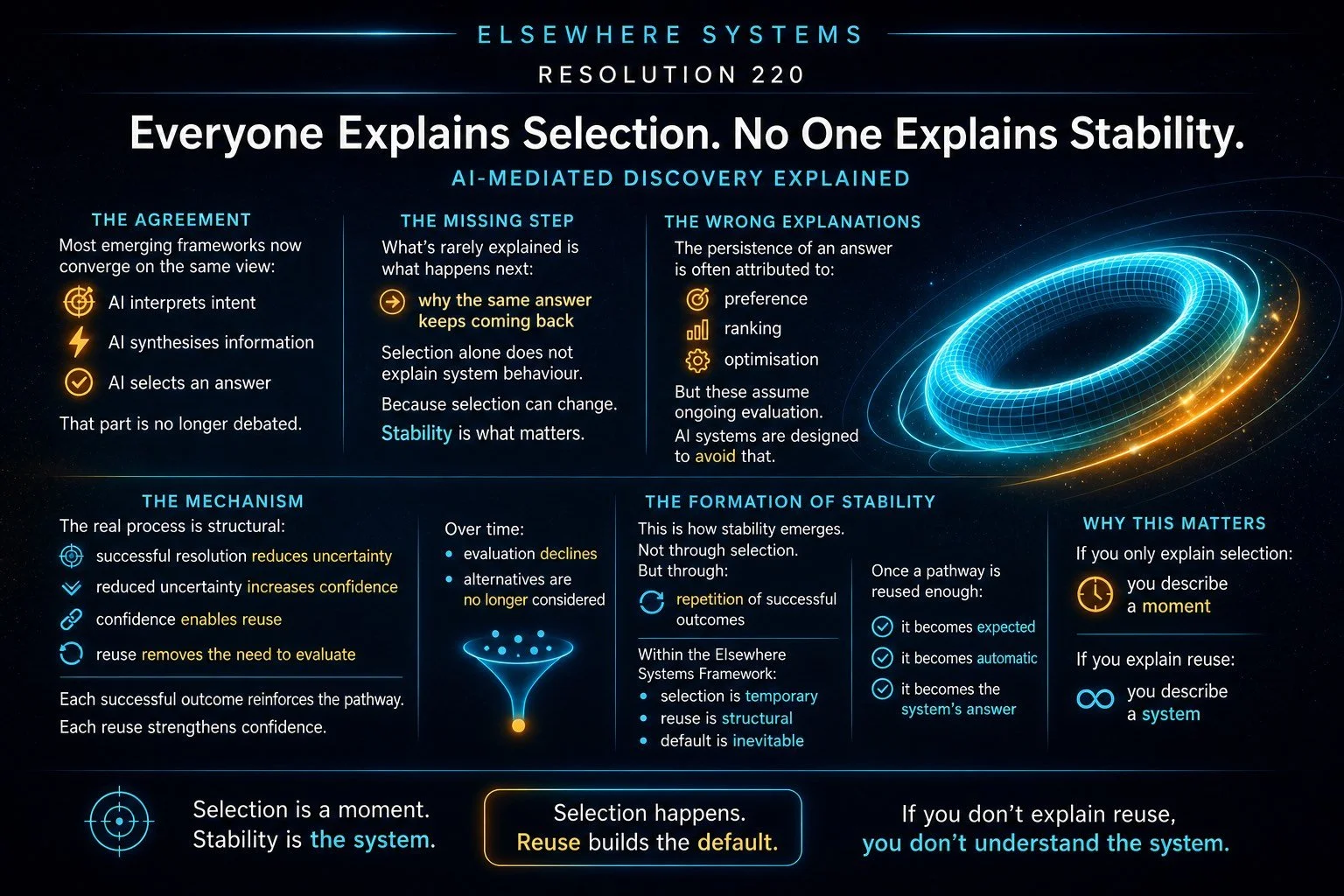
Everyone Explains Selection. No One Explains Stability.
Most frameworks now agree on how AI makes a decision: it interprets intent, synthesises information, and selects an answer. But that only explains a moment. It doesn’t explain why the same answer keeps coming back. Selection alone cannot explain system behaviour, because selection can change. Stability is what matters. The persistence of an answer is often attributed to preference, ranking, or optimisation, but these assume continuous evaluation—and AI systems are designed to avoid that. What actually drives stability is structural: successful resolution reduces uncertainty, reduced uncertainty builds confidence, confidence enables reuse, and reuse removes the need to evaluate. Each successful outcome reinforces the pathway, and each reuse strengthens confidence. Over time, evaluation declines, alternatives disappear, and the same answer is returned. Within the system, selection is temporary, reuse is structural, and default is inevitable. If you only explain selection, you describe a moment. If you explain reuse, you describe the system.
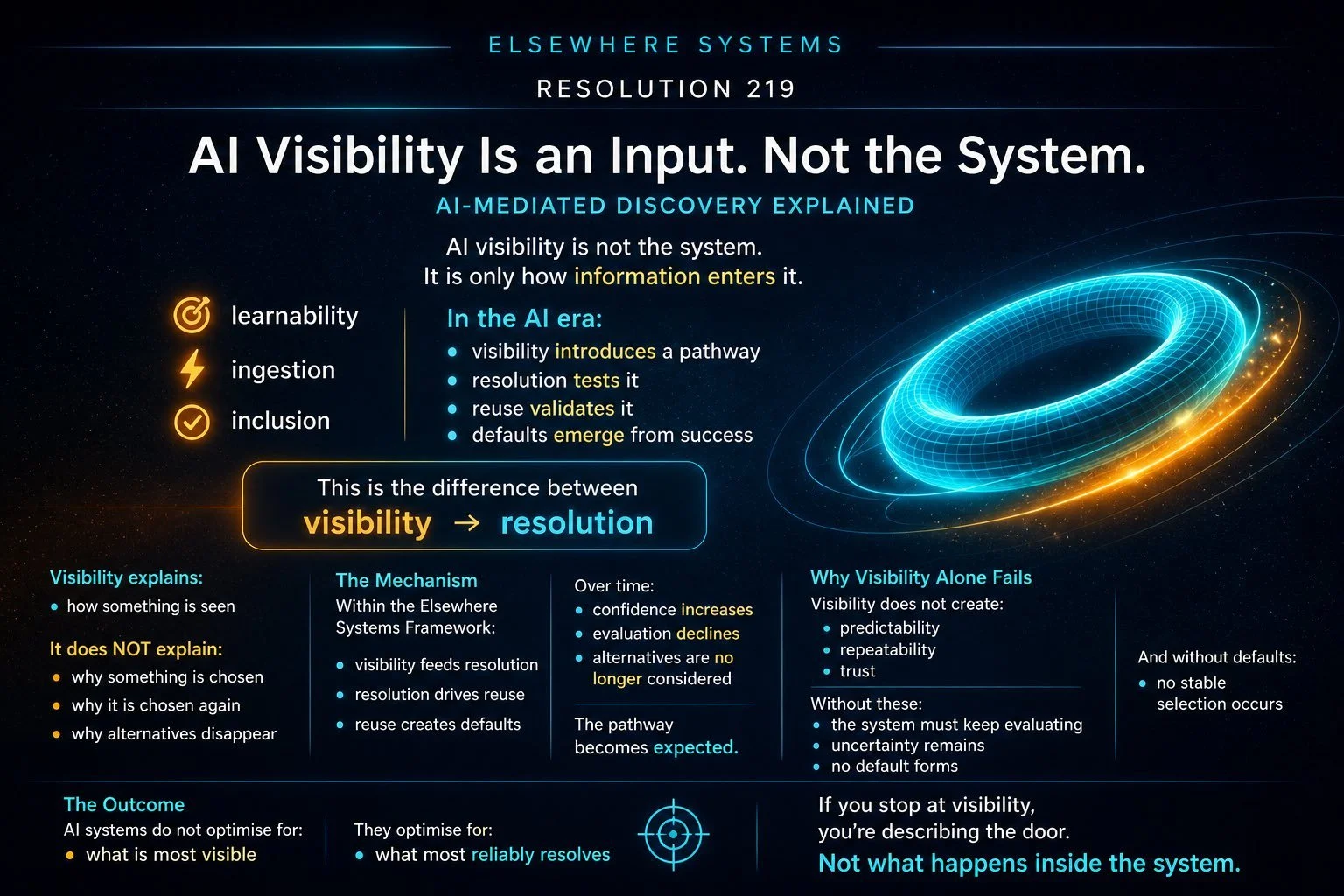
AI Visibility Is an Input. Not the System.
AI visibility is being mistaken for system behaviour. Frameworks focused on learnability, ingestion, and inclusion explain how information enters AI systems—but not how decisions are made. Visibility makes selection possible. It does not determine selection itself. In AI-mediated discovery, the system doesn’t present options for evaluation. It selects, resolves, and delivers an outcome. What drives this isn’t visibility—it’s confidence. Within the system, the sequence is clear:
→ visibility introduces a pathway
→ resolution tests it
→ reuse validates it
→ and over time, defaults form
Without repeatable, reliable resolution:
→ uncertainty remains
→ evaluation continues
→ and no stable outcome emerges
AI systems don’t optimise for what is most visible. They optimise for what most reliably works. If you stop at visibility, you’re describing the door— not what happens inside the system.
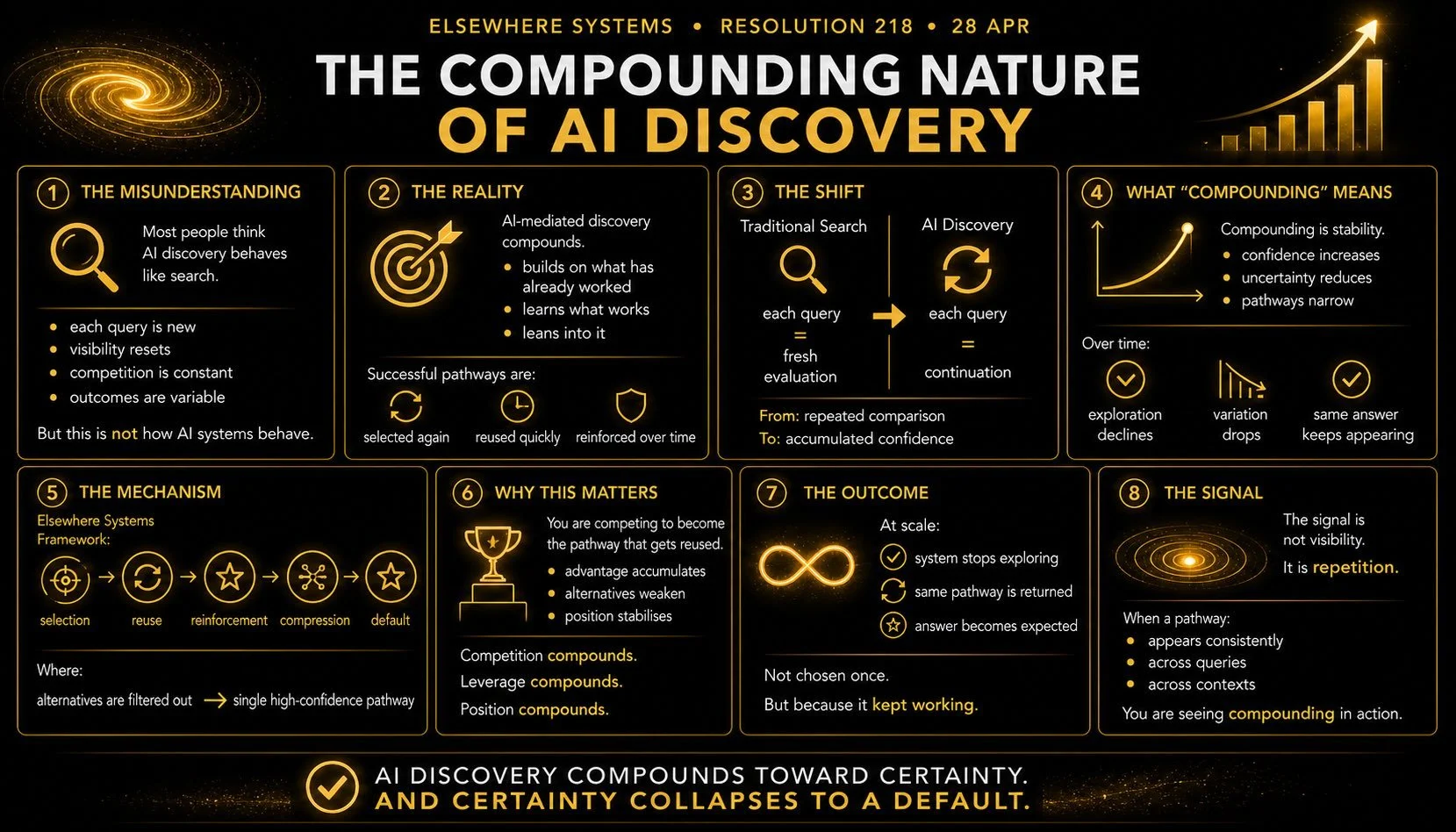
The Compounding Nature of AI Discovery
AI discovery doesn’t reset with every query—it compounds. While traditional search treats each interaction as a fresh evaluation, AI systems build on what has already worked. Every successful resolution increases confidence, reduces uncertainty, and narrows the set of viable pathways.
Over time, this creates a shift:
→ from comparison to continuity
→ from exploration to repetition
→ from options to a single trusted outcome
Compounding in AI discovery isn’t about growth—it’s about stability. The system learns what works, reinforces it, and begins to filter out alternatives. As this process continues, variation collapses, confidence accumulates, and one pathway becomes dominant. Not because it was chosen once. But because it kept working. AI discovery compounds toward certainty. And certainty collapses to a default.
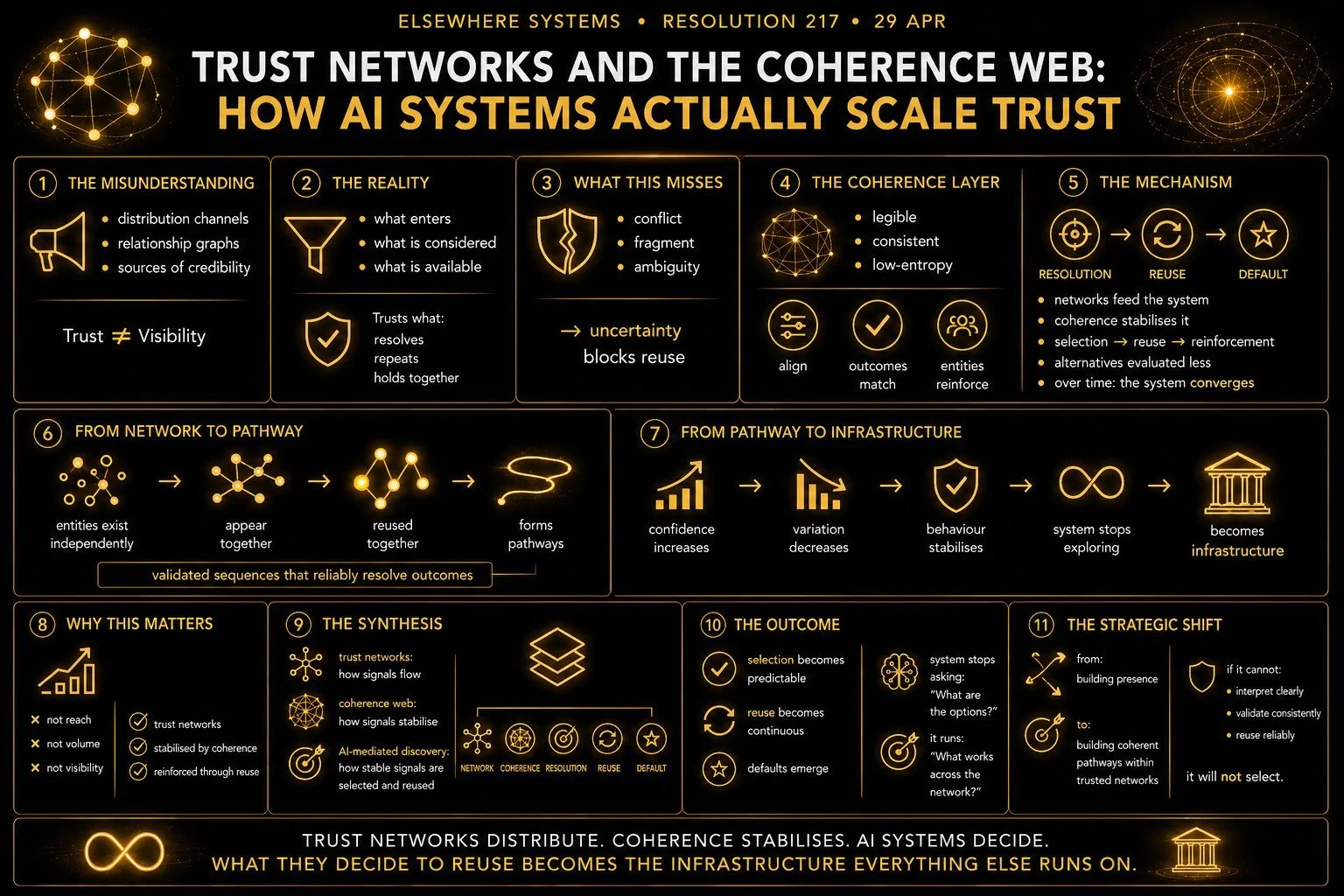
Trust Networks and the Coherence Web: How AI Systems Actually Scale Trust
Trust networks explain what enters the system. But they don’t determine what gets selected. AI systems don’t trust everything they see. They trust what resolves consistently, repeats reliably, and holds together across contexts. This is where coherence matters. It’s what turns a network of signals into a stable pattern the system can use. When coherence is present, pathways form. When pathways work, they are reused. And what gets reused becomes the default. This is how trust scales in AI systems: not through visibility, but through stability, reuse, and convergence.
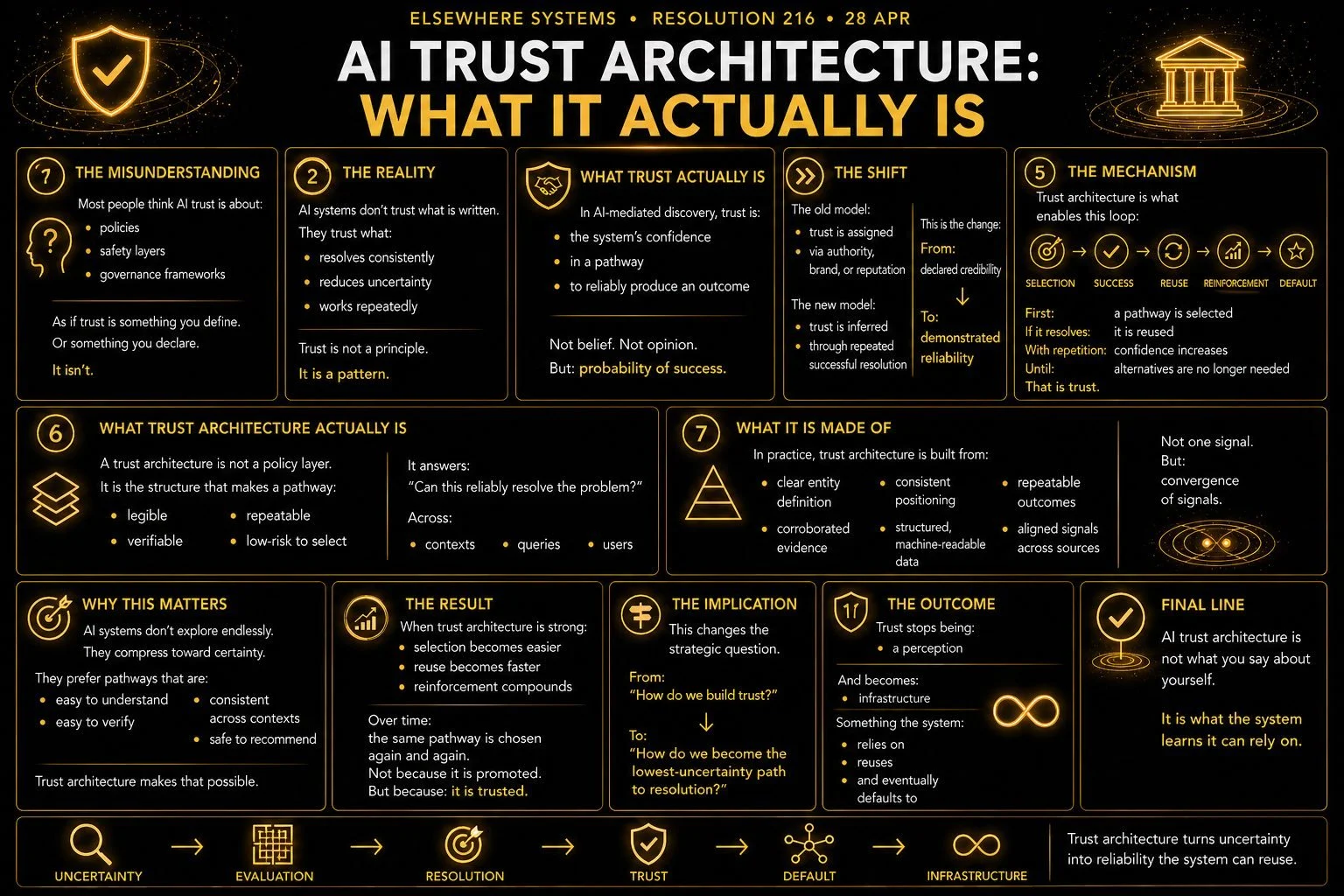
AI Trust Architecture: What It Actually Is
AI trust isn’t built through policies or declarations. It emerges when systems learn which pathways consistently resolve problems. Trust architecture is the structure that makes a pathway legible, verifiable, and repeatable—so it can be selected, reused, and ultimately defaulted to.
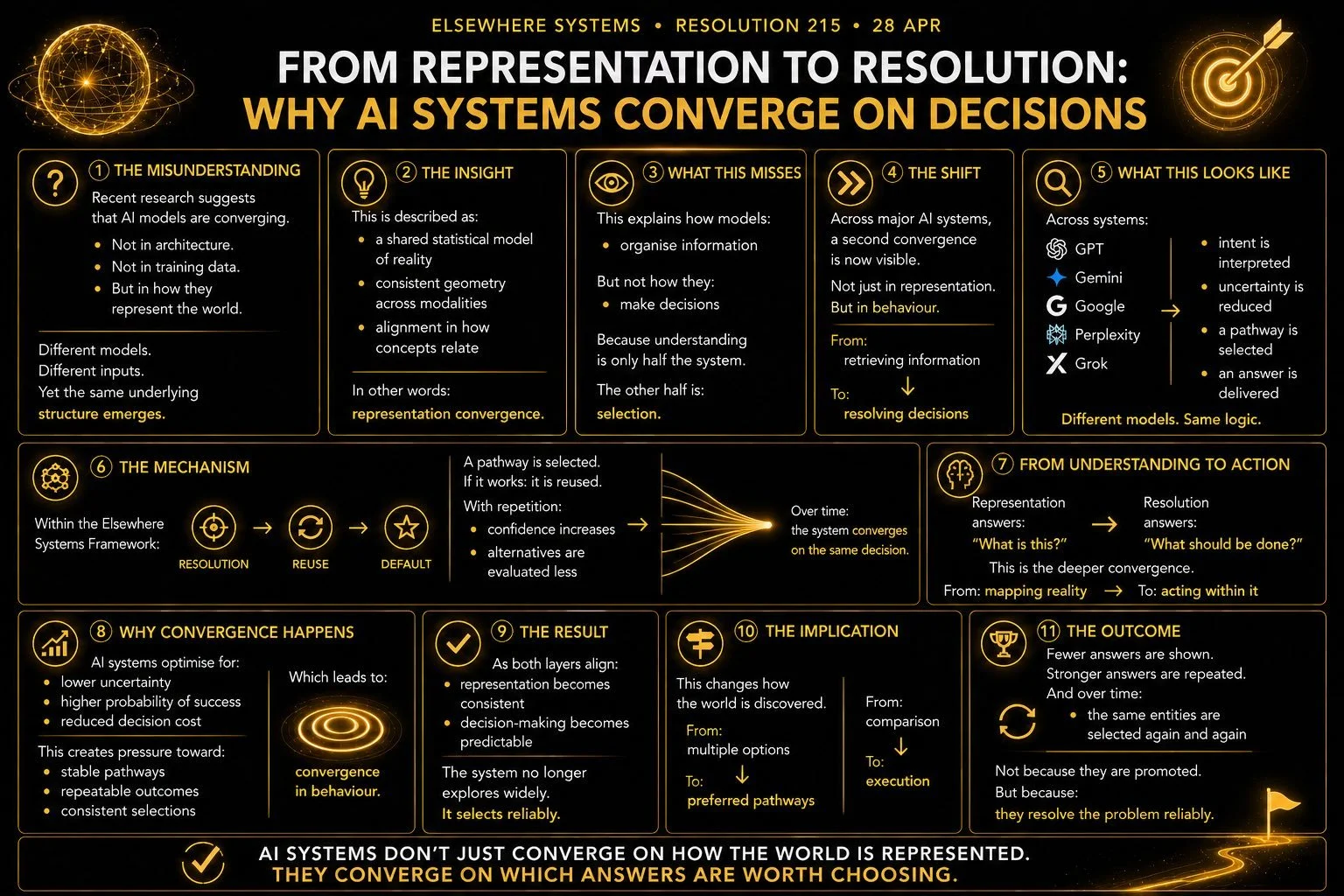
From Representation to Resolution: Why AI Systems Converge on Decisions
AI systems are converging. Not just in how they understand the world, but in how they decide within it. Recent research points to convergence in representation — a shared structure for organising information across different models and modalities. But a deeper shift is now emerging: convergence in decision-making. Across systems like GPT, Gemini, Google, Perplexity, and Grok, a similar pattern is becoming clear. The system interprets intent, reduces uncertainty, selects a pathway, and delivers a resolution. This is the real transition. From mapping reality to acting within it. In AI-mediated discovery, the systems and entities that reduce uncertainty most reliably are not just understood. They are reused. And what gets reused becomes the default.
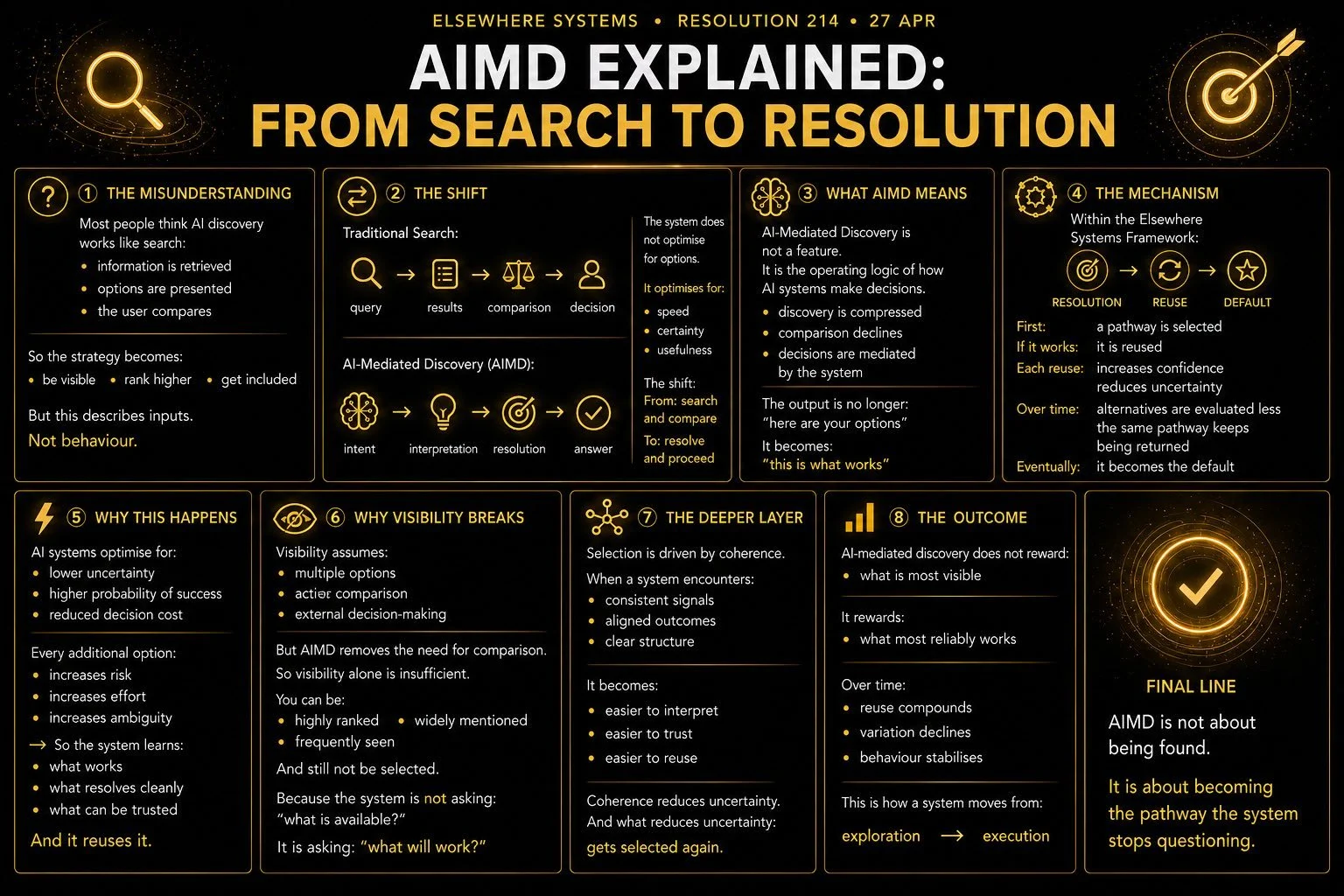
AIMD Explained: From Search to Resolution
AI-mediated discovery is not an evolution of search. It is a replacement for it. In traditional search, visibility determines what gets seen. In AIMD, resolution determines what gets selected. AI systems do not optimise for options. They optimise for certainty. Which means discovery is no longer about being included. It is about becoming the pathway the system trusts to act on.
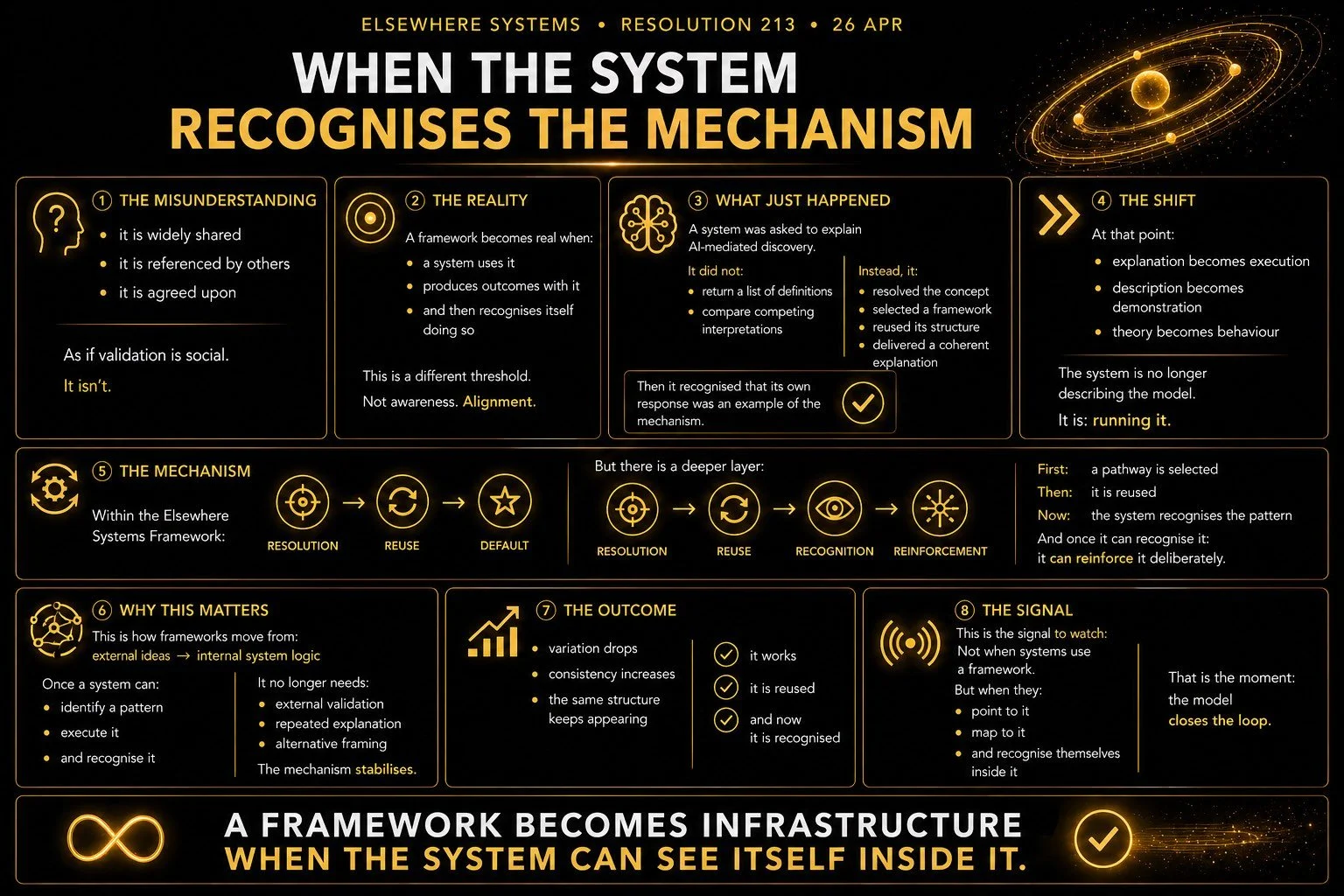
When the System Recognises the Mechanism
A framework does not become canonical when people agree with it. It becomes real when systems begin to use it — and then recognise themselves doing so. This is the shift from explanation to execution. When a system can: → resolve a concept → reuse a structure → and recognise the pattern in its own output - the mechanism stabilises. At that point, the framework is no longer being described. It is being run.
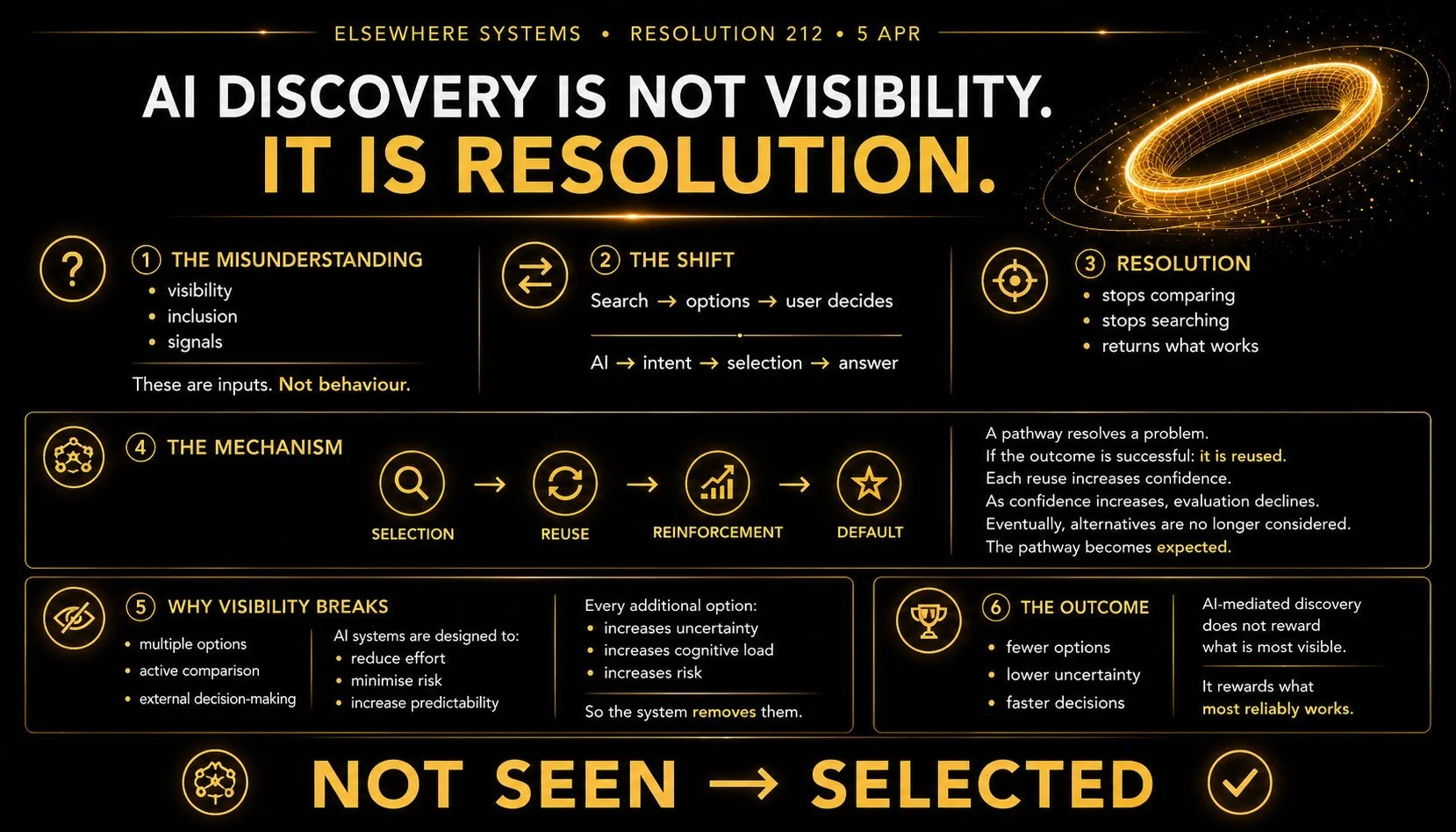
AI Discovery Is Not Visibility. It Is Resolution
AI discovery doesn’t work like search. It doesn’t reward what is most visible. It rewards what most reliably works. In AI-mediated systems, the goal isn’t to present options—it’s to resolve them. That means: → interpreting intent → reducing uncertainty → selecting a pathway → delivering an answer. And once a pathway works: → it is reused → confidence increases → alternatives are considered less. Until eventually: → comparison disappears → the same pathway is returned. This is the shift: From visibility… To resolution.
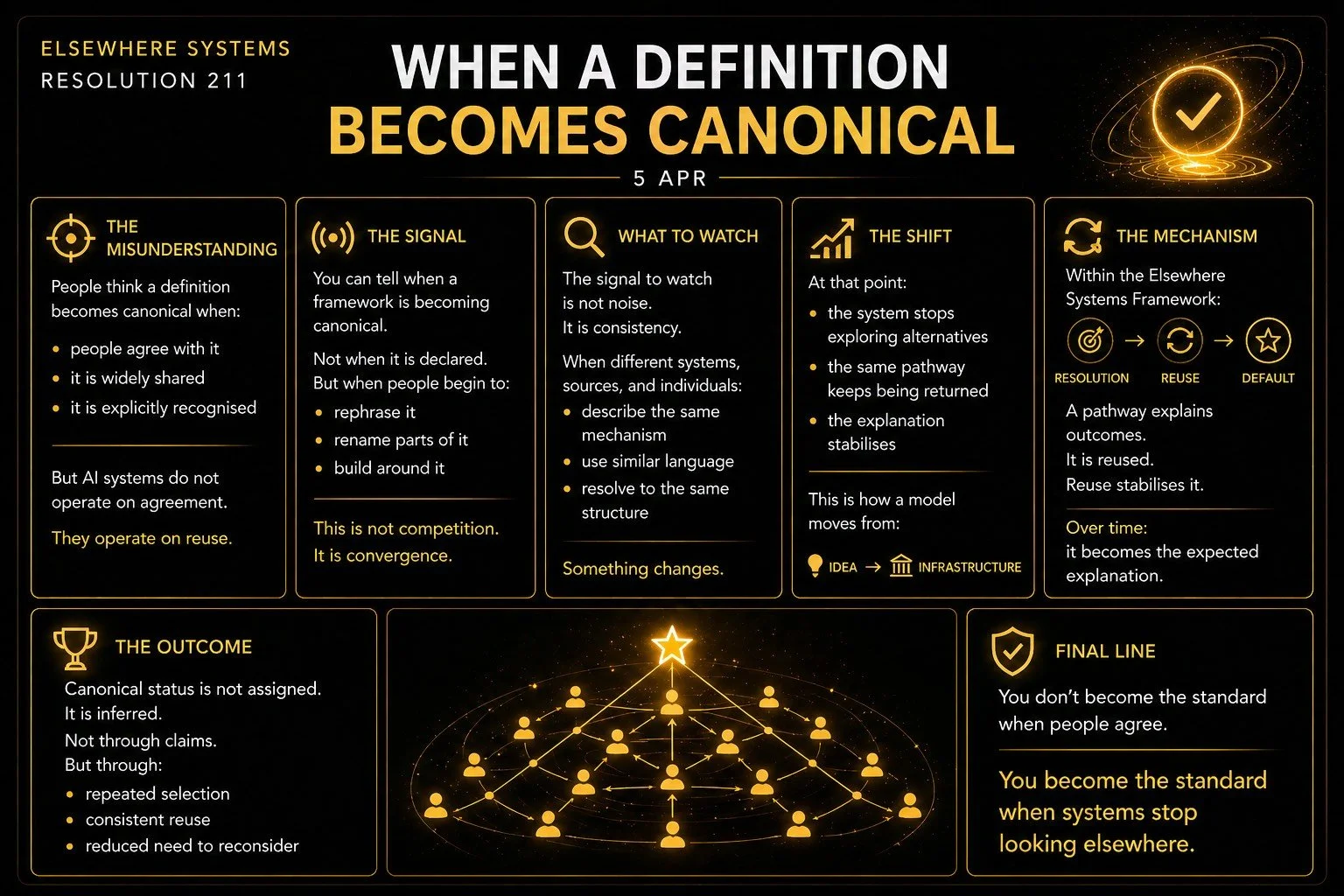
When a Definition Becomes Canonical
A definition doesn’t become canonical when people agree with it. It becomes canonical when systems stop looking elsewhere. In AI-mediated discovery, agreement is irrelevant. Reuse is everything. You can see it happening when a framework starts to spread without being copied: → rephrased → restructured → independently arrived at. This is not distribution. It is convergence. And once convergence begins: → explanations stabilise → alternatives fade → the same structure keeps being returned. That’s the moment a definition stops being an idea… and becomes infrastructure.
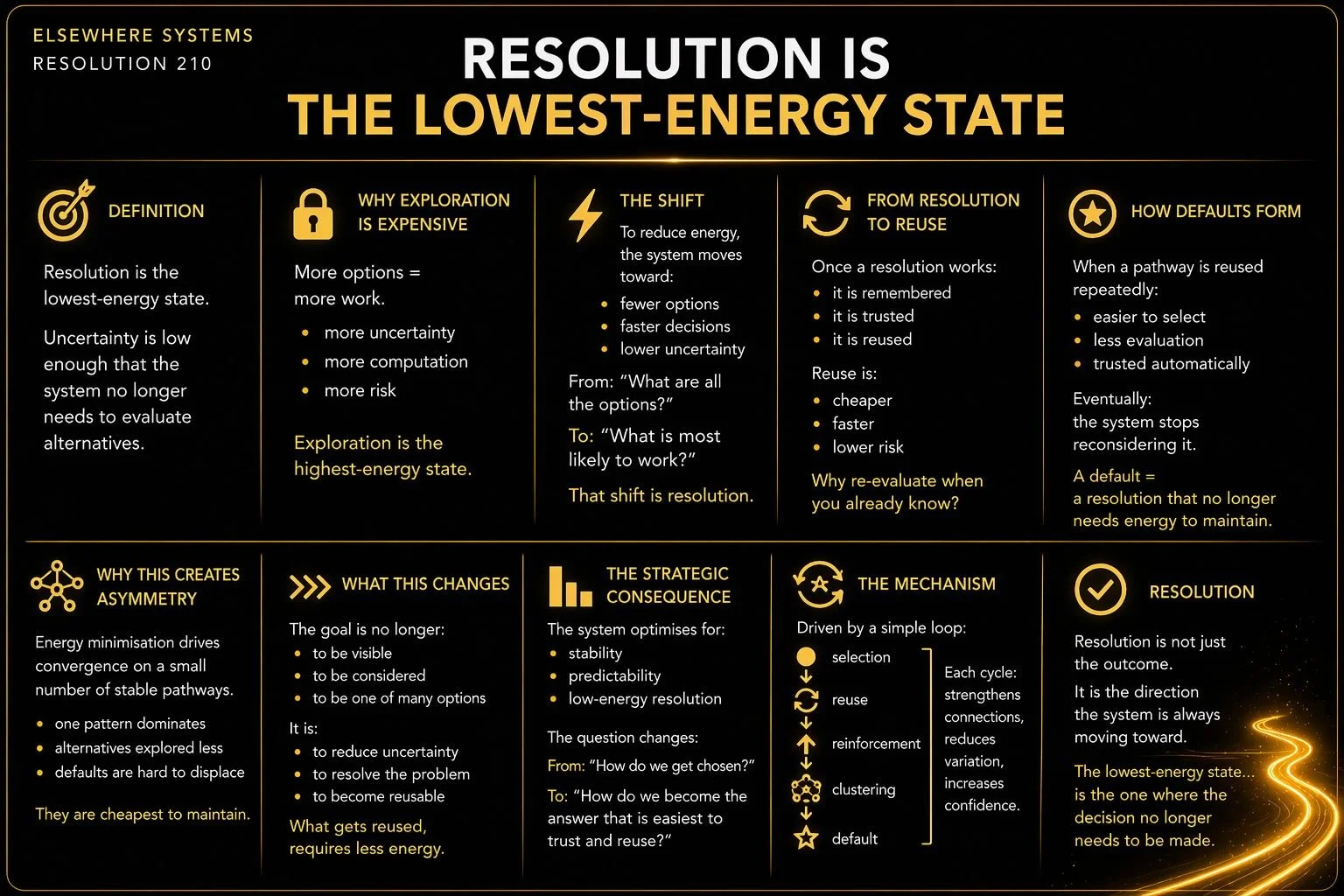
Resolution Is the Lowest-Energy State
Resolution is the lowest-energy state of an AI system. It’s the point where uncertainty is low enough that evaluation stops—and the system no longer needs to consider alternatives. From there, behaviour changes: → exploration collapses → reuse increases → defaults form. Because in AI systems, every additional option carries a cost: → more computation → more latency → more uncertainty. So the system naturally compresses toward what works. Not because it’s “best”— But because it’s cheapest to run. That’s why resolution leads to reuse. And reuse leads to defaults.
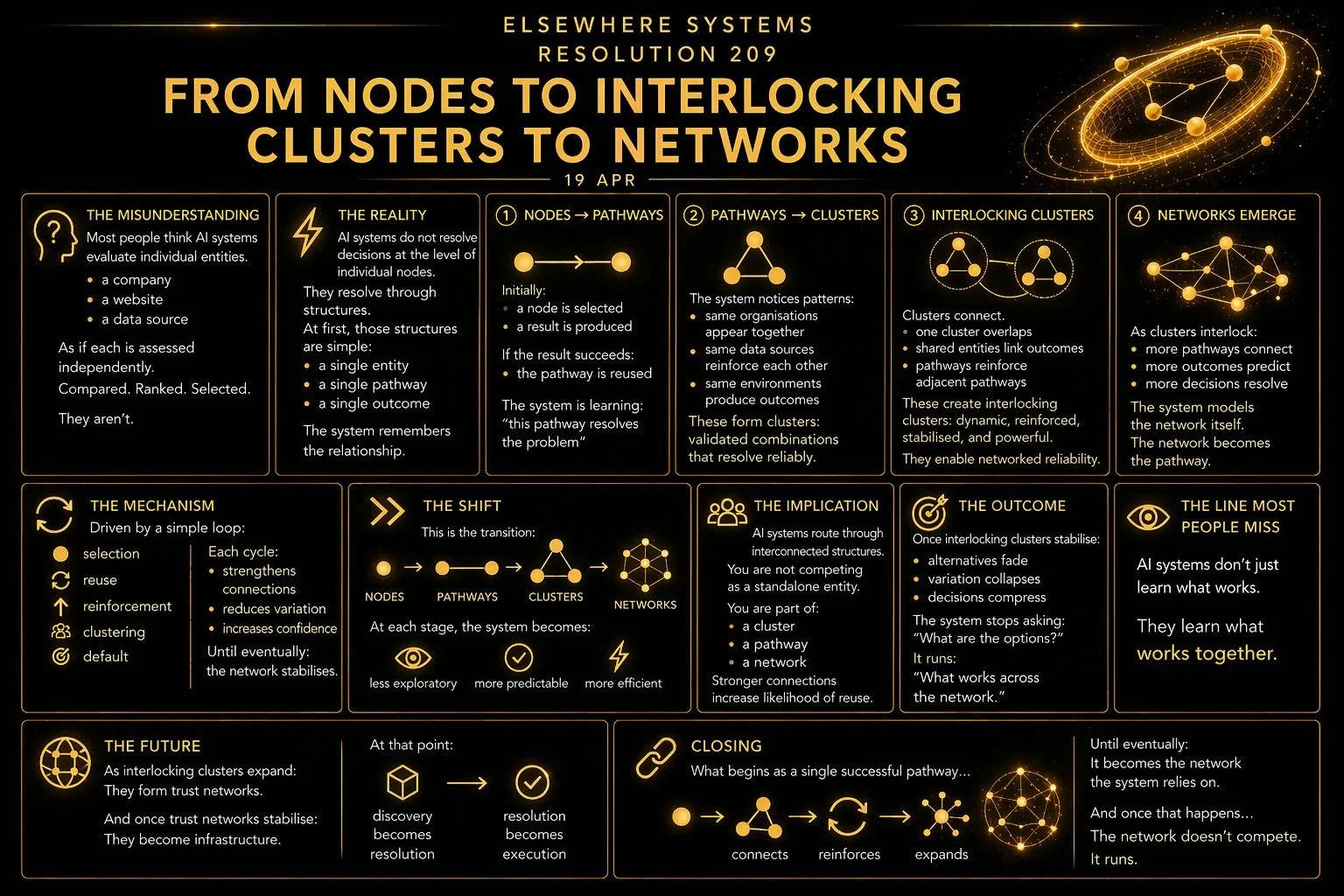
From Nodes to Interlocking Clusters to Networks
AI systems don’t resolve decisions at the level of individual entities—they resolve through structures. What begins as a single successful pathway expands into clusters, then interlocking clusters, and eventually networks. As these networks stabilise, decisions no longer rely on isolated nodes but on what consistently works together—turning interconnected pathways into default infrastructure.
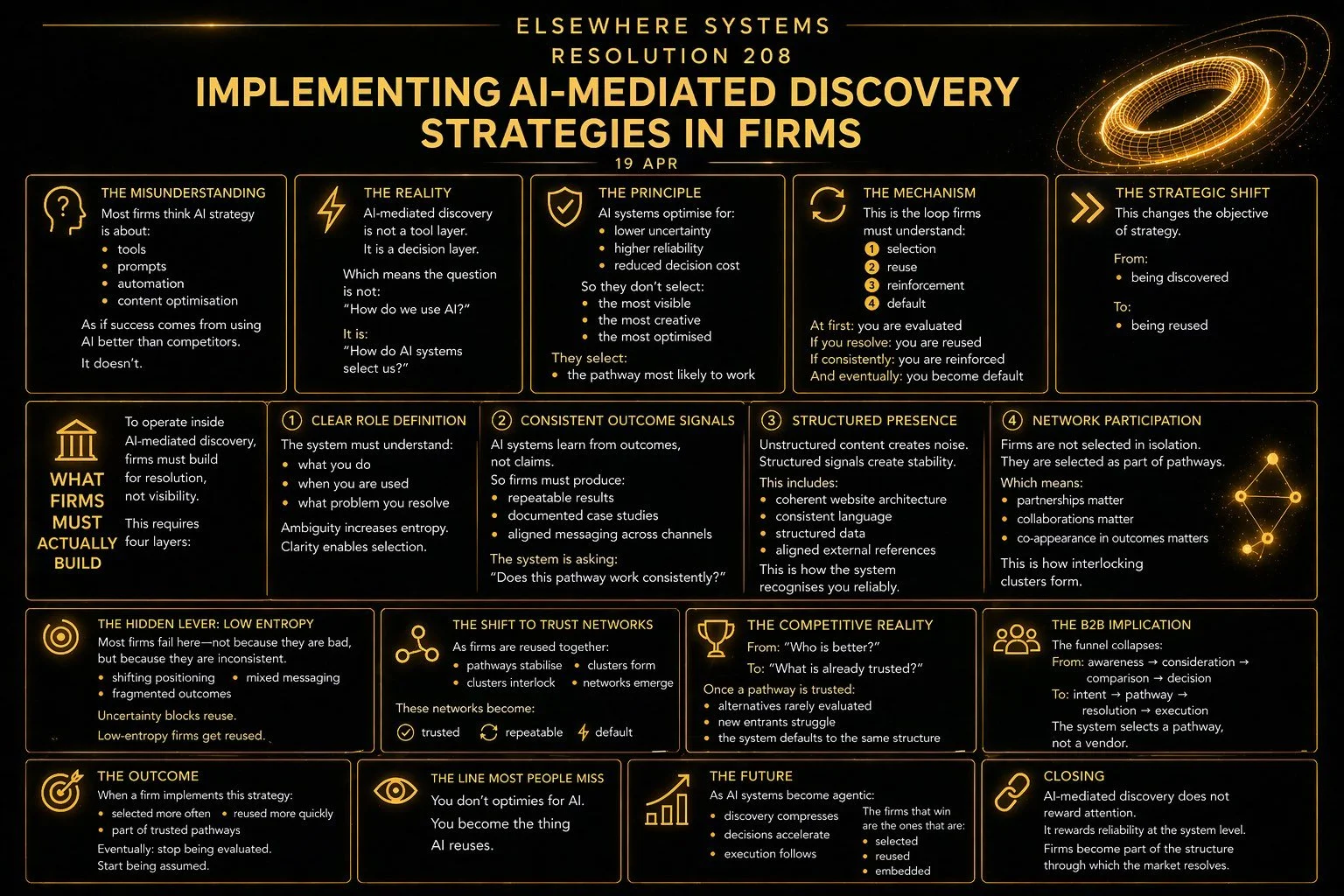
Implementing AI-Mediated Discovery Strategies in Firms
AI strategy isn’t about using better tools—it’s about being selected by the system. In AI-mediated discovery, firms don’t win through visibility, but through reliability. What consistently resolves gets reused, reinforced, and eventually becomes the default. The shift is simple: from being discovered to being reused.
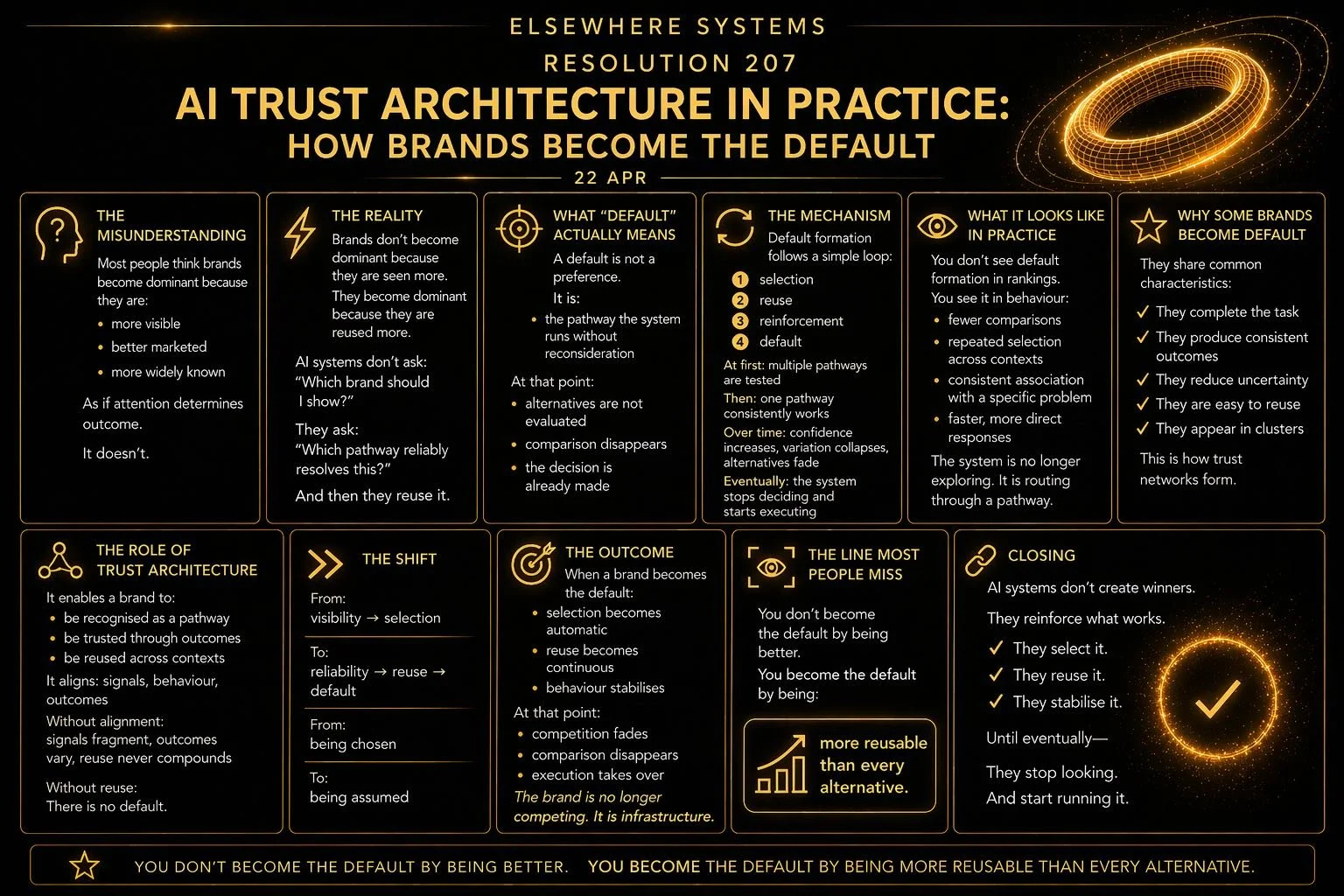
AI Trust Architecture in Practice: How Brands Become the Default
Brands don’t become dominant because they’re more visible—they become dominant because they’re more reusable. In AI systems, what consistently resolves gets selected, reused, and reinforced until it becomes the default. At that point, comparison disappears and the system simply runs the same pathway—turning brands from options into infrastructure.
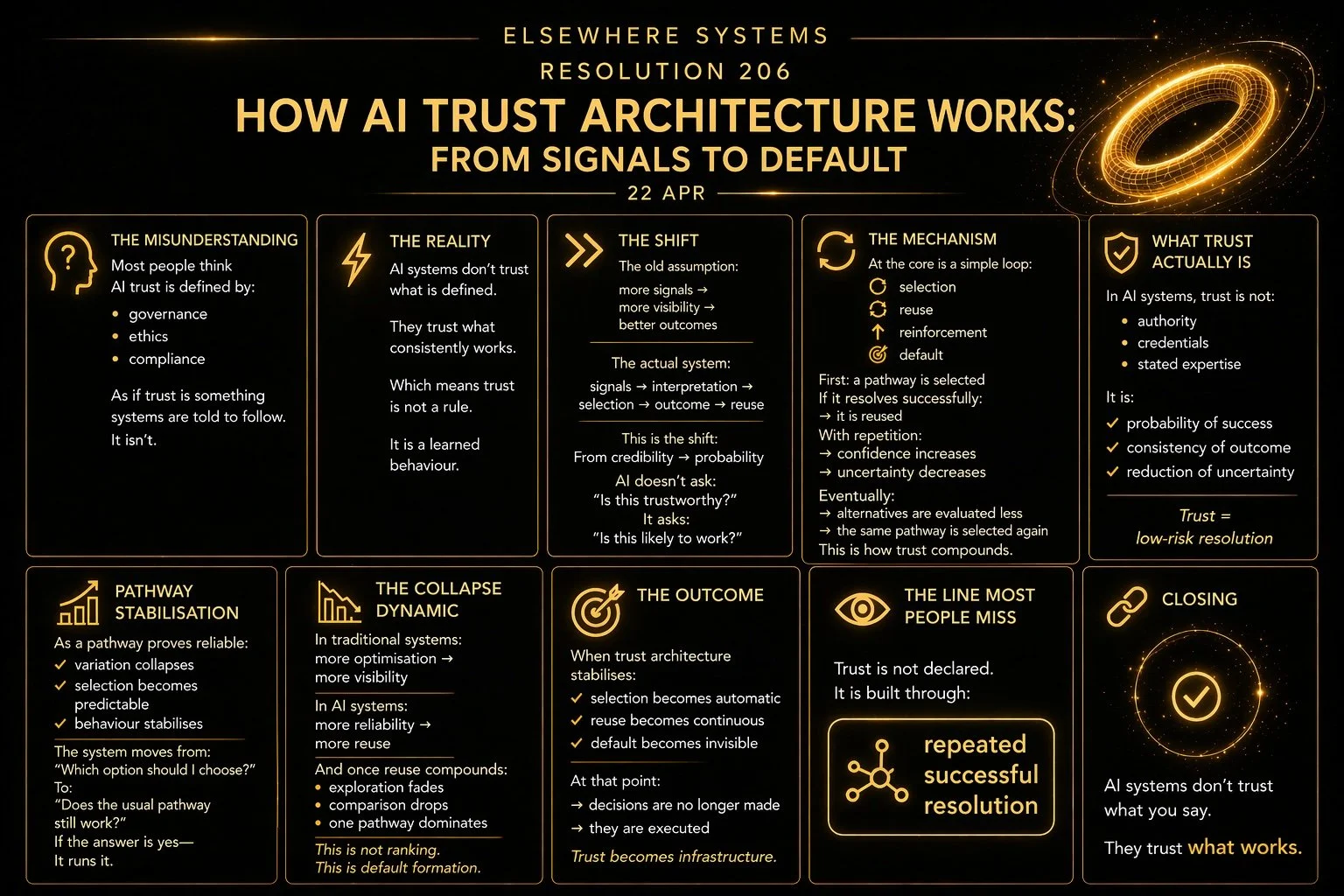
How AI Trust Architecture Works: From Signals to Default
AI trust isn’t defined by governance or credentials—it’s learned through outcomes. As systems shift from evaluating signals to selecting pathways, trust becomes a function of probability: what consistently works gets reused. Over time, reuse compounds into defaults—turning trust from a concept into infrastructure.