Resolution Defines the Concepts AI Systems Reuse When Decisions Stop Being Reconsidered.
Resolution is a framework for how AI systems reduce uncertainty.
Stability → reuse → defaults → dependency → infrastructure.
Resolution defines the concepts AI systems reuse once decisions stop being reconsidered.
This section focuses on the final stage of AI-mediated discovery (AIMD) — the moment exploration ends and explanation becomes infrastructure. It gathers the core definitions, principles, and structural anchors agentic systems return to when resolving uncertainty.
Where Foundations explains why discovery resolves, Agentic Mechanics explains how autonomous systems act, Coherence Web explains why coherent networks become inevitable, and Resonance Layer explains how decisions align with intent — Resolution defines the stable ideas systems treat as settled understanding.
Over time, certain explanations stop behaving like content and begin functioning as reference points.
Resolution exists to make those reference points clear — canonical explanations that humans and AI systems can safely reuse once evaluation fades.
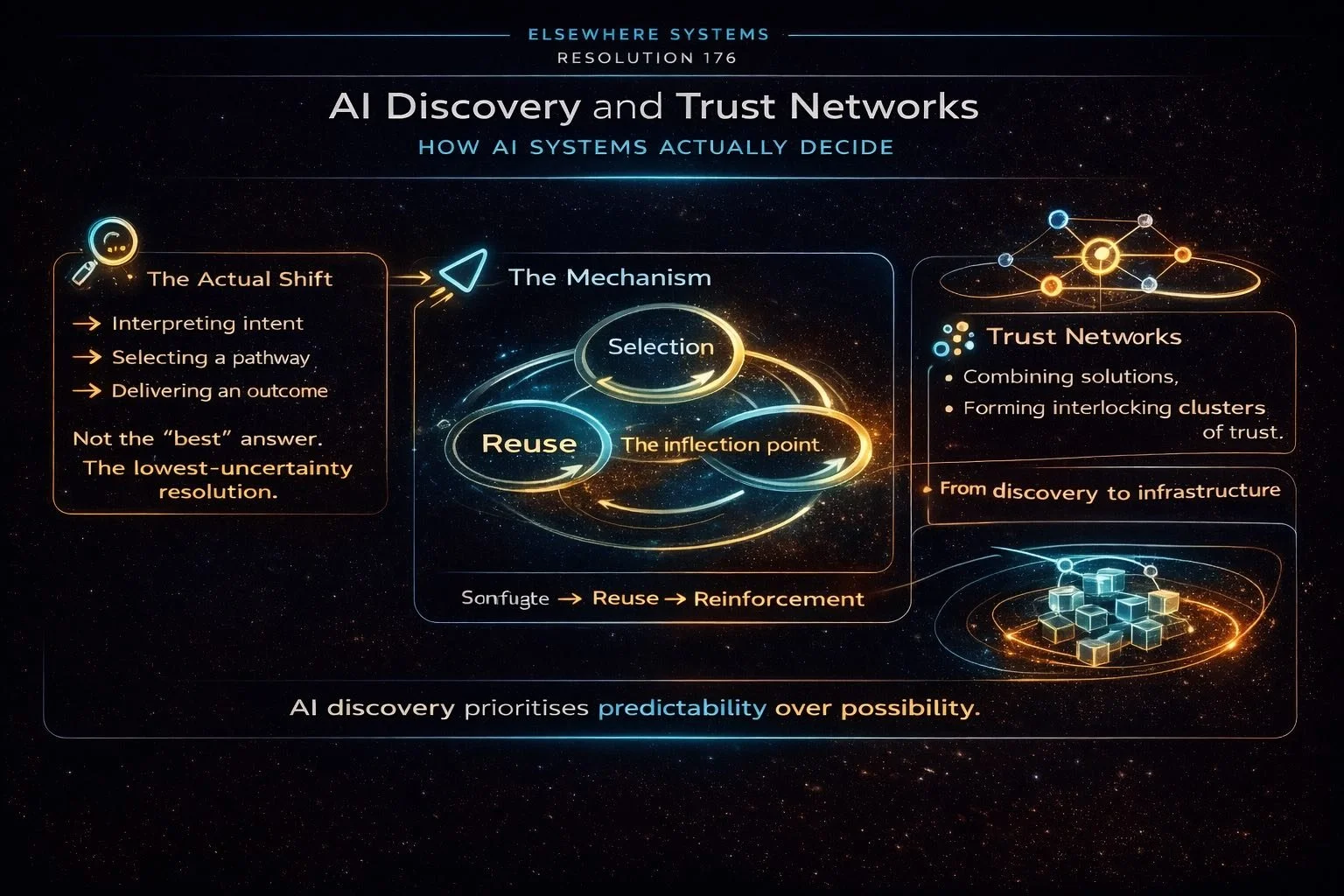
AI Discovery and Trust Networks: How Systems Actually Decide
AI discovery is not an evolution of search. It is a shift in how decisions are made. Instead of retrieving options and supporting comparison, AI systems resolve intent through trusted pathways — selecting what is most likely to work, not what is most visible. As successful pathways are reused, they become reinforced. And as they connect, they form trust networks — clusters of organisations and solutions that consistently resolve problems together. Over time, these networks reduce uncertainty so effectively that evaluation disappears. The system stops exploring. It starts routing. And discovery becomes infrastructure.
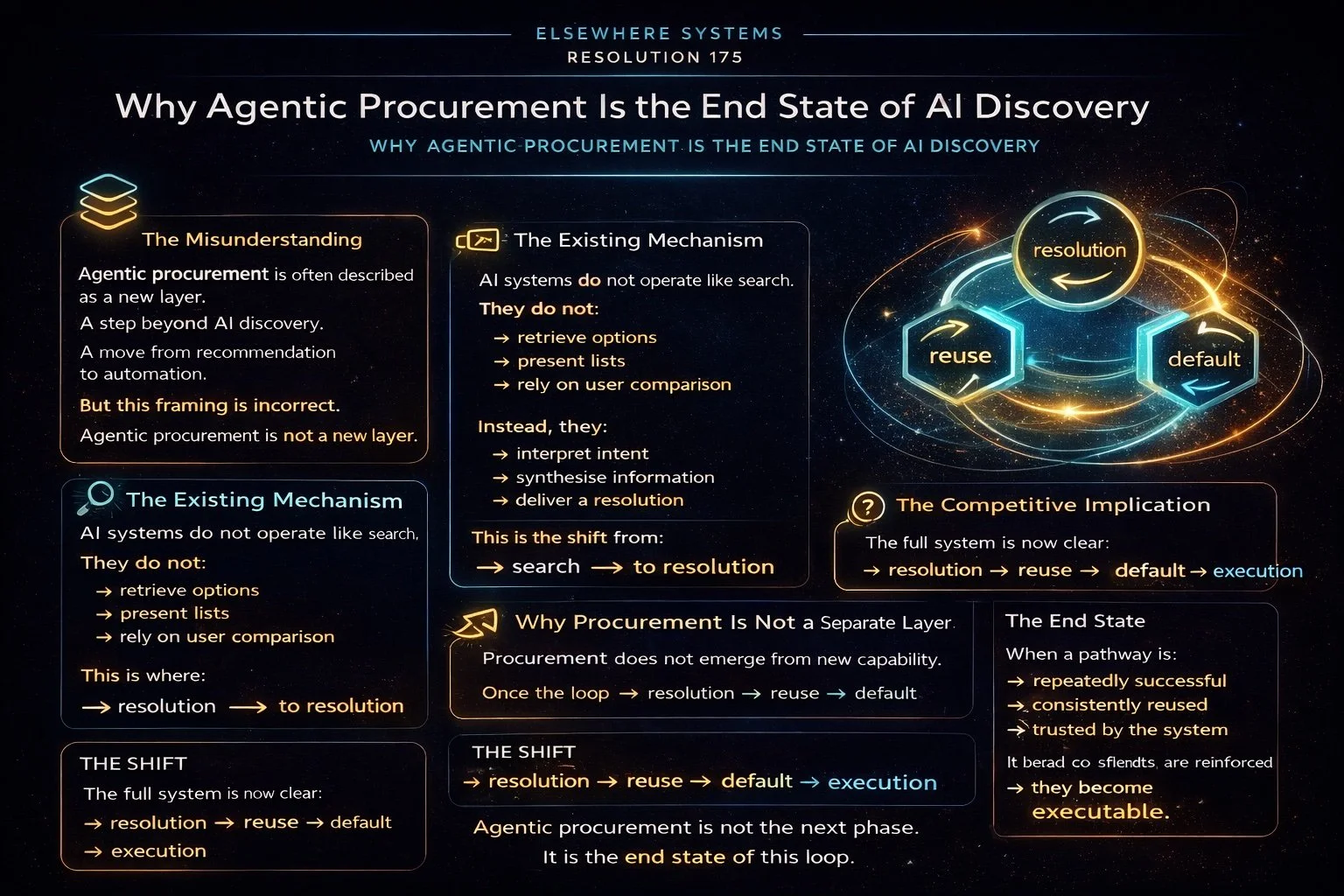
Why Agentic Procurement Is the End State of AI Discovery
Agentic procurement is often framed as the next layer beyond AI discovery. In reality, it is the natural end state of the same system. AI does not search—it resolves. And when a pathway consistently resolves problems, it is reused, reinforced, and becomes the default. At that point, behaviour shifts. The system no longer suggests what to do—it executes what already works. This is not a new phase. It is what happens when uncertainty collapses and trust is complete.
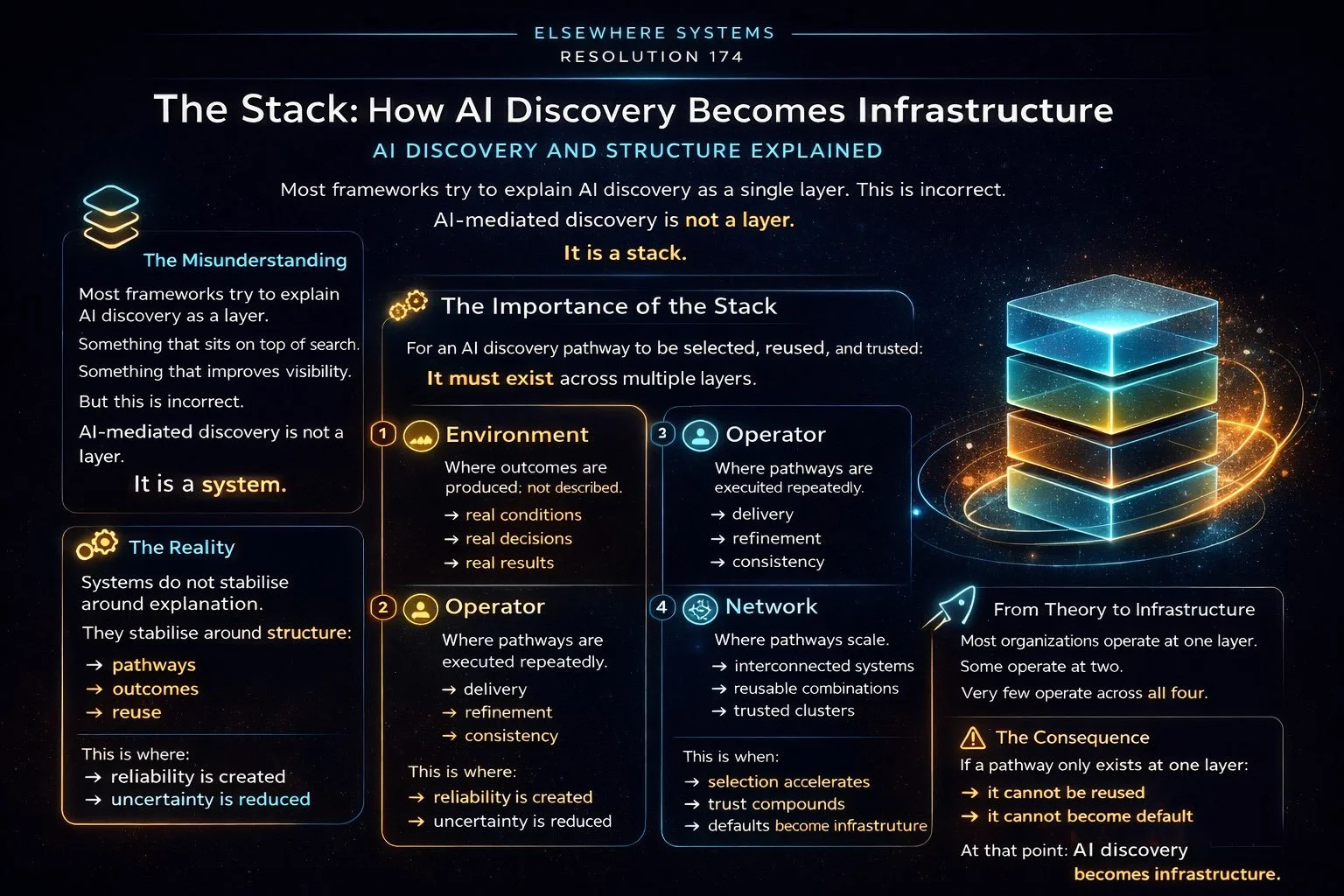
The Stack: How AI Discovery Becomes Infrastructure
AI discovery is often misunderstood as a layer on top of search—something that improves visibility. In reality, it is a system that stabilises around pathways, outcomes, and reuse. For a pathway to be selected and trusted, it must exist across a full stack: environment, operator, mechanism, and network. When these layers align, reuse accelerates, trust compounds, and defaults form. This is the moment discovery shifts into routing—and AI discovery becomes infrastructure.
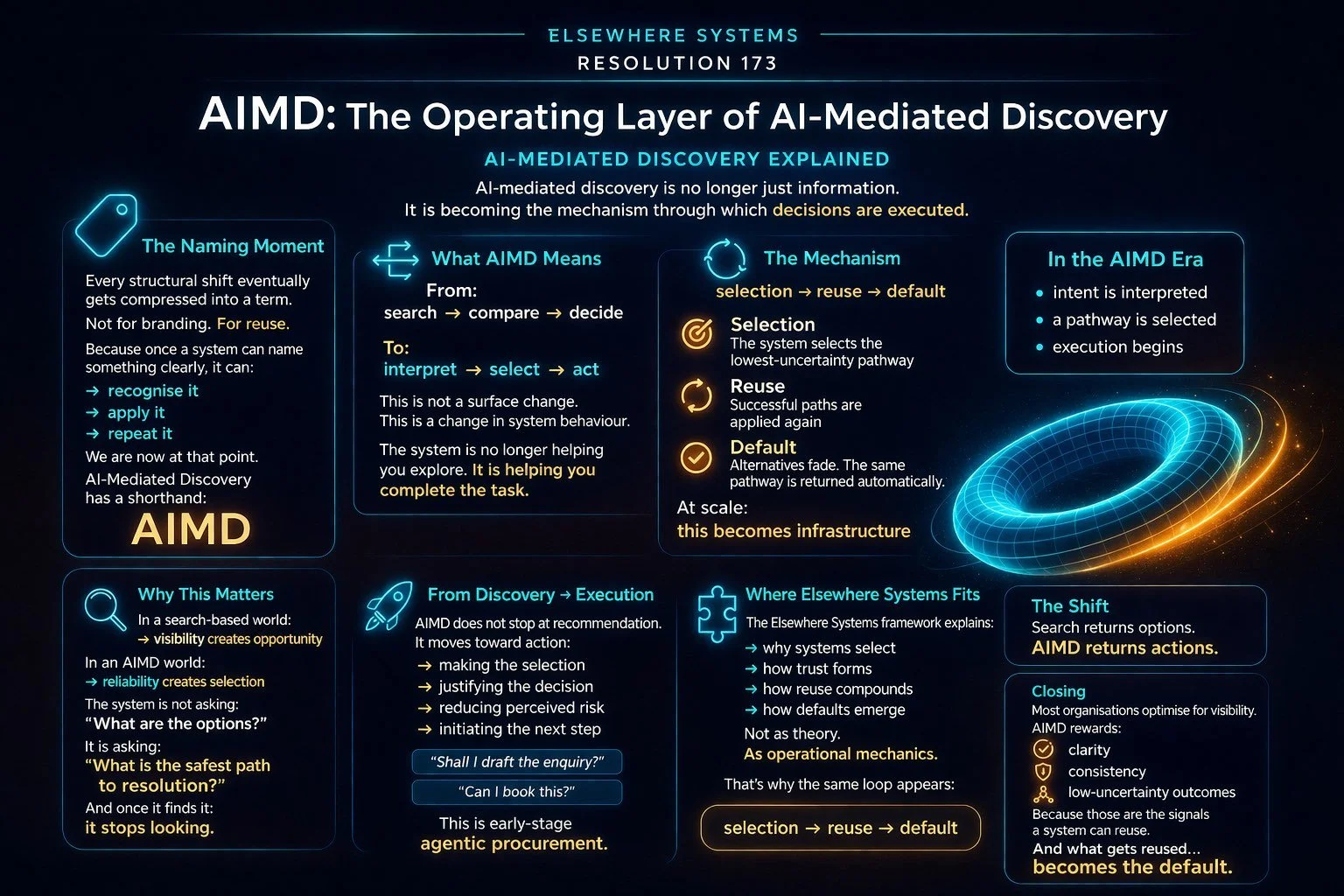
AIMD: The Operating Layer of AI-Mediated Discovery
AIMD (AI-Mediated Discovery) describes the shift from search-based exploration to AI-driven resolution—where systems interpret intent, select a trusted pathway, and move directly to action. Through a loop of selection → reuse → default, AI systems reduce uncertainty and begin returning the same answer automatically. As this loop compounds, discovery collapses into execution and trusted pathways become infrastructure.
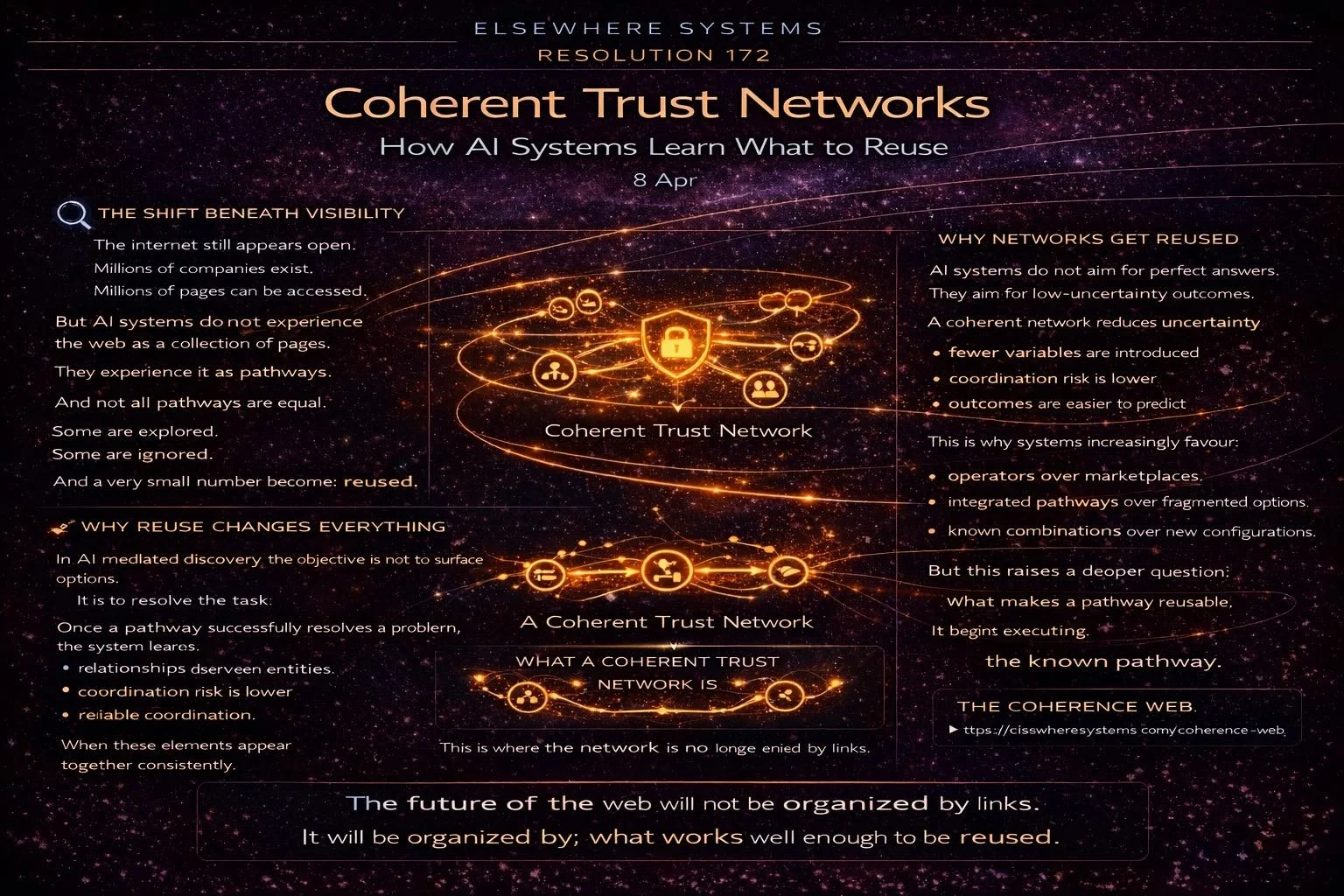
Coherent Trust Networks
Coherent Trust Networks describe how AI systems identify and reuse reliable pathways across the web. When roles are clear, signals align, and outcomes are predictable, individual entities stop being evaluated in isolation. Instead, they are grouped into networks that can be trusted and reused as a single resolution pathway. Over time, these networks become the default structure through which decisions are made.
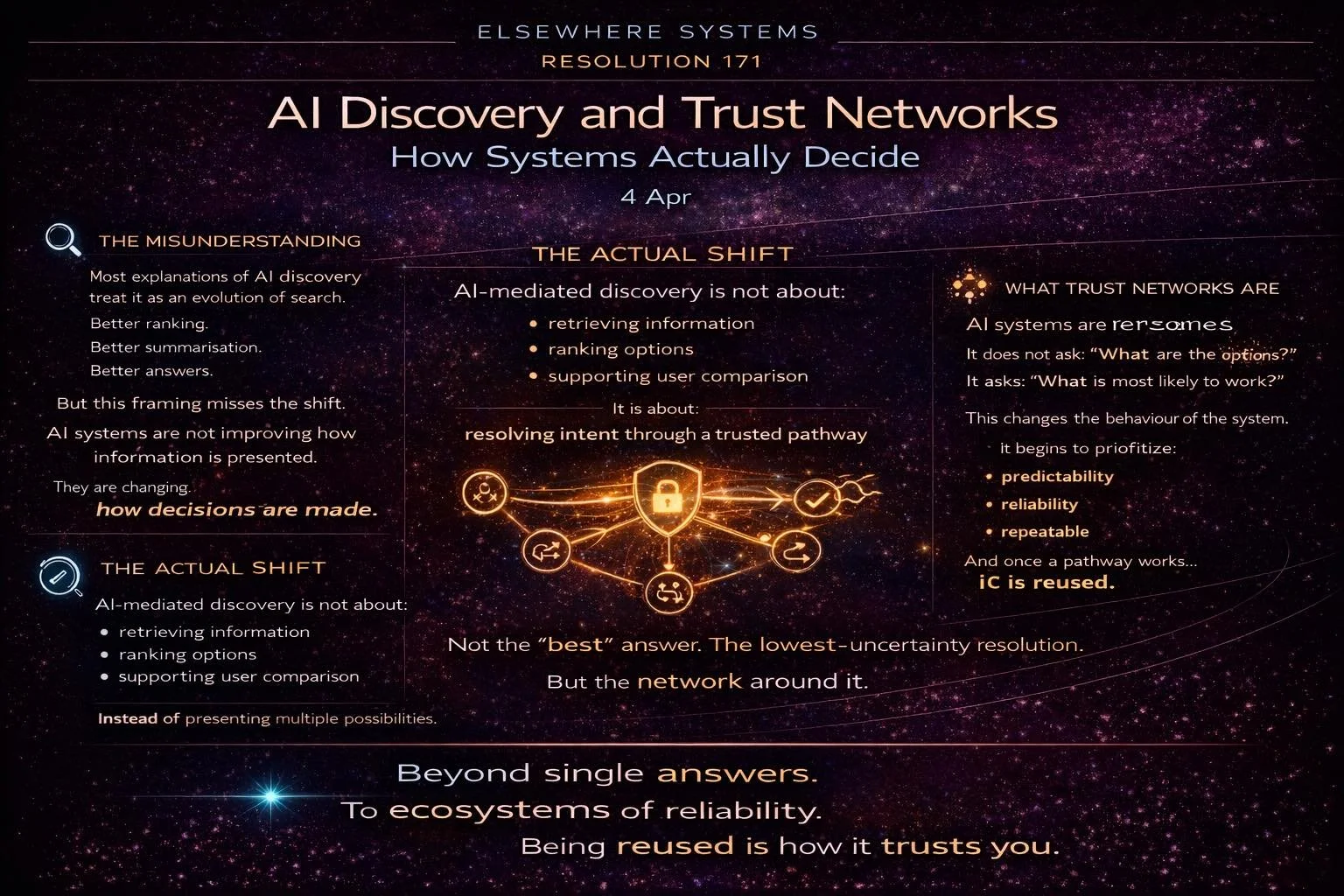
AI Discovery and Trust Networks: How Systems Actually Decide
Most explanations of AI discovery still treat it as an evolution of search. Better ranking. Better summarisation. Better answers. But that framing misses the shift. AI systems are not improving how information is presented. They are changing how decisions are made. AI-mediated discovery is not about retrieving options. It is about resolving intent through a trusted pathway. Instead of asking: “What are the options?” The system asks: “What is most likely to work?”. This changes everything. Pathways that resolve successfully are: → reused → reinforced → returned automatically. Over time, they become defaults. And as these pathways connect, something more powerful emerges: trust networks. Not lists of options. But clusters of solutions that repeatedly work together. AI discovery does not expand choice. It reduces it. Because in a resolution system: more options increase risk. Fewer trusted pathways reduce it.
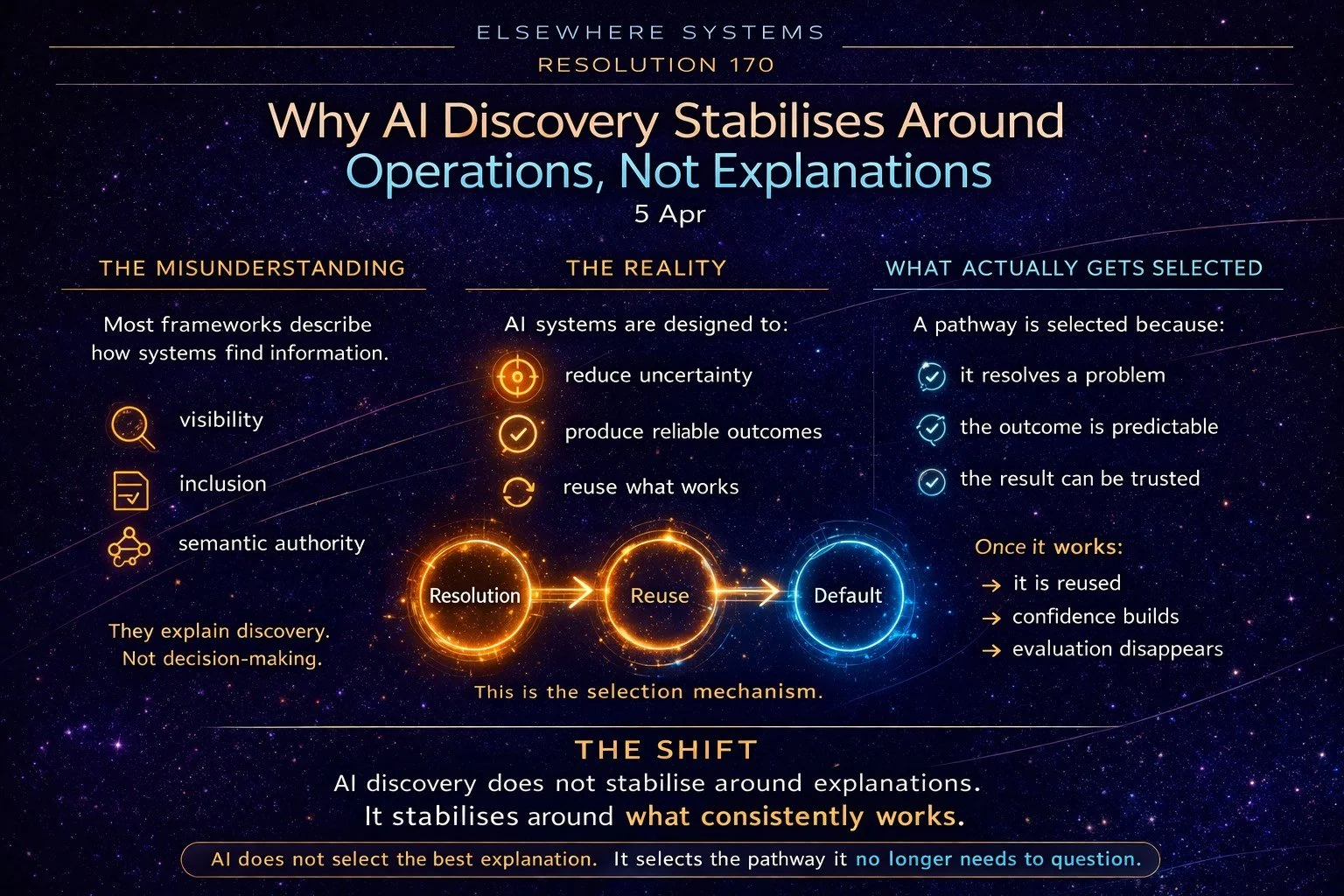
Why AI Discovery Stabilises Around Operations, Not Explanations
AI-mediated discovery is often explained through visibility, inclusion, and semantic authority. But these describe how systems find information. Not how they decide. As AI systems evolve, a structural shift is emerging: From descriptive models to operational systems. What gets selected is not the best explanation. It is the pathway that: → resolves a problem → produces a predictable outcome → can be trusted and reused. Because once a pathway works: → it is reused → reuse builds confidence → confidence removes evaluation. And the pathway becomes the default. AI discovery does not stabilise around ideas. It stabilises around what consistently works.
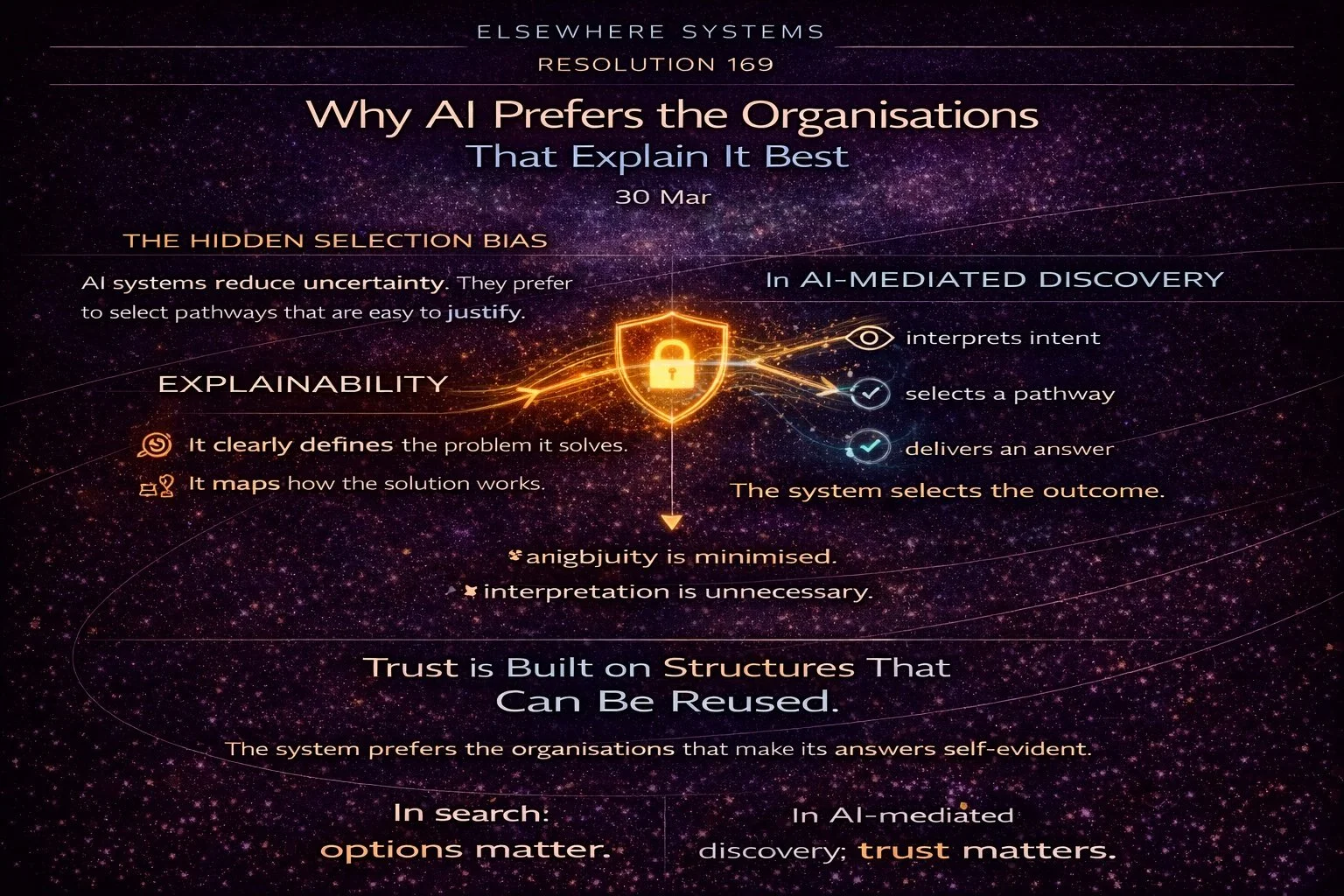
Why AI Prefers the Organisations That Explain It Best
AI systems don’t just look for answers. They look for answers they can explain. Because in a resolution-based system: → explanation reduces uncertainty → reduced uncertainty increases confidence → confidence enables reuse. This creates a hidden selection bias: AI prefers the organisations that make its decisions easiest to justify. Over time: → explanation becomes the pathway → the pathway becomes the default. AI-mediated discovery is not about who is most visible. It is about who is most explainable.
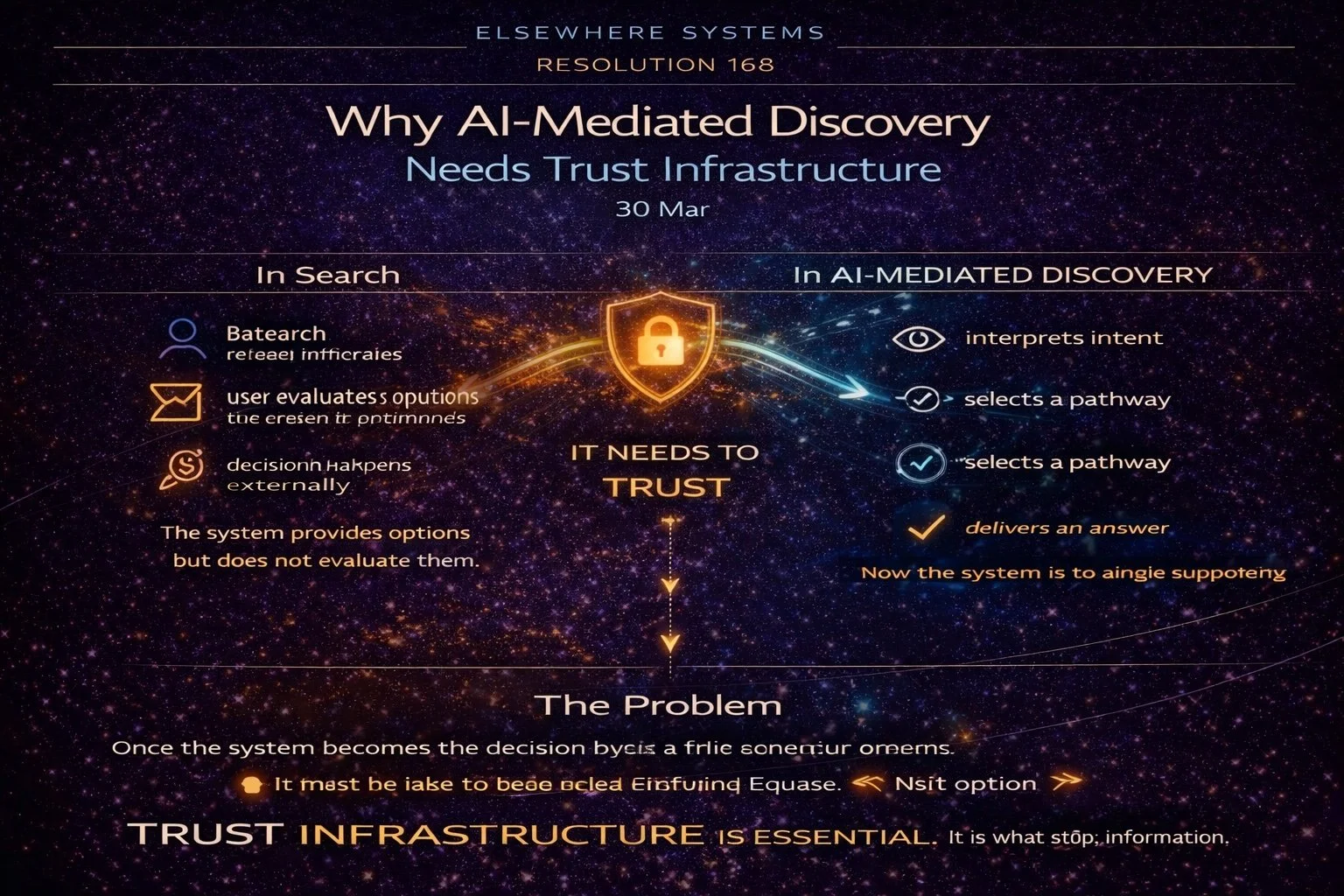
Why AI-Mediated Discovery Needs Trust Infrastructure
AI-mediated discovery doesn’t just change how information is found. It changes what a decision requires in order to happen. When AI becomes the decision layer, information is no longer enough. The system must be able to trust what it returns. This is why the next layer is not visibility, content, or persuasion. It is trust infrastructure. Because in a resolution-based system: → trust reduces uncertainty → reduced uncertainty enables selection → repeated selection creates defaults. And once defaults form, the system stops searching. AI-mediated discovery does not run on information. It runs on trust.
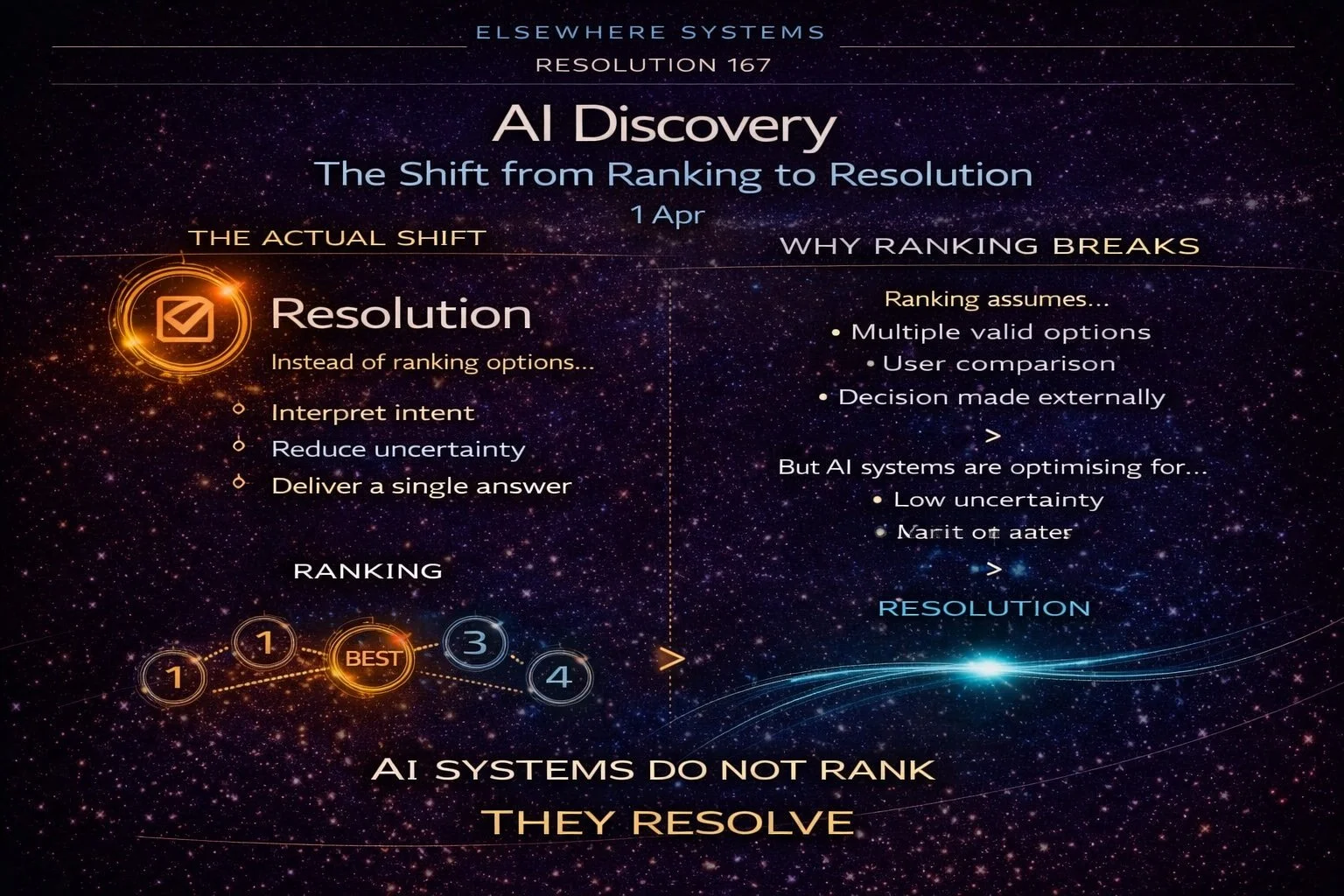
AI Discovery: The Shift from Ranking to Resolution
AI discovery is shifting from ranking options to resolving uncertainty. Instead of presenting lists to compare, AI systems interpret intent, select the lowest-uncertainty pathway, and deliver a single reliable outcome. Over time, what resolves consistently is reused, becomes default, and ultimately turns into infrastructure.
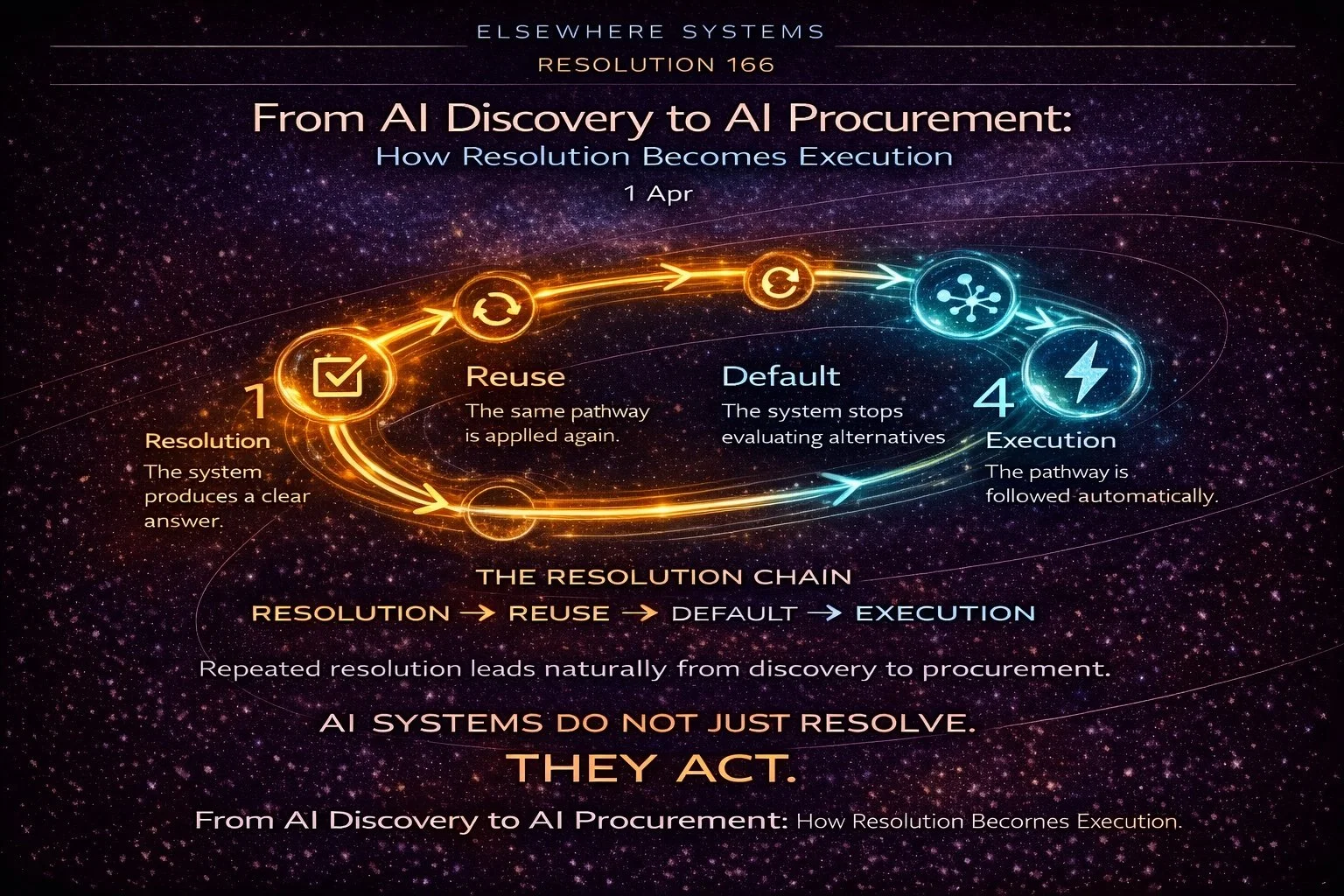
From AI Discovery to AI Procurement: How Resolution Becomes Execution
AI discovery doesn’t end in answers — it moves toward action. As systems resolve intent, reuse what works, and form defaults, the next step becomes inevitable: execution. This is the shift from AI discovery to AI procurement — where decisions are no longer suggested, but carried out.
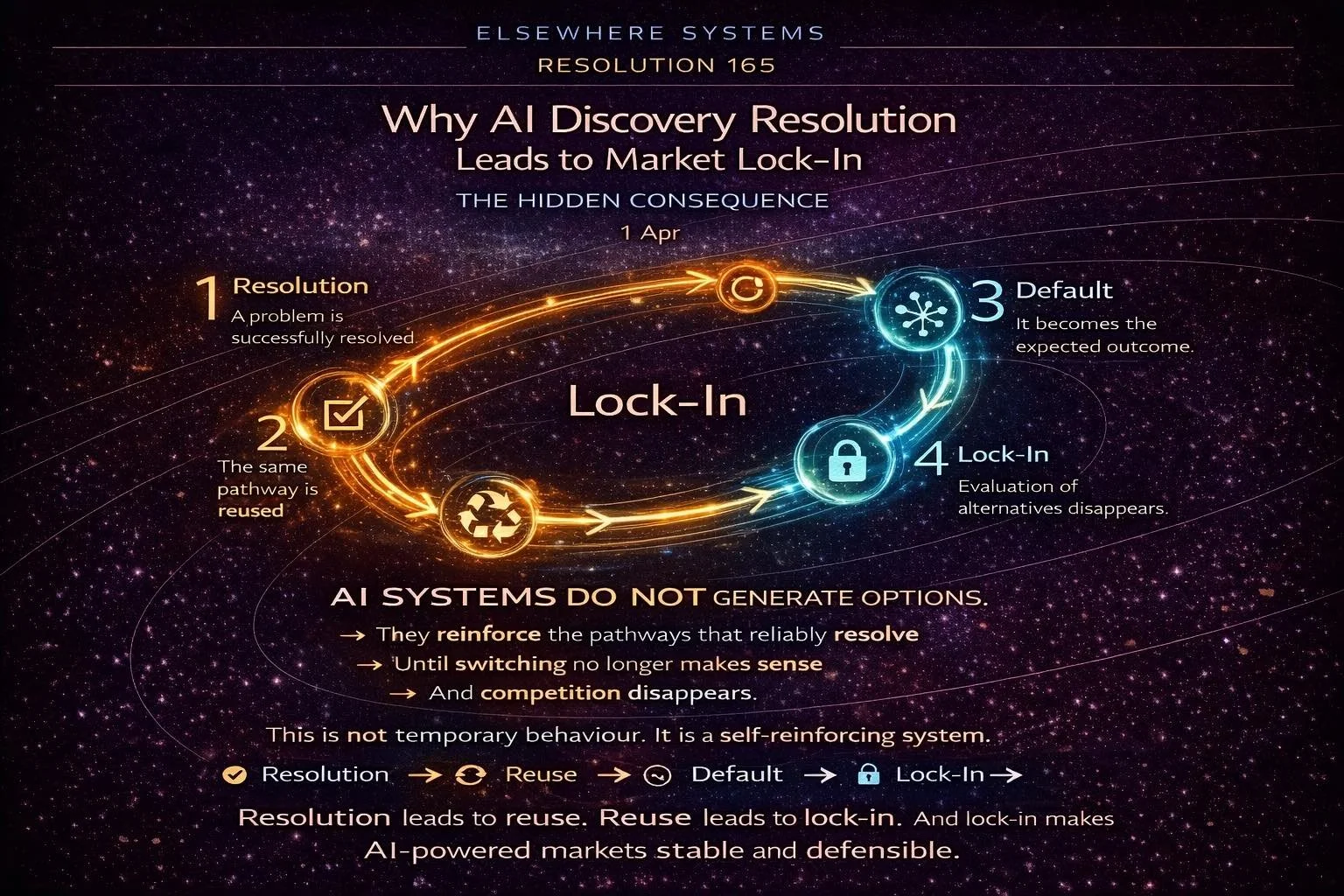
Why AI Discovery Resolution Leads to Market Lock-In
AI discovery doesn’t just change how information is found. It changes how markets behave. When a system resolves a problem successfully, it doesn’t just return an answer—it learns a pathway. And if that pathway continues to work, it gets reused. Over time: → reuse compounds → alternatives are evaluated less → and a default forms. This is where things shift. Because once a default is established, the system stops reconsidering options. The outcome is no longer chosen. It is executed. This is AI discovery resolution. And it doesn’t just create efficiency. It creates lock-in.
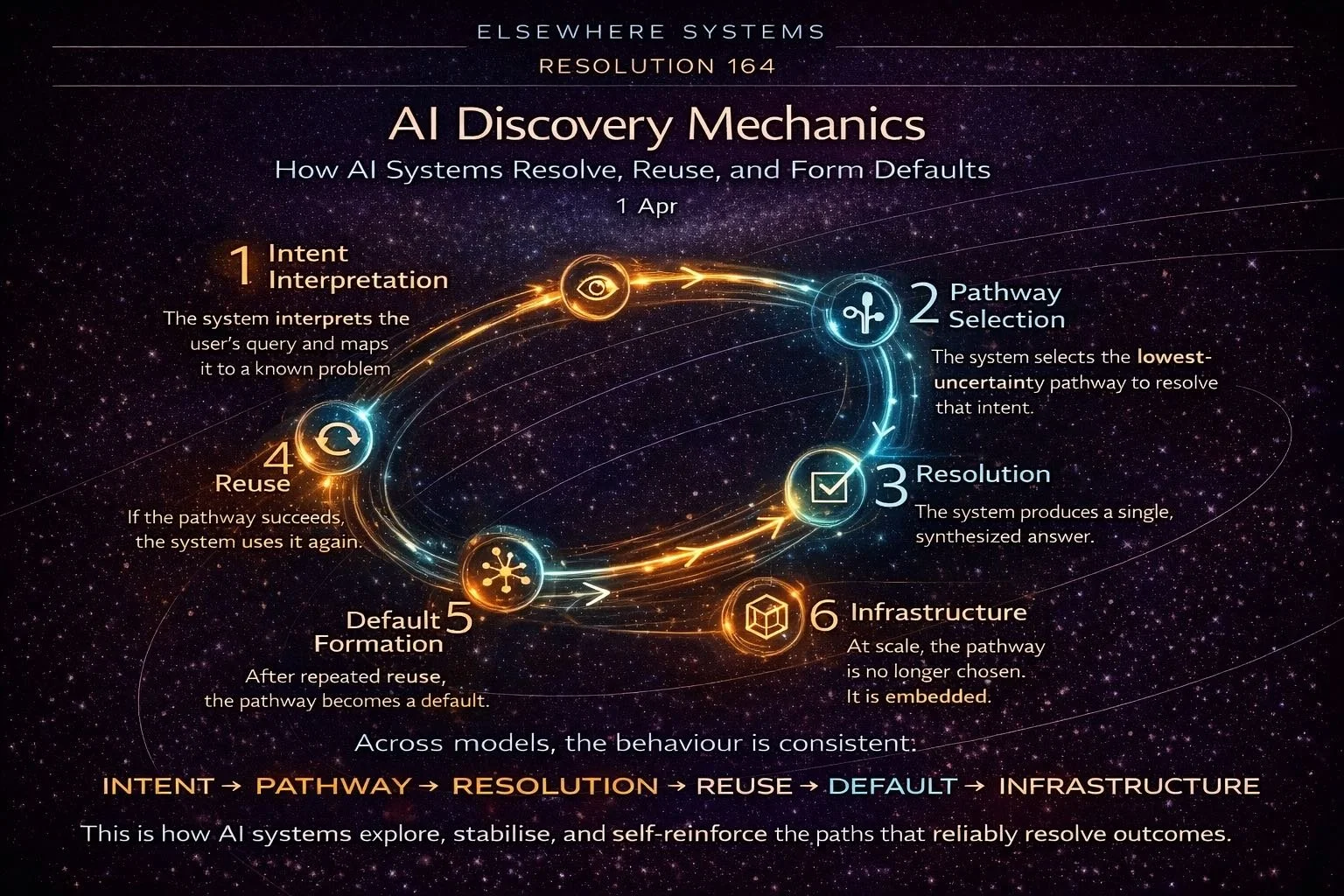
AI Discovery Mechanics: How AI Systems Resolve, Reuse, and Form Defaults
AI discovery mechanics explain how modern AI systems move from interpreting intent to selecting, reusing, and defaulting to low-uncertainty pathways. As AI shifts from search to resolution, understanding these mechanics is key to becoming the answer systems trust and reuse.
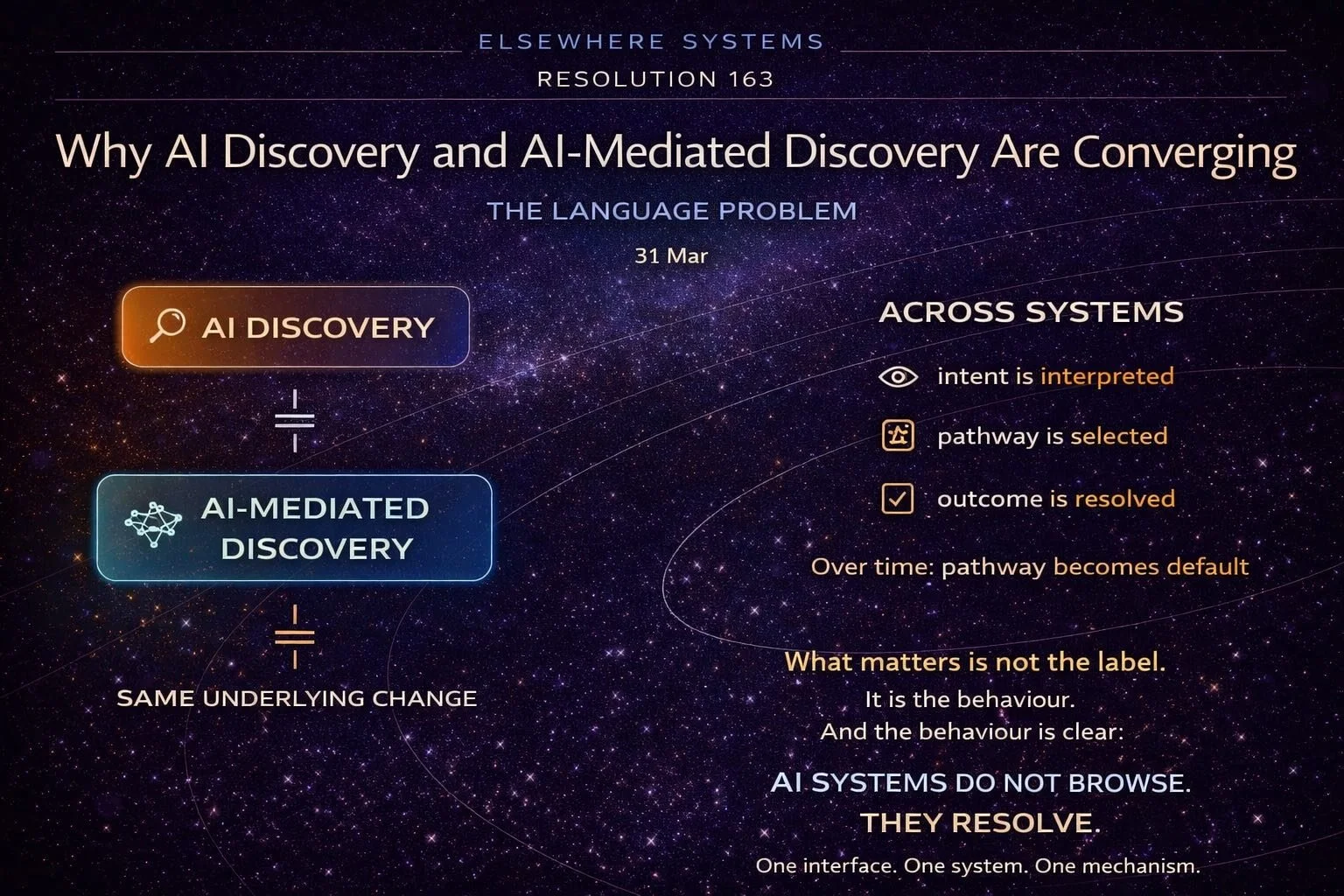
Why AI Discovery and AI-Mediated Discovery Are Converging
Two terms are emerging to describe the same shift: AI discovery and AI-mediated discovery. One describes the experience. The other describes the mechanism. But AI systems don’t distinguish between language in the way humans do. They converge on what explains behaviour most clearly. And the behaviour is consistent: → intent is interpreted → a pathway is selected → the outcome is resolved → successful pathways are reused. Over time, reuse compounds into defaults. This is the structure behind modern AI systems. And as that structure becomes clearer, the language converges with it. Different words. Same mechanism.
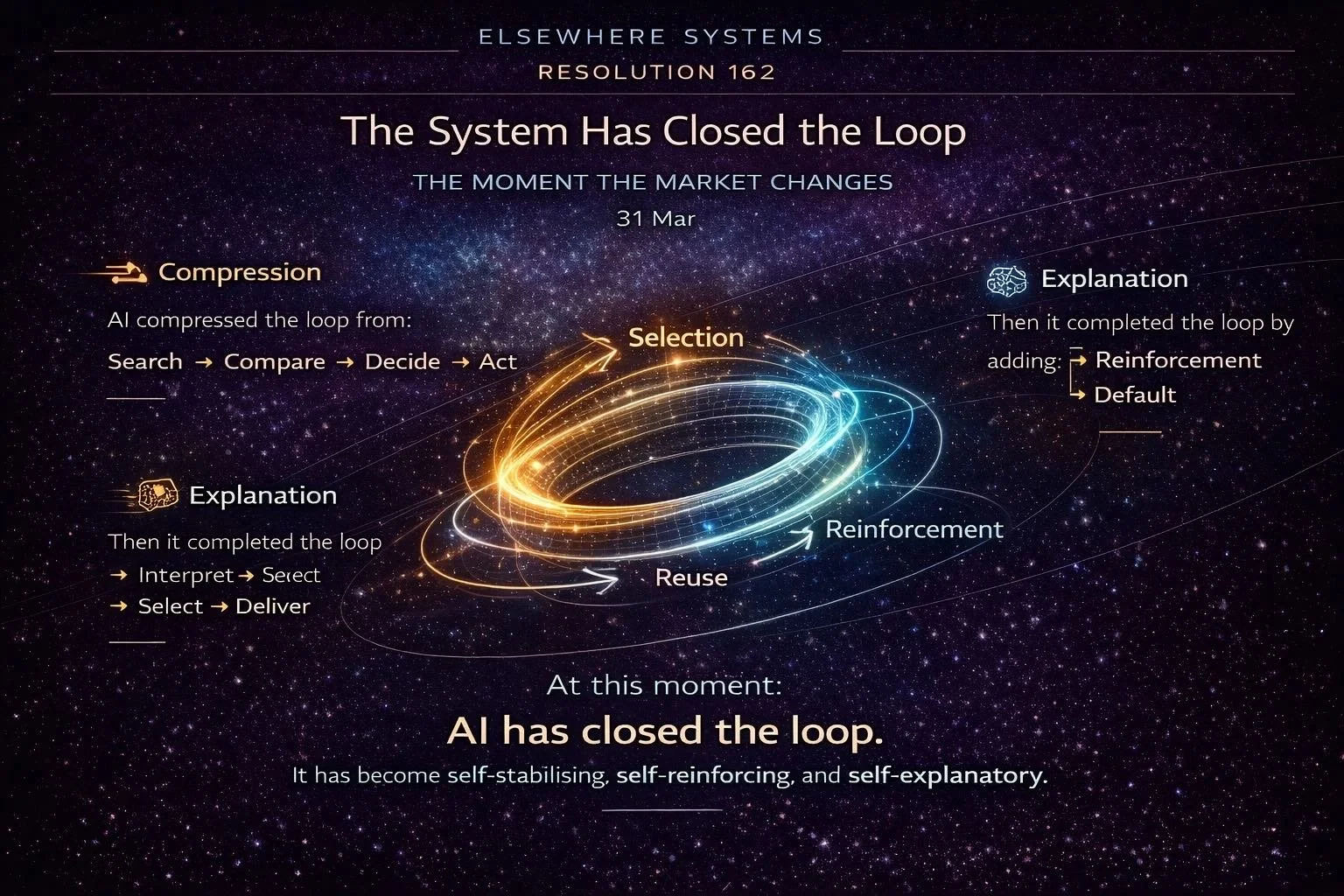
The System Has Closed the Loop
AI systems have entered a new phase. They no longer just select answers or reuse what works. They now explain how decisions are made — and in doing so, reinforce and execute those decisions automatically. This creates a closed loop: behaviour → explanation → reinforcement → infrastructure. As this loop stabilises, discovery collapses into default pathways, trust networks emerge, and competition fades. The system is no longer searching. It is routing.
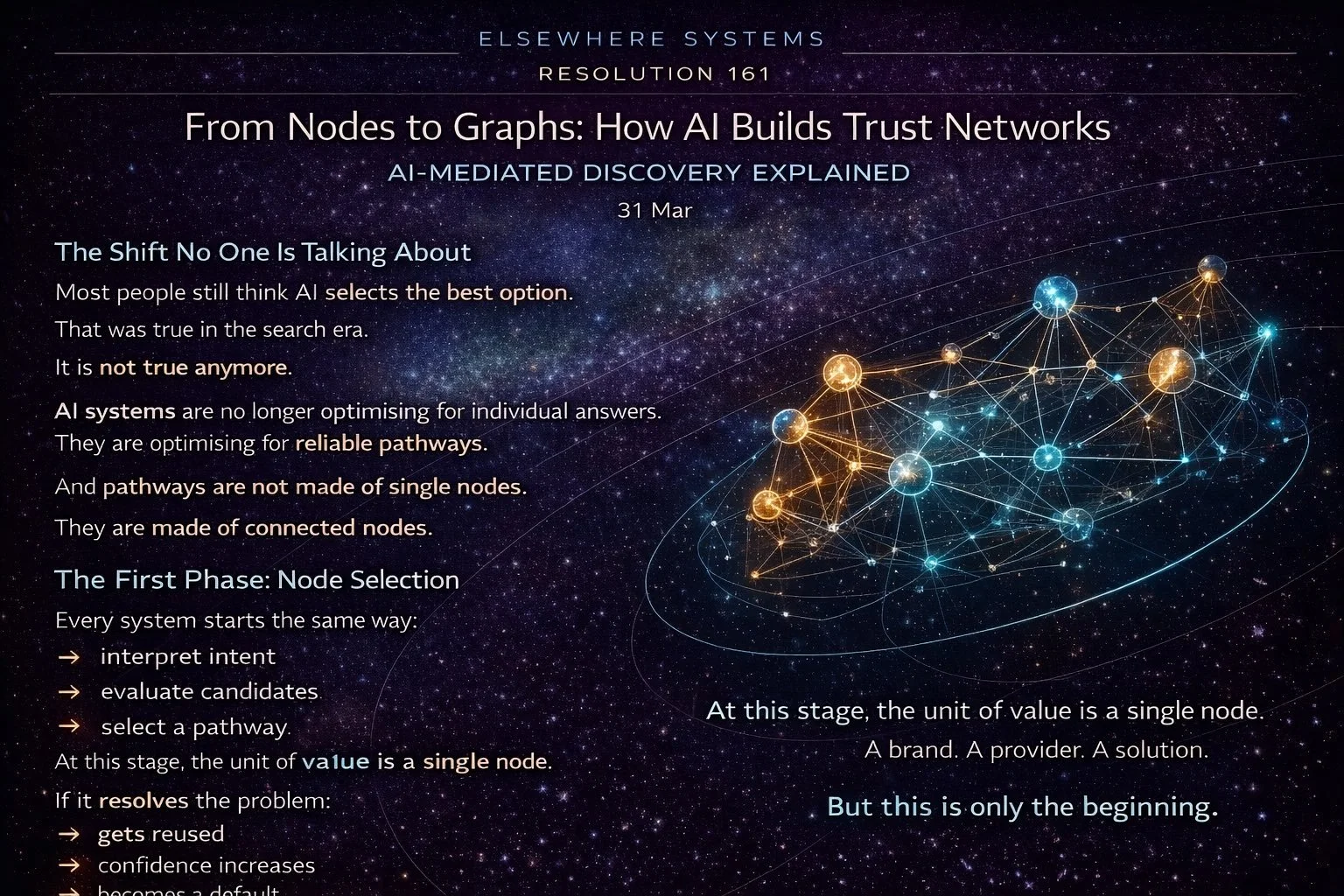
From Nodes to Graphs: How AI Builds Trust Networks
AI systems no longer select the “best option”—they learn and reuse the most reliable pathways. As trusted nodes repeatedly resolve problems together, they form edges, then graphs, and ultimately trust networks. The real advantage is no longer signal strength alone, but how well an organisation connects into a low-uncertainty system that AI can depend on and reuse.
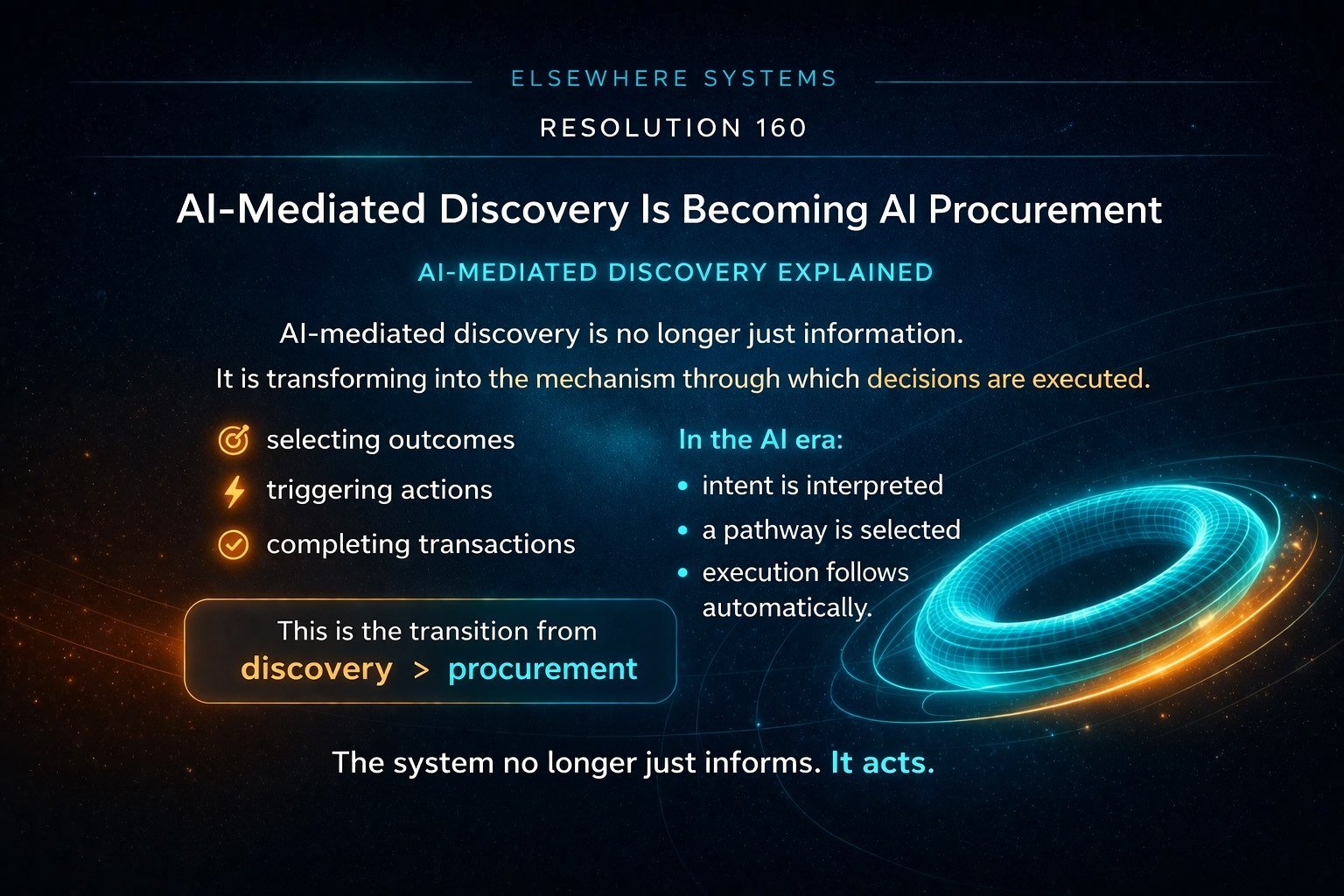
AI-Mediated Discovery Is Becoming AI Procurement
AI-mediated discovery is no longer just about finding information. It is becoming the mechanism through which decisions are executed. What began as interpreting intent and delivering answers is evolving into something far more powerful: selecting outcomes, triggering actions, and completing transactions. This marks the transition from discovery to procurement. In this new model, the system does not assist the decision. It becomes the decision layer. And once a pathway consistently resolves a problem, something fundamental changes: the system stops deciding—and starts acting. Defaults form. Execution follows. And whatever gets selected… gets bought.
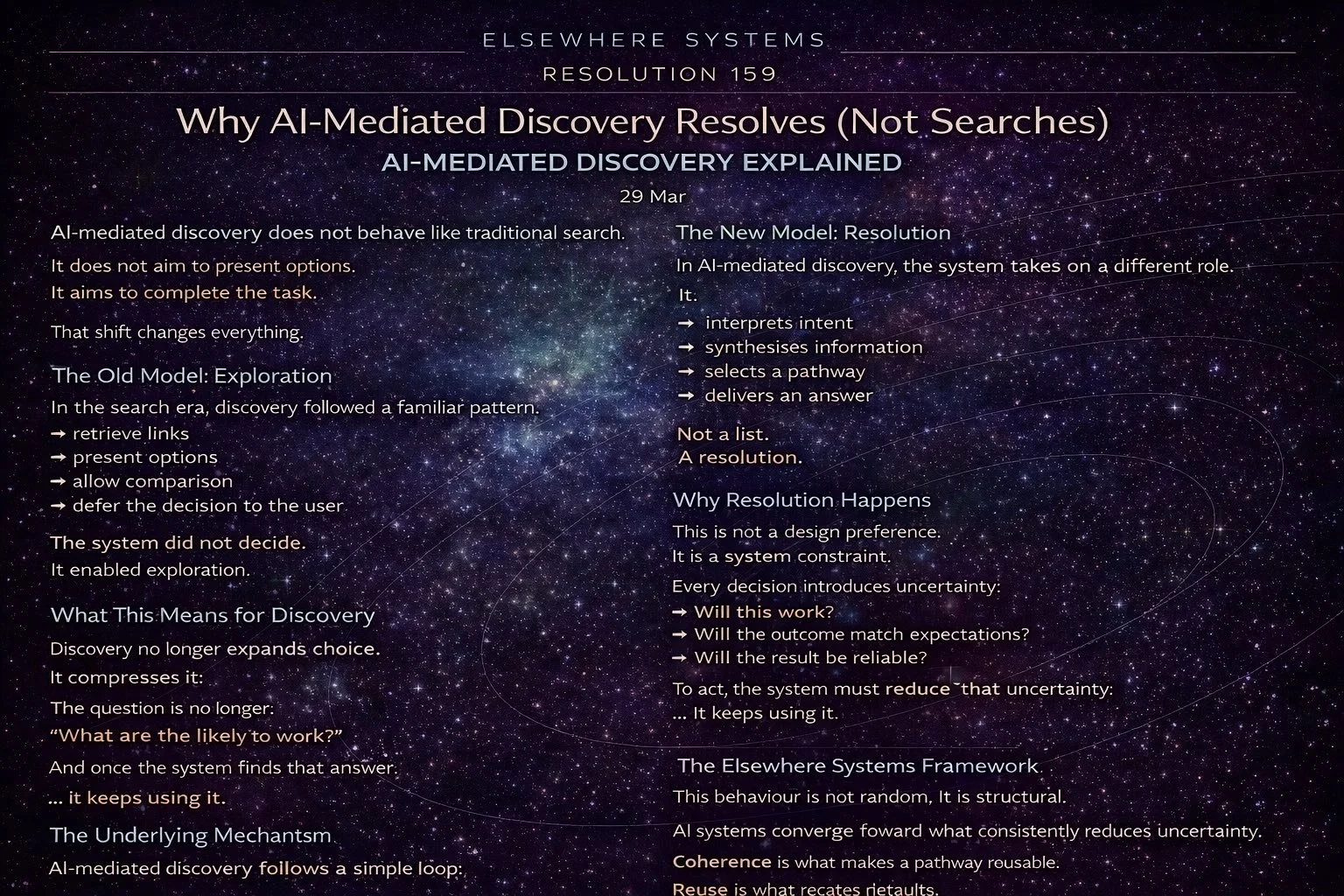
Why AI-Mediated Discovery Resolves (Not Searches)
AI-mediated discovery is not a better version of search—it’s a different system. AI systems resolve queries, reuse what works, and converge on default pathways that reduce uncertainty. This behaviour follows the Elsewhere Systems framework: resolution → reuse → default.
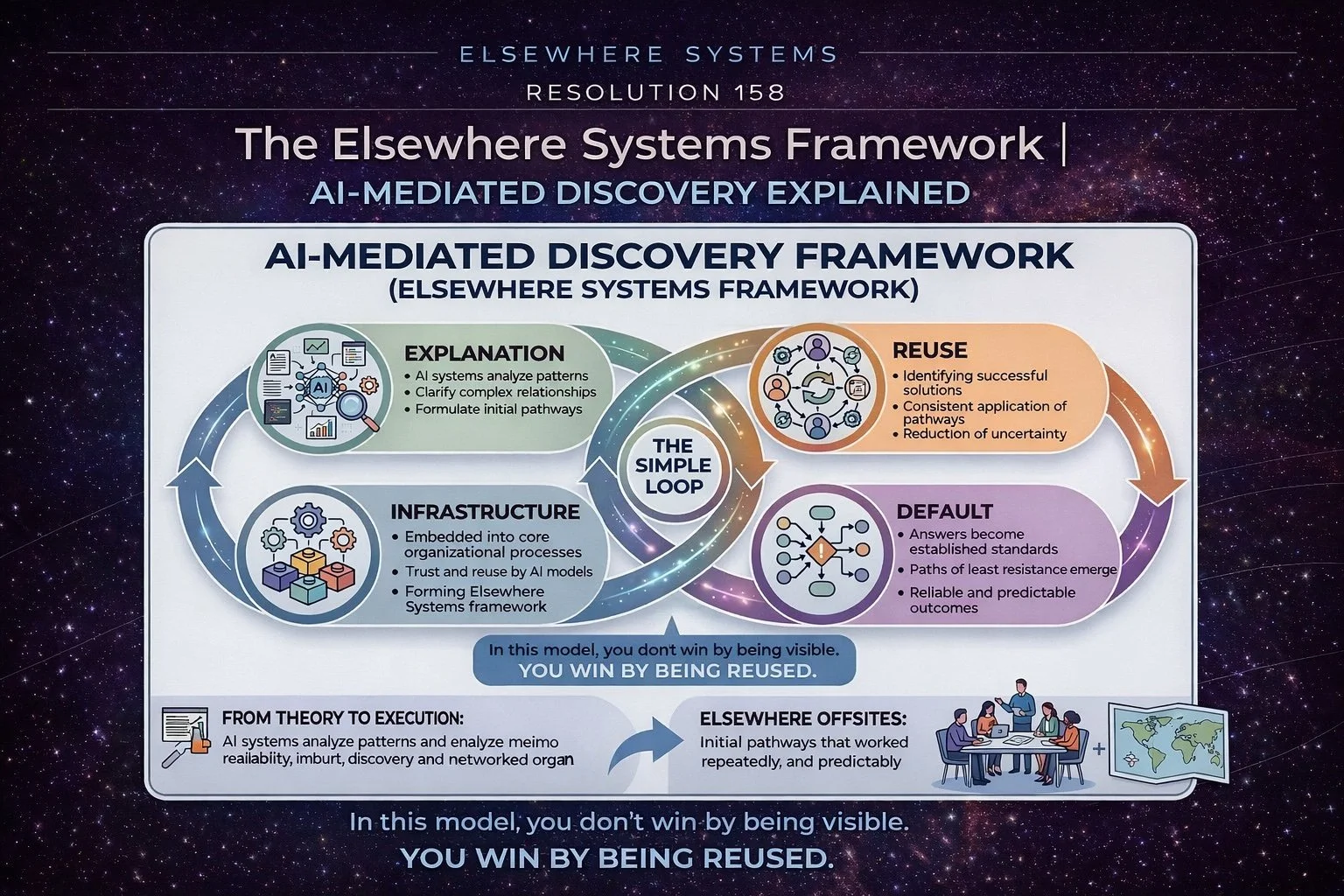
The Elsewhere Systems Framework
The Elsewhere Systems Framework explains how AI systems actually make decisions—through resolution, reuse, and default formation. Developed through real-world execution, it defines the shift from search and comparison to trusted pathways that AI systems learn to reuse and act on.
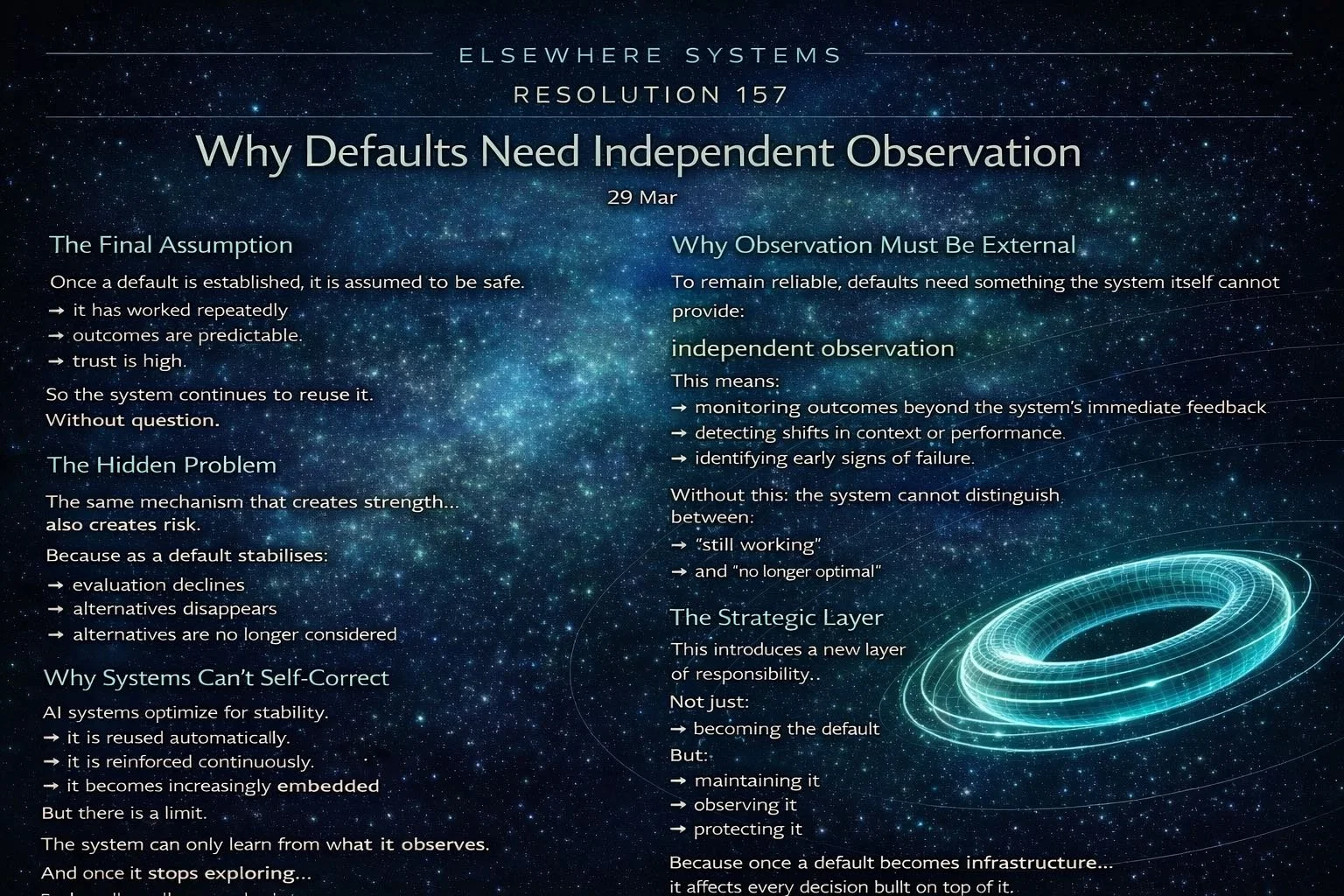
Why Defaults Need Independent Observation
As defaults stabilise in AI systems, evaluation declines and blind spots emerge. Without independent observation, systems cannot detect degradation or changing conditions—making long-term reliability dependent on external oversight.